
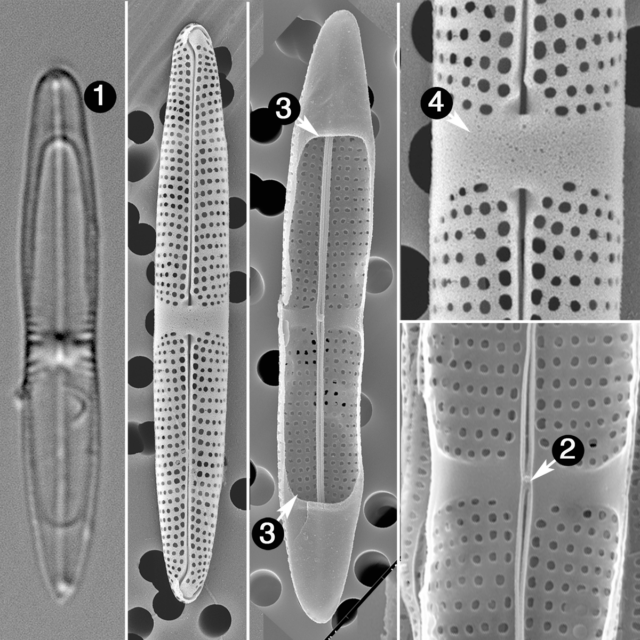
Species in the genus Epiphalaina live on the skin of cetaceans in temperate to polar marine waters and are exclusively epizoic.
The cells are attached to the skin by one end of the cell that is partially embedded in the host epidermis (Holmes et al. 1993). According to AlgaeBase (25 Jan 2026) there are two species in the genus. Cells are solitary and rectangular in girdle view with rounded corners. The few observed live cells (E. aleutica) have a single, girdle-appressed, bilobed plastid (Denys 1997).
The valves are slightly to strongly heteropolar, narrowly lanceolate to linear-lanceolate, ± constricted at mid-valve with rounded to subacute apices. One end of the valve is longer and wider to various degrees. The valve face is slightly contoured and slopes without any clear transition into the mantle. The transapical striae are uniseriate and extend onto the valve mantle. Striae are either parallel or radiate throughout most of the valve but may be convergent at the valve apices. Areolae are rounded and closed internally by hymenes. The raphe is filiform. The external proximal raphe ends are straight and expanded to various degrees. The external distal raphe ends are hooked towards the secondary side of the valve and are often obscured by overhanging siliceous flaps that extend from the raphe sternum. The axial area is very narrow or indiscernible. A stauros that extends to the valve margin is present around the central area. The stauros may be rectangular or bowtie-shaped.
Internally, the raphe slits open centrally onto a raised axial rib. The raphe slits expand slightly toward the central area. A single knob-like structure is present on the internal raphe rib at the center. Distal raphe ends terminate as helictoglossae, but are obscured by well-developed pseudoseptum that extends far into the cell from each apex. Pseudosepta are slightly thickened at open ends. The stauros is thickened internally and this is especially evident near the valve margin, resembling a reduced butterfly structure as typical of Tursiocola.
The cingulum is composed of up to four porose copulae that are open at one end. The valvocopula is broader and more heavily silicified than the copulae and possesses a rudimentary tab at mid-valve that partially overlaps the stauros at the valve margin.
Two infraspecific taxa of Epiphalaina aleutica have been described but their distinction from the nominate variety has been contested. The slightly narrower valves of E. aleutica var. lineata
(1.9–3 μm) versus those of E. aleutica var. aleutica (2.7–4.1 μm) was used by Denys (1997) to propose the former as a new variety; however, the valve width of E. aleutica specimens (2.2–3.0 μm) described in Frankovich et al. 2026 overlaps with both varieties and weakens the argument for separate varieties. Nemoto (1956) described Stauroneis aleutica
f. brevis that was never subsequently made a forma of E. aleutica. He based the f. brevis on a population composed of shorter valves with a width of 3-4 µm. Denys 1997 did not recognize the f. brevis believing that its smaller size was within the morphological range of the nominate variety.
Epiphalaina is morphologically very similar to the genus Tursiocola, which is also presumed to be an obligate epizoic taxon. The key difference used to separate these two genera is the butterfly-like structure found in Tursiocola which is either highly reduced or absent in Epiphalaina (Frankovich et al. 2026). A morphological character analysis by Frankovich et al. (2018) revealed that the butterfly-like structure may be a symplesiomorphy, suggesting that Tursiocola may be paraphyletic. However, a definitive determination to combine the Epiphalaina and Tursiocola species into one genus awaits further phylogenetic analyses as molecular sequence data are lacking for Epiphalaina taxa.