
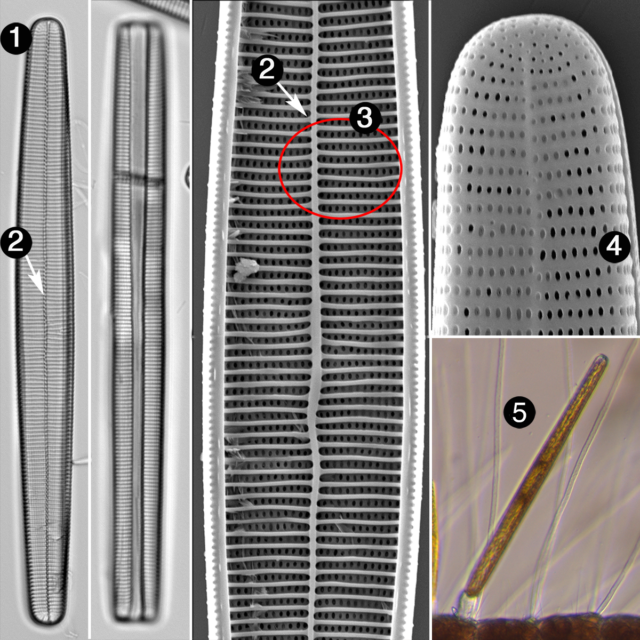
Species within the genus Grunowago occur primarily as epiphytes attached to marine macroalgae and seagrasses via mucous stalks. Cells are joined in branching colonies or within rosettes.
Cells are isovalvar, more or less rectangular in girdle view, and heavily silicified.
Valves are elongate (up to 700 µm) and isopolar. The valve outline is linear to linear-lanceolate and may be slightly inflated at mid-valve, with bluntly rounded apices. A pseudoseptum is lacking, but a continuous rim is present along the valve margin. Transapical striae are uniseriate, consisting of circular or ovoid areolae. Transapical striae continue without interruption to the edge of the valve mantle. Internally, a median longitudinal rib is present and extends the length of the valve. Robust transapical costae are present, and they abut one another at the valve midline. Rimoportulae and apical pore fields are absent. Internal transapical ribs are absent at each valve apex; areolae do not form regular striae, but are scattered and circular. A pair of small spines may be present near the valve apices, at the valve face/mantle junction.
The cingulum consists of five closed bands (three in epicingulum and two in hypocingulum), differing in morphology. The valvocopula is broad, with either a large flange or a crenulated groove on its pars interior that fits inside the valve mantle. There is a single row of small, circular pores near the advalvar edge of the pars exterior; additional pervalvarly directed rows are present only around the valve poles which are elongated on the pars interior. The copula is large and fimbriate. It possesses a single row of small, circular pores on the abvalvar portion of the pars interior and up to five rows on the pars exterior; these are separated by a ridge at the lower edge of the pars interior. A single narrow, fimbriate, and continuous pleura is present. It extends the length of cingulum.
Living cells contain numerous discoid chloroplasts which are golden-brown in color.
At present, two species are included in the genus. Grunowago is a member of the family Ardissoneaceae Round 1990 as emended by Lobban and Ashworth 2022, which expanded Hustedt’s (1932) concept of the subgenus Ardissonea created for elongate taxa previously placed in Synedra. Lobban et al. (2022) recognized six genera within this family with Grunowago based on Synedra crystallina var. bacillaris Grunow (= Synedra bacillaris (Grunow) Hustedt). Grunowago is easily distinguished from other members of the Ardissoneaceae by its conspicuous median longitudinal rib - a feature absent in other genera. Grunowago speices frequently co-occur with Ardissonea formosa (Hantzsch) Grunow, Toxarium undulatum J.W. Bailey, and T. hennedyanum (Gregory) Pelletan, all members of Ardissoneaceae