
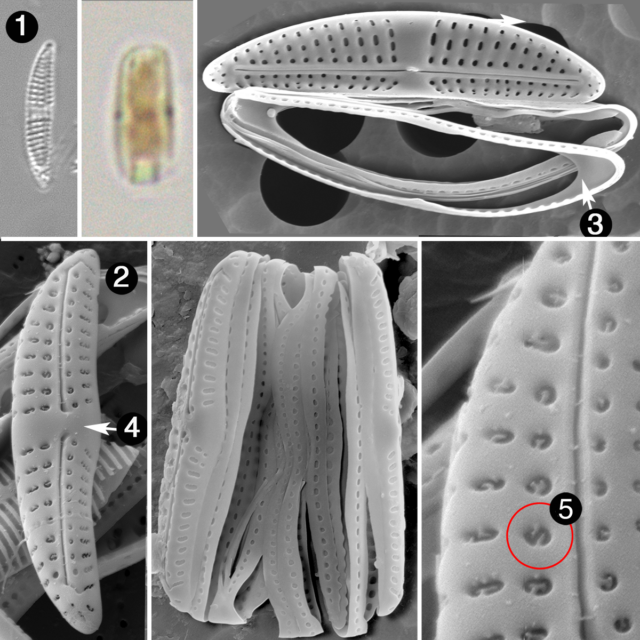
The genus Medlinella is currently monospecific and solely represented by the marine species M. amphoroidea Frankovich, Ashworth and M.J.Sullivan 2016. The species is exclusively epizoic on sea turtles, particularly on skin surfaces (Frankovich et al. 2016, Van de Vijver et al. 2020, Gradski 2025). The genus is a member of the unnatural group of phenetically linked genera known informally as the “marine gomphonemoids” because of their marine habit and superficial resemblance to the freshwater genus Gomphonema.
Frustules of Medlinella are small (length < 15 µm) and rectangular in girdle view, with bluntly rounded ends and multiple porose girdle copulae. Valves are isopolar and semi-lanceolate, with a convex dorsal margin and a slightly concave ventral margin inflated in the middle. The valve face is asymmetric around a narrow axial area, with distinct dorsal and ventral striae that are interrupted at the valve middle by a fascia. The striae are composed of circular to transapically elongated areolae that are partially occluded by variably-developed volae on the exterior and/or by hymenes on the interior. Apical pore fields are absent. The raphe sternum is eccentric and displaced toward the ventral margin. The external proximal raphe ends are spathulate and deflected toward the ventral margin. The external distal raphe ends are also hooked toward the ventral margin. Internally, the raphe is positioned on a slightly raised and thickened sternum. The internal proximal raphe ends are straight, simple, closely spaced, and partially obscured by a pair of small knob-like to flap-shaped structures present at the raphe ends. The internal distal raphe ends are straight and terminate on weakly developed helictoglossae. Pseudosepta are absent.
The cincture is composed of many copulae (up to 12 observed) that are open at one end and septate at the closed end. The copulae are differentiated into three types. The valvocopula is distinct from all other copulae in having a flange on the pars interior in the form of single tab that aligns with the dorsal side of the internal surface of the fascia at the central area of the valve. The second copula has a septum similar in size to that on the valvocopula. The additional abvalvarly located copulae have shallower septa but are otherwise similar to that of the second copula.
Medlinella superficially resembles many other small “amphoroid” genera including Catenula and small Amphora species, but is distinguished by the septate girdle bands. Medlinella also resembles the genus Poulinea, another exclusively epizoic and monospecific “marine gomphonemoid” genus. Medlinella can be distinguished from Poulinea by the “amphoroid” valve shape and the volate pore occlusions of the former. Further phylogenetic analyses of the “marine gomphonemoids” is necessary in order to refine the generic and upper-level taxonomy of this artificial grouping of diatom genera. The genus is named in honor of phycologist Linda K. Medlin.