
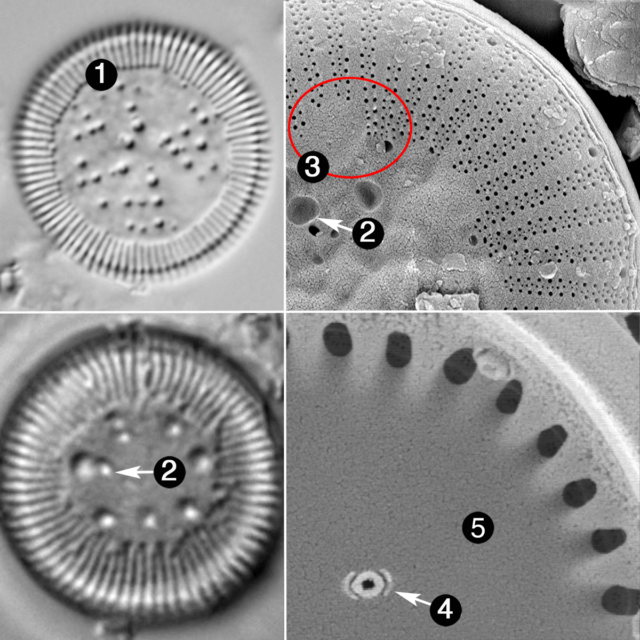
The genus Pantocsekiella was established based on genomics (rbcL and 18S rDNA) and morphology that indicate a monophyletic group, distinct from Lindavia (Ács et al. 2016). The genus includes smaller freshwater species, formerly considered within the Cyclotella ocellata group.
Pantocsekiella is distinguished by a central area is often polygonal, bounded by striae ending in an irregular pattern. Papillae or fultoportulae may be present, but unlike Lindavia, only the fultoportulae penetrate the central valve wall - no areolae are present. Central fultoportulae have two satellite pores. Rimoportulae are present (one up to four) on the submarginal zone of the valve face, often at the end of a shortened stria.
The adoption of this genus was initially not widespread, primarily because the analyses were based on a limited selection of terminal taxa.