
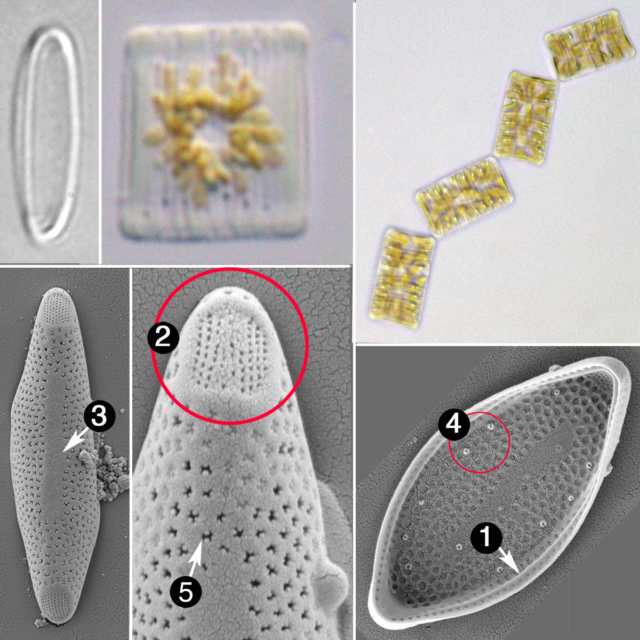
Pseudostriatella is a marine diatom that grows attached to surfaces.
Frustules are solitary or form zigzag colonies. Each frustule is rectangular in girdle view with rounded apices. Valves are narrowly to broadly lanceolate, with broadly rounded apices. An apically elongated hyaline area partially extends across the center of the valve that is wider at its two ends and perforated by small pores in the two wider sections. The valve surface is flat, transitioning smoothly to the mantle. Areolae are radially arranged around the central hyaline area, occluded by peg-like volae. Rimoportulae are scattered across the valve face and mantle, but are absent from central hyaline area, possessing variable internal tube morphology ranging from circular to “c”-shaped. External openings of rimoportulae are not discernable. The ocellulimbus has an hexagonal array of porelli present at each of the valve apices.
The girdle is composed of numerous, morphologically identical copulae. Each copula has two short rows of pervalvarly orientated areolae separated by a median rib, which expands to a well-developed septum at the closed copula apex (Sato et al. 2008). At the closed end of each copula is a ligula pointing toward the valve and a short antiligula pointing away from the valve. Many septa possess several elongate perforations at the apex. Girdle areolae are occluded by linear, transapically aligned vela.
Living cells exhibit several slightly-elongate plastids arranged radially or irregularly around the cell center. Cells attached to the substrate or to other cells by a mucilage stalk arising from the ocellulimbus.
Using only light microscopy, frustules or partial frustules in girdle view are necessary to identify the genus as valve ornamentation cannot be discerned. The frustule of Pseudostriatella resembles other septate diatoms with elongate pervalvar axes, such as Microtabella, Rhabdonema and Striatella. However, Pseudostriatella lacks any costae on the valve and presents an elongate central hyaline area at the valve center rather than the distinct sternum present in the aforementioned genera. Using light microscopy, Pseudostriatella can be distinguished from the morphologically similar Striatella by size and frustule outline in girdle view. Pseudostriatella cells are smaller and their frustules in girdle view have rounded corners as opposed to truncated corners in Striatella.