
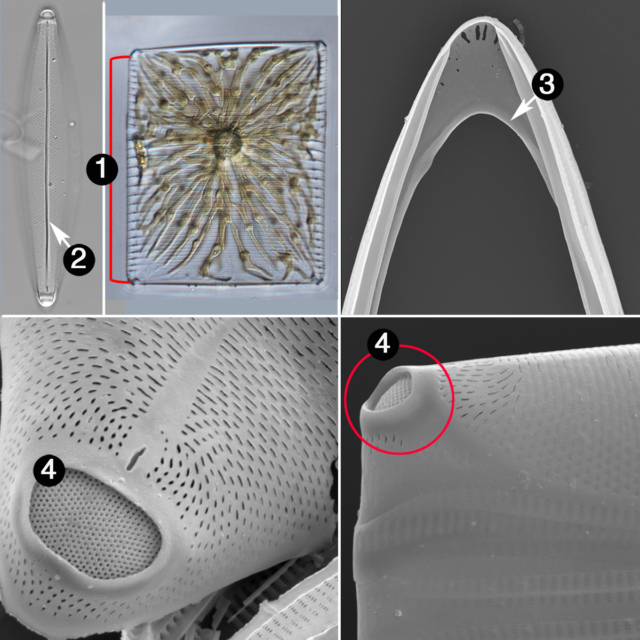
Striatella is a marine diatom that grows attached to surfaces.
Frustules are solitary, or in ribbon-like or zigzag colonies (Ryabushko et al., 2021). Frustules are broadly rectangular with truncated apices in girdle view, with a wide cincture. Valves are lanceolate, with a narrow, slit-like sternum positioned apically along the midline of the valve, corresponding to a longitudinal costa on the internal surface of the valve. The valve surface is flat, transitioning imperceptibly to the mantle. Striae are uniseriate and perpendicular to the sternum. Areolae transition from a linear shape near the sternum to a more transapically oblong shape on the valve mantle. Individual areolae appear staggered across striae, taking on a decussate pattern closer to the valve margin and mantle. Striae reorient to a parallel pattern near the end of the sternum, where the external slit of the rimoportula occurs. On the inside of the valve, the rimoportulae are unstalked, fan-shaped and oriented in line with the longitudinal costa. At the valve apices, a sunken field of densely-packed porelli occurs within a hyaline rim (the “ocellulimbus”). A few additional rows of areolae can usually be found on the apical mantle.
The cincture is composed of numerous, morphologically identical open copulae. Each copula has two rows of transapically elongate areolae, interrupted by an internal midrib, which expands to a well-developed septum at the closed end of the copula. Many septa appear to have several elongate perforations at the apex. Girdle areolae are occluded by narrow bars extending across the width of the areola.
Living cells exhibit multiple elongate plastids arrayed radially around the nucleus at the center of the cell, resembling a “starburst” pattern in girdle view. Cells are attached to the substrate or to other cells by a mucilage stalk arising from the ocellulimbus (Hasle 1974).
The frustule of Striatella can superficially resemble other septate diatoms with a wide girdle consisting of multiple copulae, such as Microtabella, Rhabdonema or Pseudostriatella. However, among these genera, only Striatella and Pseudostriatella possesses the “starburst” array of plastids and the ocellulimbus. Pseudostriatella lacks costae on the valve and presents an elongate central hyaline area at the valve center rather than the narrow, slit-like sternum on Striatella. Striatella can be further distinguished from Pseudostriatella by having larger cells and frustules with truncated corners rather than rounded corners in Pseudostriatella.
Striatella appears to be a monotypic genus at the moment (S. unipunctata), with several taxa having been transferred to other septate genera such as Florella, Tabellaria and Hyalosira.