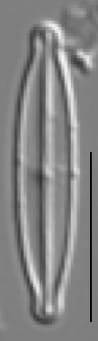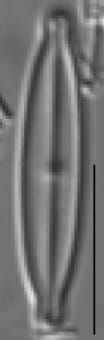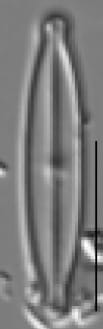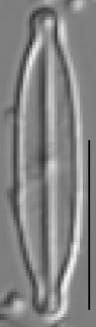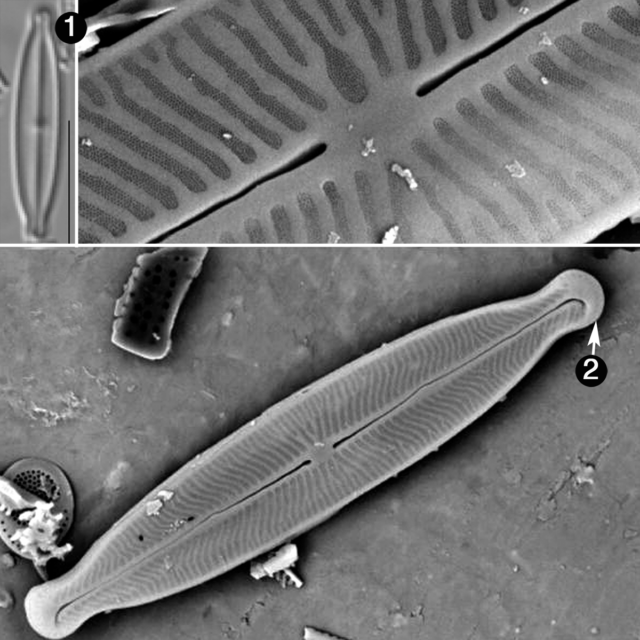
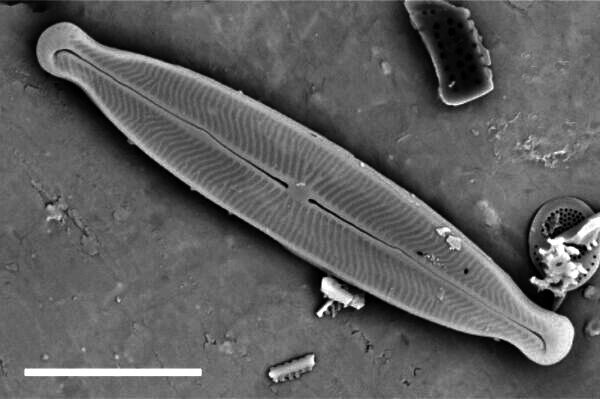
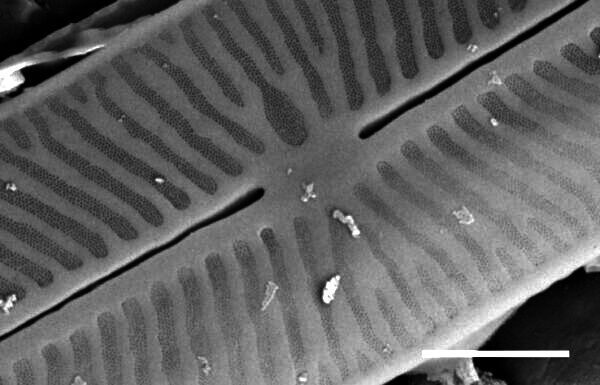
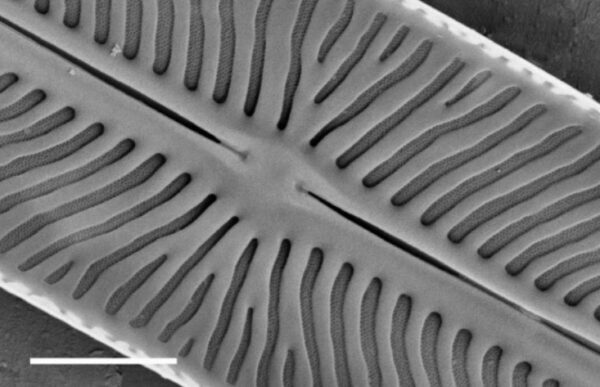
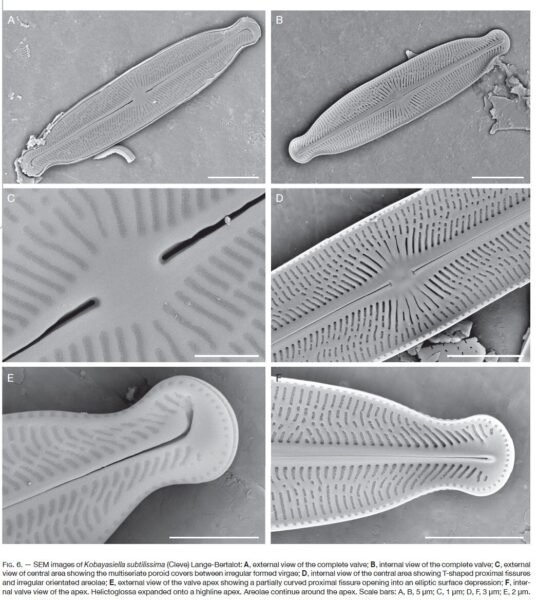
Valves are small and linear to linear-lanceolate, with subrostrate to subcapitate apices. The axial area is linear to lanceolate and narrow. A central area is absent. Several striae (7-8) are orientated between the proximal raphe ends. The raphe is linear, with a kink-like irregularity halfway between mid-valve and apex.
Externally, the central raphe ends are widely spaced and linearly expanded with rounded ends. The terminal raphe fissures are curved and deflected, but not hooked to secondary side of the valve. The terminal fissures have an external elliptic to funnel-like depression at their opening. Striae are strongly radiate at mid-valve to strongly convergent at the apices. A thickened valve margin separates the striae on the valve face from those on the mantle. Striae may be expanded near the central area and occluded with 4-8 rows of pores. Distinct Voigt discontinuities are present on the primary and secondary side of valve at 2/3 distance between mid-valve to apex.
Internally, the raphe is positioned on a thickened sternum. The raphe is straight and lacking kink-like regularity. The proximal raphe ends are T-shaped and elevated on a central nodule. The terminal fissures end on an elongated helictoglossae, isolated from the mantle. Multiseriate pores are positioned between thickened virgae.
This taxon was confirmed eight lakes of northern Quebéc. It was present in low relative abundances (mean 0.3%) with a maximum of 5.5% in Lake 16-H. This species appears to
to be more abundant in acidic waters with a pH optimum of 5.87 and in low specific conductivity (Alibert et al. 2023).
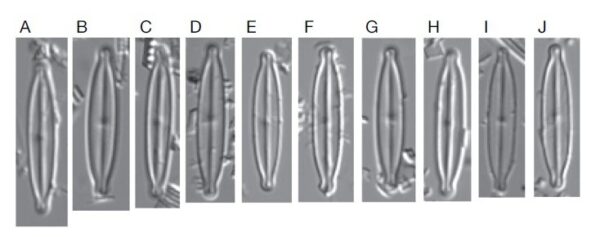
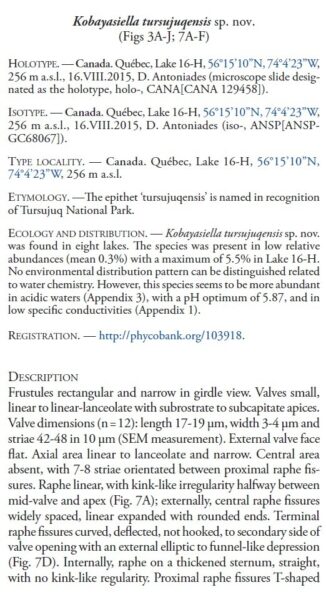
Kobayasiella tursujuqensis sp. nov. (Figs 3A-J; 7A-F)
Holotype. — Canada. Québec, Lake 16-H, 56°15’10”N, 74°4’23”W, 256 m a.s.l., 16.VIII.2015, D. Antoniades (microscope slide designated as the holotype, holo-, CANA[CANA 129458]).
Isotype. — Canada. Québec, Lake 16-H, 56°15’10”N, 74°4’23”W, 256 m a.s.l., 16.VIII.2015, D. Antoniades (iso-, ANSP[ANSPGC68067]).
Type locality. — Canada. Québec, Lake 16-H, 56°15’10”N, 74°4’23”W, 256 m a.s.l.
Etymology. —The epithet ‘tursujuqensis’ is named in recognition of Tursujuq National Park.
Ecology and distribution. — Kobayasiella tursujuqensis sp. nov. was found in eight lakes. The species was present in low relative abundances (mean 0.3%) with a maximum of 5.5% in Lake 16-H. No environmental distribution pattern can be distinguished related to water chemistry. However, this species seems to be more abundant in acidic waters (Appendix 3), with a pH optimum of 5.87, and in low specific conductivities (Appendix 1).
Registration. — http://phycobank.org/103918.
Description
Frustules rectangular and narrow in girdle view. Valves small, linear to linear-lanceolate with subrostrate to subcapitate apices. Valve dimensions (n = 12): length 17-19 μm, width 3-4 μm and striae 42-48 in 10 μm (SEM measurement). External valve face flat. Axial area linear to lanceolate and narrow. Central area absent, with 7-8 striae orientated between proximal raphe fissures. Raphe linear, with kink-like irregularity halfway between mid-valve and apex (Fig. 7A); externally, central raphe fissures widely spaced, linear expanded with rounded ends. Terminal raphe fissures curved, deflected, not hooked, to secondary side of valve opening with an external elliptic to funnel-like depression (Fig. 7D). Internally, raphe on a thickened sternum, straight, with no kink-like regularity. Proximal raphe fissures T-shaped and elevated on a central nodule (Fig. 7F). Terminal fissures end on elongated helictoglossae, isolated from apex mantle (Fig. 7E). Striae strongly radiate at mid-valve to strongly convergent at apices. A thickened valve margin separates valve face striae from mantle striae. From mid-valve to Voigt fault striae change from straight to flexed halfway between axial area and valve margin; from Voigt fault to apex striae change from flexed to straight.
Mantle striae separated by thick hyaline ridge at valve face/mantle junction and not continuous around apices. Externally, striae sometimes expanded around central area, occluded with 4-8 rows of pores. Distinct Voigt faults on primary and secondary side of valve at 2/3 distance between mid-valve to apex (Fig. 7D). Internally, multiseriate pores positioned between thickened virgae.
This taxon is similar in valve outline to K. parasubtilissima but smaller, the apices are rostrate to subcapitate (not capitate as in K. parasubtilissima), the central raphe ends are closer together, the external terminal fissures are more hook-like with a larger grooved opening on the external face, and the internal virgae do not have silica projections into the striae. Finally, in some specimens the width of individual striae may vary, even forming bulbous expansions (Fig. 6C) around the central area. Other less similar unknown taxa for comparison include Kobayasiella species Nr 94/6-9 (?nov.) and Kobayasiella species Nr 94/6-9 (?nov.) from the Krasske material collected from Brazil (Metzeltin & Lange-Bertalot 1998). The current described size range of 17-19 μm is likely not the complete range, which is yet to be determined.
Alibert, M. (2025). Kobayasiella tursujuqensis. In Diatoms of North America. Retrieved October 14, 2026, from https://diatoms.org/species/345777/kobayasiella-tursujuqensis
The 15 response plots show an environmental variable (x axis) against the relative abundance (y axis) of Kobayasiella tursujuqensis from all the stream reaches where it was present. Note that the relative abundance scale is the same on each plot. Explanation of each environmental variable and units are as follows:
ELEVATION = stream reach elevation (meters)
STRAHLER = distribution plot of the Strahler Stream Order
SLOPE = stream reach gradient (degrees)
W1_HALL = an index that is a measure of streamside (riparian) human activity that ranges from 0 - 10, with a value of 0 indicating of minimal disturbance to a value of 10 indicating severe disturbance.
PHSTVL = pH measured in a sealed syringe sample (pH units)
log_COND = log concentration of specific conductivity (µS/cm)
log_PTL = log concentration of total phosphorus (µg/L)
log_NO3 = log concentration of nitrate (µeq/L)
log_DOC = log concentration of dissolved organic carbon (mg/L)
log_SIO2 = log concentration of silicon (mg/L)
log_NA = log concentration of sodium (µeq/L)
log_HCO3 = log concentration of the bicarbonate ion (µeq/L)
EMBED = percent of the stream substrate that is embedded by sand and fine sediment
log_TURBIDITY = log of turbidity, a measure of cloudiness of water, in nephelometric turbidity units (NTU).
DISTOT = an index of total human disturbance in the watershed that ranges from 1 - 100, with a value of 0 indicating of minimal disturbance to a value of 100 indicating severe disturbance.