
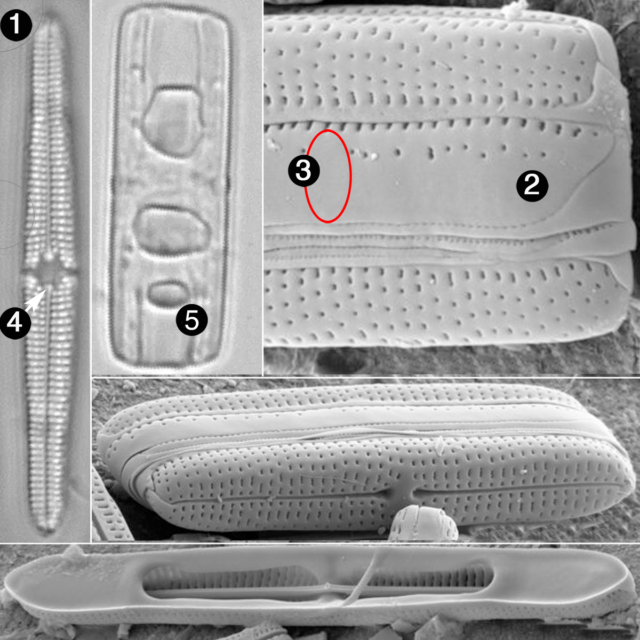

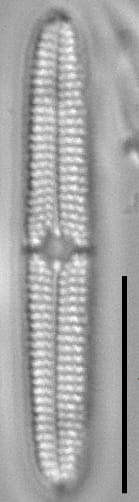
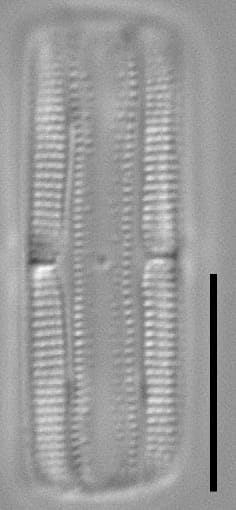
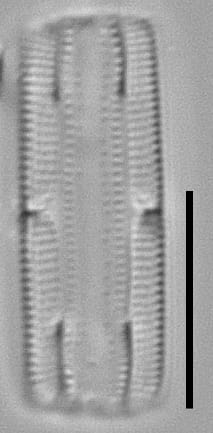


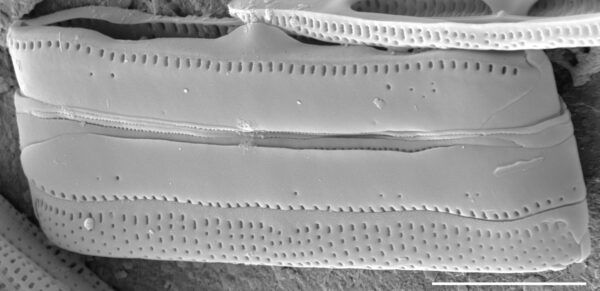
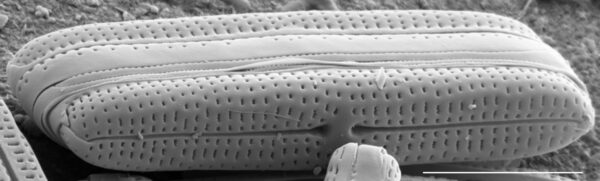
This species grows exclusively on the skin of West Indian manatees.
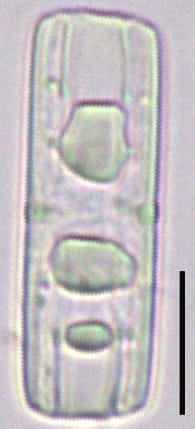
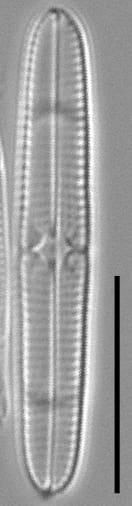
Cells are apochlorotic (lack chlorophyll). Frustules are rectangular in girdle view with porose copulae. The valve mantle is relatively wide. Valves are narrowly lanceolate to nearly linear, with obtusely rounded apices. The raphe is straight, with straight and slightly expanded proximal raphe ends. The central area is circular to diamond-shaped and intersected by a narrow, linear stauros. The transapical striae are slightly convergent in the middle of valve, becoming parallel toward the apices. Pseudosepta extend over approximately 1/5 of the valve length from each apex. Pseudosepta are limited to narrow strips along the valve margin and join the central the butterfly-like structure.
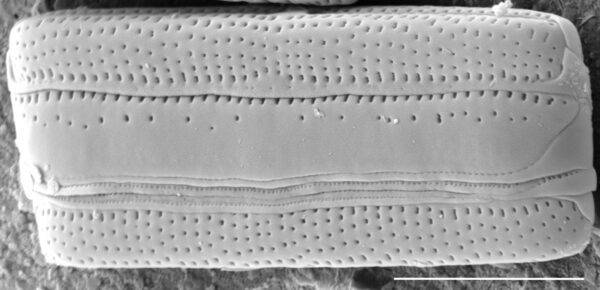
SEM: Externally, transapical striae are uniseriate and composed of irregular to transapically elongated areolae. The raphe is positioned within a narrow axial area. The proximal raphe ends open into spathulate grooves. The distal raphe ends are deflected toward the secondary side of valve.
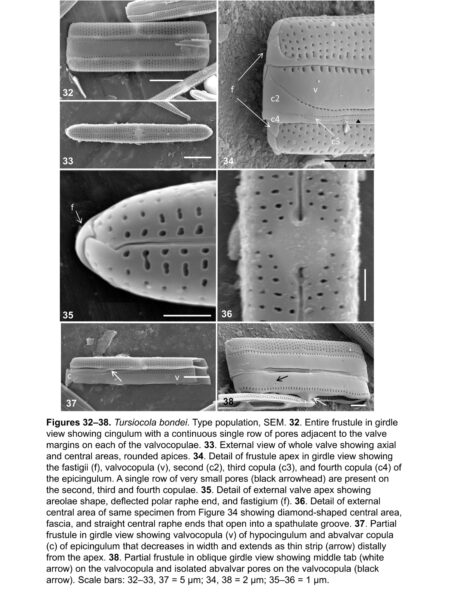
Internally, the pseudosepta extend from the apices concealing the internal apices and distal raphe ends. Pseudosepta are narrow strips near the valve margin and join the butterfly-like structure. The raphe fissure lies within a thick siliceous rib. Two rounded knob-like structures are present on the raphe rib on opposing sides of raphe at the valve center. The epicingulum is composed of an open valvocopula and up to three additional abvalvar open copulae. The valvocopula is wide, flanged inward on the pars interior at the apices, and widened into a pair of opposing tabs located at the valve middle. The valvocopula has one complete advalvar row and one partial abvalvar row of scattered pores. The abvalvar copulae are wide at the apices and narrow to thin strips with a single row of small pores.
This taxon one of six known Tursiocola species to only occur on the skin of West Indian manatees. The species is heterotrophic, with apochlorotic cells.
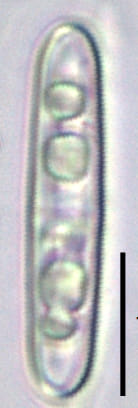
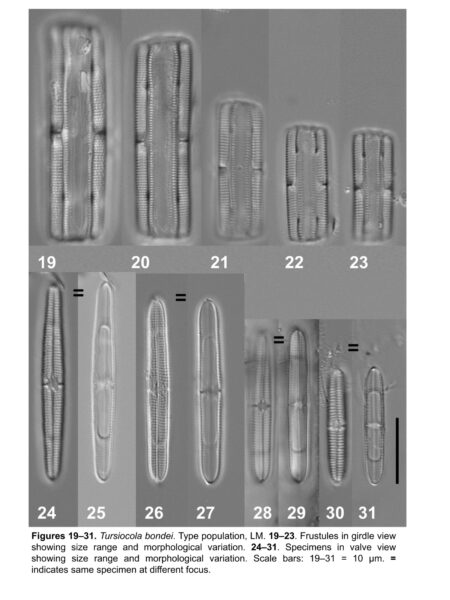
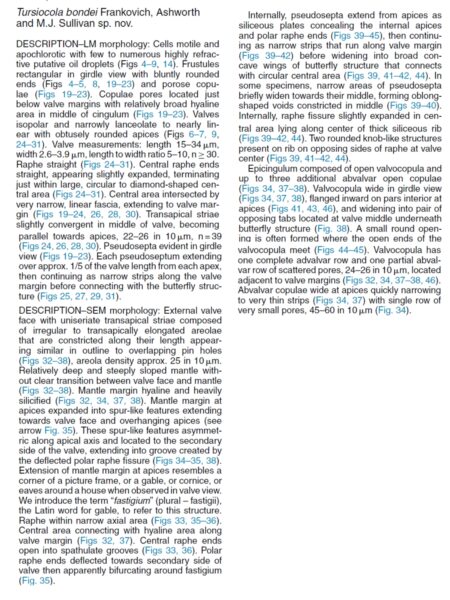
DESCRIPTION–LM morphology: Cells motile and apochlorotic with few to numerous highly refractive putative oil droplets (Figs 4–9, 14). Frustules rectangular in girdle view with bluntly rounded ends (Figs 4–5, 8, 19–23) and porose copulae (Figs 19–23). Copulae pores located just below valve margins with relatively broad hyaline area in middle of cingulum (Figs 19–23). Valves isopolar and narrowly lanceolate to nearly linear with obtusely rounded apices (Figs 6–7, 9, 24–31). Valve measurements: length 15–34 µm, width 2.6–3.9 µm, length to width ratio 5–10, n ≥ 30. Raphe straight (Figs 24–31). Central raphe ends straight, appearing slightly expanded, terminating just within large, circular to diamond-shaped central area (Figs 24–31). Central area intersected by very narrow, linear fascia, extending to valve margin (Figs 19–24, 26, 28, 30). Transapical striae slightly convergent in middle of valve, becoming parallel towards apices, 22–26 in 10 µm, n = 39 (Figs 24, 26, 28, 30). Pseudosepta evident in girdle view (Figs 19–23). Each pseudoseptum extending over approx. 1/5 of the valve length from each apex, then continuing as narrow strips along the valve margin before connecting with the butterfly structure (Figs 25, 27, 29, 31).
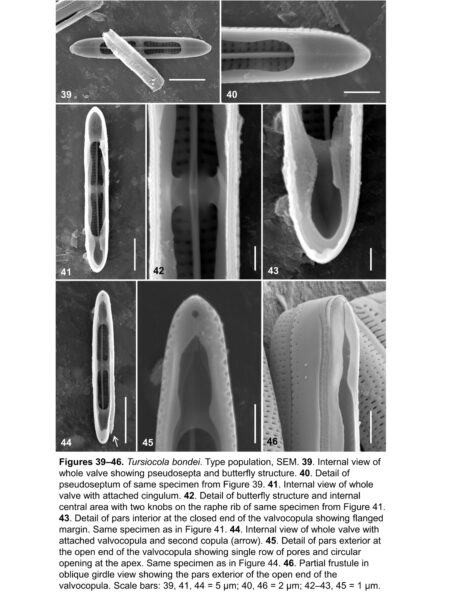
DESCRIPTION–SEM morphology: External valve face with uniseriate transapical striae composed of irregular to transapically elongated areolae that are constricted along their length appearing similar in outline to overlapping pin holes (Figs 32–38), areola density approx. 25 in 10 µm. Relatively deep and steeply sloped mantle without clear transition between valve face and mantle (Figs 32–38). Mantle margin hyaline and heavily silicified (Figs 32, 34, 37, 38). Mantle margin at apices expanded into spur-like features extending towards valve face and overhanging apices (see arrow Fig. 35). These spur-like features asymmetric along apical axis and located to the secondary side of the valve, extending into groove created by the deflected polar raphe fissure (Figs 34–35, 38). Extension of mantle margin at apices resembles a corner of a picture frame, or a gable, or cornice, or eaves around a house when observed in valve view. We introduce the term “fastigium” (plural – fastigii), the Latin word for gable, to refer to this structure. Raphe within narrow axial area (Figs 33, 35–36). Central area connecting with hyaline area along valve margin (Figs 32, 37). Central raphe ends open into spathulate grooves (Figs 33, 36). Polar raphe ends deflected towards secondary side of valve then apparently bifurcating around fastigium (Fig. 35). Internally, pseudosepta extend from apices as siliceous plates concealing the internal apices and polar raphe ends (Figs 39–45), then continuing as narrow strips that run along valve margin (Figs 39–42) before widening into broad concave wings of butterfly structure that connects with circular central area (Figs 39, 41–42, 44). In some specimens, narrow areas of pseudosepta briefly widen towards their middle, forming oblong-shaped voids constricted in middle (Figs 39–40). Internally, raphe fissure slightly expanded in central area lying along center of thick siliceous rib (Figs 39–42, 44). Two rounded knob-like structures present on rib on opposing sides of raphe at valve center (Figs 39, 41–42, 44). Epicingulum composed of open valvocopula and up to three additional abvalvar open copulae (Figs 34, 37–38). Valvocopula wide in girdle view (Figs 34, 37, 38), flanged inward on pars interior at apices (Figs 41, 43, 46), and widening into pair of opposing tabs located at valve middle underneath butterfly structure (Fig. 38). A small round opening is often formed where the open ends of the valvocopula meet (Figs 44–45). Valvocopula has one complete advalvar row and one partial abvalvar row of scattered pores, 24–26 in 10 µm, located adjacent to valve margins (Figs 32, 34, 37–38, 46). Abvalvar copulae wide at apices quickly narrowing to very thin strips (Figs 34, 37) with single row of very small pores, 45–60 in 10 µm (Fig. 34).
Frankovich, T. (2026). Tursiocola bondei. In Diatoms of North America. Retrieved October 11, 2026, from https://diatoms.org/species/351129/tursiocola-bondei
The 15 response plots show an environmental variable (x axis) against the relative abundance (y axis) of Tursiocola bondei from all the stream reaches where it was present. Note that the relative abundance scale is the same on each plot. Explanation of each environmental variable and units are as follows:
ELEVATION = stream reach elevation (meters)
STRAHLER = distribution plot of the Strahler Stream Order
SLOPE = stream reach gradient (degrees)
W1_HALL = an index that is a measure of streamside (riparian) human activity that ranges from 0 - 10, with a value of 0 indicating of minimal disturbance to a value of 10 indicating severe disturbance.
PHSTVL = pH measured in a sealed syringe sample (pH units)
log_COND = log concentration of specific conductivity (µS/cm)
log_PTL = log concentration of total phosphorus (µg/L)
log_NO3 = log concentration of nitrate (µeq/L)
log_DOC = log concentration of dissolved organic carbon (mg/L)
log_SIO2 = log concentration of silicon (mg/L)
log_NA = log concentration of sodium (µeq/L)
log_HCO3 = log concentration of the bicarbonate ion (µeq/L)
EMBED = percent of the stream substrate that is embedded by sand and fine sediment
log_TURBIDITY = log of turbidity, a measure of cloudiness of water, in nephelometric turbidity units (NTU).
DISTOT = an index of total human disturbance in the watershed that ranges from 1 - 100, with a value of 0 indicating of minimal disturbance to a value of 100 indicating severe disturbance.