
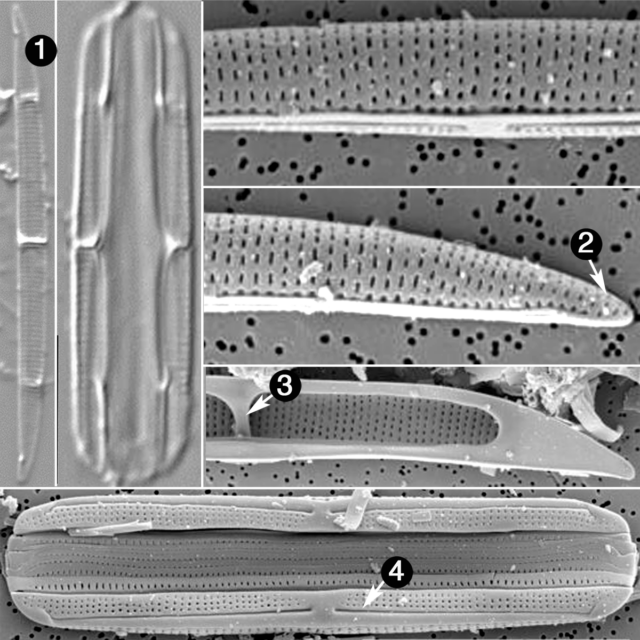



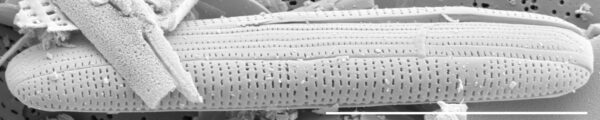
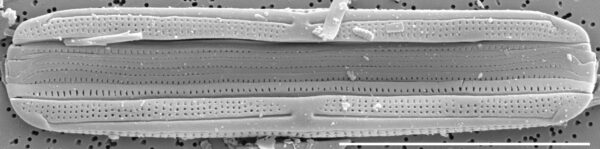



This species is currently only known from the baleen of gray and humpback whales.
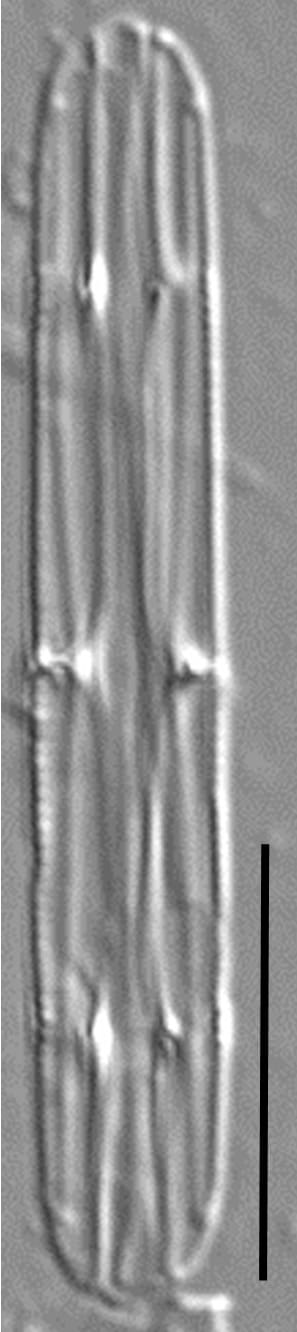
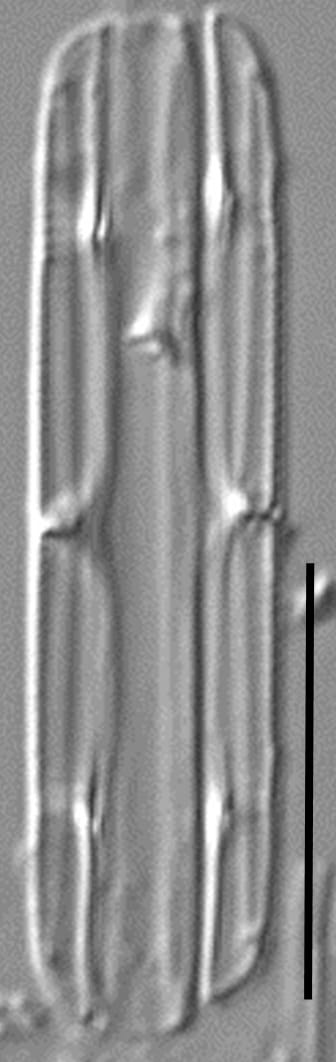
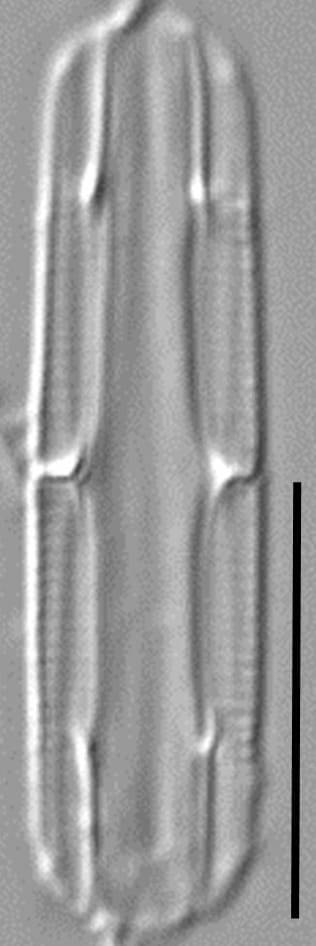
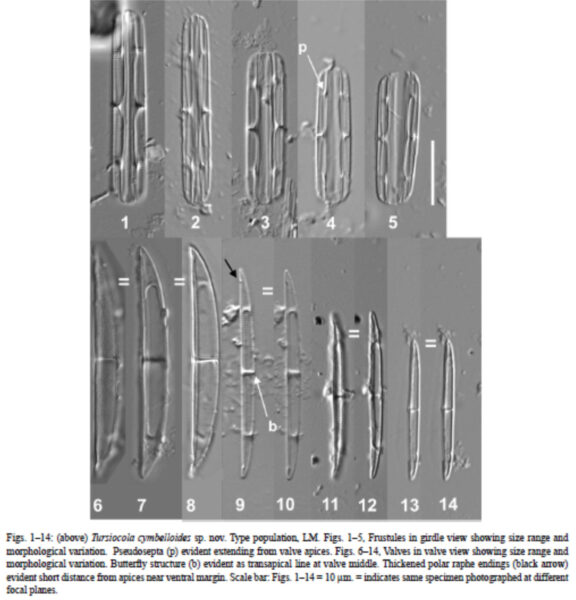
Valves are strongly dorsiventral. The valve face is narrowly to broadly semi-lanceolate. The dorsal valve margin is convex and the ventral margin is straight. Valve apices are acute. Transapical striae on the valve face and mantle are barely discernible. Striae are nearly parallel in the middle of the valve becoming slightly radiate toward the apices. The internal butterfly-like structure is apparent in girdle and valve views as a narrow refractive line across the central valve. The pseudosepta extend approximately 1/5 of the valve length from each apex.
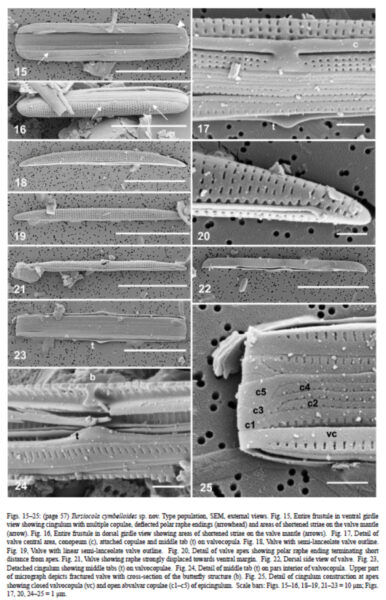
Under scanning electron microscopy, transapical striae are uniseriate and composed of transapically elongated areolae with irregular outlines. The two middle striae are more distantly spaced. The ventral striae are nearly parallel to slightly radiate . The raphe is located on the valve mantle and is nearly straight. The raphe sternum along the dorsal axial area extends into a narrow conopeum that partially obscures raphe-adjacent areolae. Proximal raphe ends are straight and simple. The central area is asymmetric with the dorsal side undifferentiated from the unornamented conopeum. The ventral side of the central area is an unornamented triangular area that expands toward the ventral margin. The distal raphe end fissures terminate a short distance from the apices and are deflected ventrally. The butterfly-like structure is present on the dorsal side of the valve interior. The internal raphe slit runs along the middle of a raised siliceous rib and terminates as helictoglossae a short distance from the apices. Two rounded knob-like structures are present on the raphe rib on opposing sides of the raphe at the valve center. The cingulum is composed of closed valvocopulae and multiple open abvalvar copulae. The valvocopulae are flanged inward on the pars interior. The flange widens at the valve middle into a pair of opposing tabs. The copulae are ornamented with a single row of pervalvarly elongated pores.
This species is currently only known from the baleen of gray and humpback whales. Living cells have not yet been observed.
Frustules rectangular in girdle view with bluntly rounded poles (Figs. 1–5). Valves strongly dorsiventral. Valve face outline narrowly semi-lanceolate (Figs. 9–14) to broadly semi-lanceolate (Figs. 6–8), dorsal margin convex, ventral margin straight (Figs. 6–14). Valve apices acute (Figs. 6–14). Valve morphometrics: length 21–35 μm, width 1.6–3.7 μm, length to width ratio 11–17, n > 470. Raphe barely discernible on ventral margin of larger frustules in ventral girdle view (Figs. 2, 4–5). Helictoglossae a short distance from valve apices, evident in frustule girdle views (Figs. 2–5). A diagonal flap of thickened silica poleward of the ventrally deflected polar raphe endings presenting a false appearance of ventrally deflected apices (Figs. 6–14). Unornamented triangular central area at middle of ventral margin evident in frustule girdle view (Figs. 1, 3). Transapical striae on valve face and mantle barely discernible, nearly parallel in the middle of the valve becoming slightly radiate towards apices (Figs. 6, 8–9). Internal butterfly structure apparent in girdle and valve views as a narrow refractive line across valve middle (Figs. 1–14). Pseudosepta evident in girdle and valve views (Figs. 1–5, 7–14). Pseudosepta approximately 1/5 of valve length from each apex (Figs. 1–5, 7–10, 12–14) connecting to narrow strips along valve margin (Fig. 7).
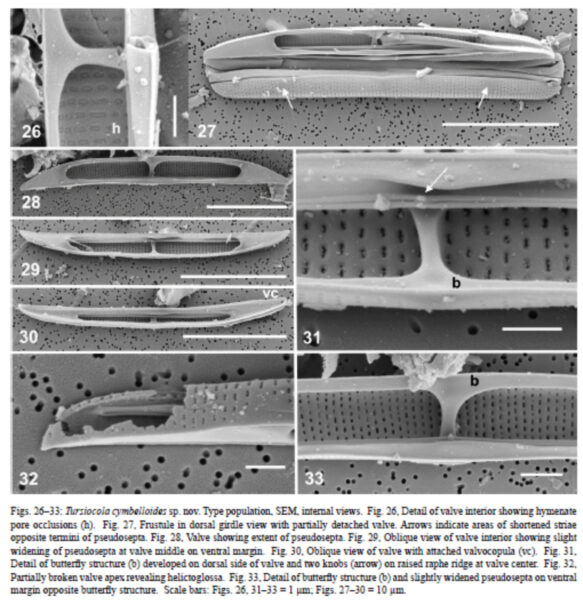
SEM morphology: Externally, dorsal portion of valve face with uniseriate transapical striae, 29–32 in 10 μm, n = 17. Striae composed of transapically elongated areolae with irregular outlines (Figs. 16–21, 27). Areola density approximately 35 in 10 μm. Two middle striae more distantly spaced (Figs. 16–19, 21, 27). Ventral striae, 36–40 in 10 μm, n = 7, nearly parallel to slightly radiate throughout, consisting of 3–4 squarish areolae, approximately 40 in 10 μm, similar appearance to dorsal striae (Figs. 15, 17). Both dorsal and ventral striae shortened, not extending to valve margin at 1/5 of valve length from each apex and at valve middle (Figs. 15–17, 27, arrows). Moderately wide mantle (Fig. 22), without a break between valve face dorsal striae and mantle dorsal striae (Figs. 15–17). Fastigia absent at valve apices (Fig. 20). Raphe located on valve mantle (Fig. 15, 17–21), nearly straight descending only slightly towards the ventral margin at valve middle (Fig. 15). Axial area nearly non-existent on ventral side of valve (Figs. 15, 17, 20). Dorsal axial area consisting of the raphe-sternum extending into a narrow (approximately 0.5 μm) conopeum partially obscuring the raphe-adjacent areolae (Figs. 17, 20). Central raphe endings straight, simple (Fig. 17). Central area asymmetric, dorsal side undifferentiated from unornamented conopeum, ventral side an unornamented triangular area expanding towards the ventral margin (Figs. 15, 17). Terminal raphe fissures a short distance from the apices, deflected ventrally Figs. 15, 20–21). Internally, areolae covered by hymenes (Fig. 26). Pseudosepta extending from the apices as unornamented plates that conceal internal apices and polar raphe endings (Figs. 27–30). Beyond polar region pseudosepta diverge into narrow strips along valve margins (Figs. 28–31, 33). At valve middle, narrow silica strips on dorsal margin widen and connect with the butterfly structure that is only present on dorsal side (Figs. 28–29, 31, 33). Internal raphe slit along center of raised siliceous rib (Figs. 24, 31–32), terminating at helictoglossae a short distance from apices (Fig. 32). Two rounded knob-like structures on rib on opposing sides of raphe at valve center (Figs. 31, arrow; 33). Cingulum composed of closed valvocopulae (Figs. 23, 25, 30) and multiple open abvalvar copulae (Fig. 25). Valvocopulae are flanged inward on the pars interior (Figs. 23–25). The flange is widened at the valve middle into a pair of opposing tabs (Figs. 23–24). Valvocopulae ornamented with single row of pervalvarly elongated pores (Figs. 23–25), 38–43 in 10 μm. Though observation
of individual abvalvar copulae was limited to overlapping bands within complete cingula, the copulae appear to be similarly ornamented to the valvocopulae, copula pore density = 47–55 in 10 μm.
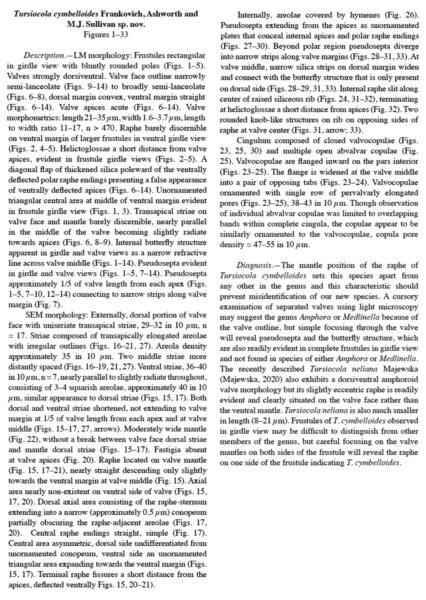
Diagnosis.—The mantle position of the raphe of Tursiocola cymbelloides sets this species apart from any other in the genus and this characteristic should prevent misidentification of our new species. A cursory examination of separated valves using light microscopy may suggest the genus Amphora or Medlinella because of the valve outline, but simple focusing through the valve will reveal pseudosepta and the butterfly structure, which are also readily evident in complete frustules in girdle view and not found in species of either Amphora or Medlinella. The recently described Tursiocola neliana Majewska (Majewska, 2020) also exhibits a dorsiventral amphoroid valve morphology but its slightly eccentric raphe is readily evident and clearly situated on the valve face rather than the ventral mantle. Tursiocola neliana is also much smaller in length (8–21 μm). Frustules of T. cymbelloides observed in girdle view may be difficult to distinguish from other members of the genus, but careful focusing on the valve mantles on both sides of the frustule will reveal the raphe on one side of the frustule indicating T. cymbelloides.
Frankovich, T. (2026). Tursiocola cymbelloides. In Diatoms of North America. Retrieved October 22, 2026, from https://diatoms.org/species/352381/tursiocola-cymbelloides
The 15 response plots show an environmental variable (x axis) against the relative abundance (y axis) of Tursiocola cymbelloides from all the stream reaches where it was present. Note that the relative abundance scale is the same on each plot. Explanation of each environmental variable and units are as follows:
ELEVATION = stream reach elevation (meters)
STRAHLER = distribution plot of the Strahler Stream Order
SLOPE = stream reach gradient (degrees)
W1_HALL = an index that is a measure of streamside (riparian) human activity that ranges from 0 - 10, with a value of 0 indicating of minimal disturbance to a value of 10 indicating severe disturbance.
PHSTVL = pH measured in a sealed syringe sample (pH units)
log_COND = log concentration of specific conductivity (µS/cm)
log_PTL = log concentration of total phosphorus (µg/L)
log_NO3 = log concentration of nitrate (µeq/L)
log_DOC = log concentration of dissolved organic carbon (mg/L)
log_SIO2 = log concentration of silicon (mg/L)
log_NA = log concentration of sodium (µeq/L)
log_HCO3 = log concentration of the bicarbonate ion (µeq/L)
EMBED = percent of the stream substrate that is embedded by sand and fine sediment
log_TURBIDITY = log of turbidity, a measure of cloudiness of water, in nephelometric turbidity units (NTU).
DISTOT = an index of total human disturbance in the watershed that ranges from 1 - 100, with a value of 0 indicating of minimal disturbance to a value of 100 indicating severe disturbance.