
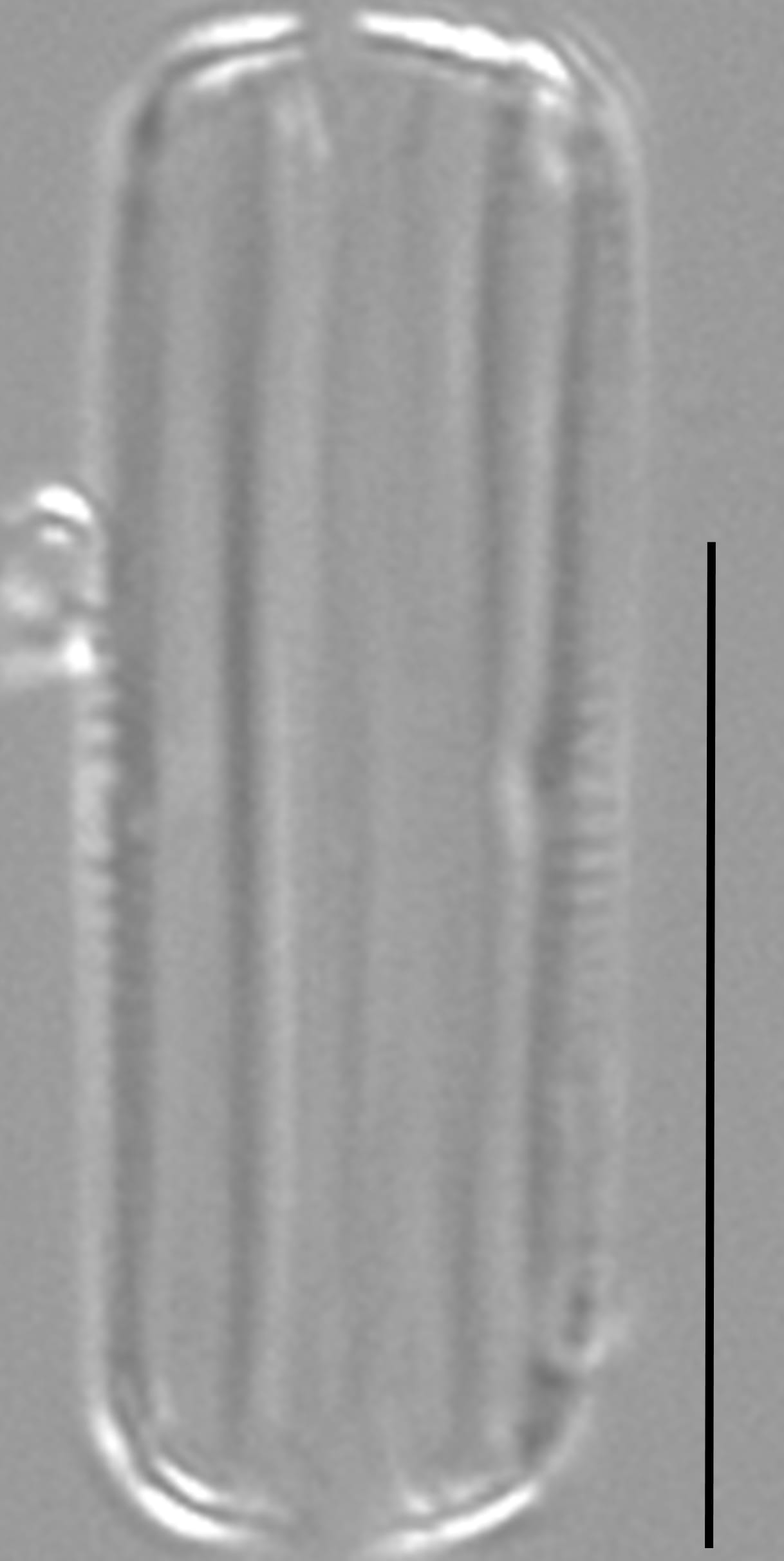
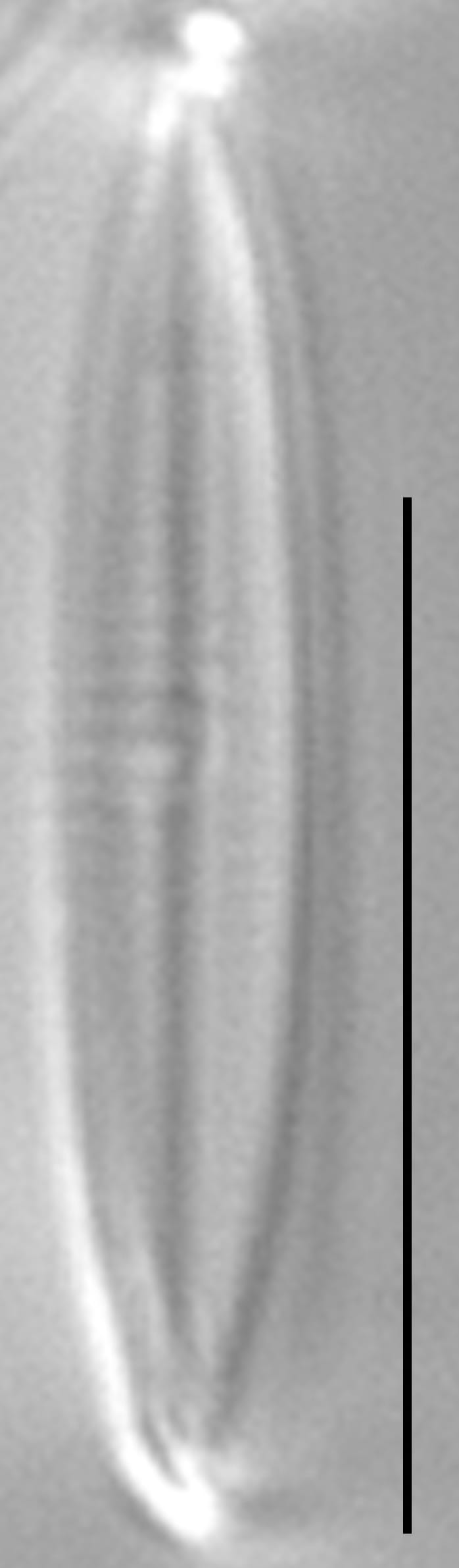
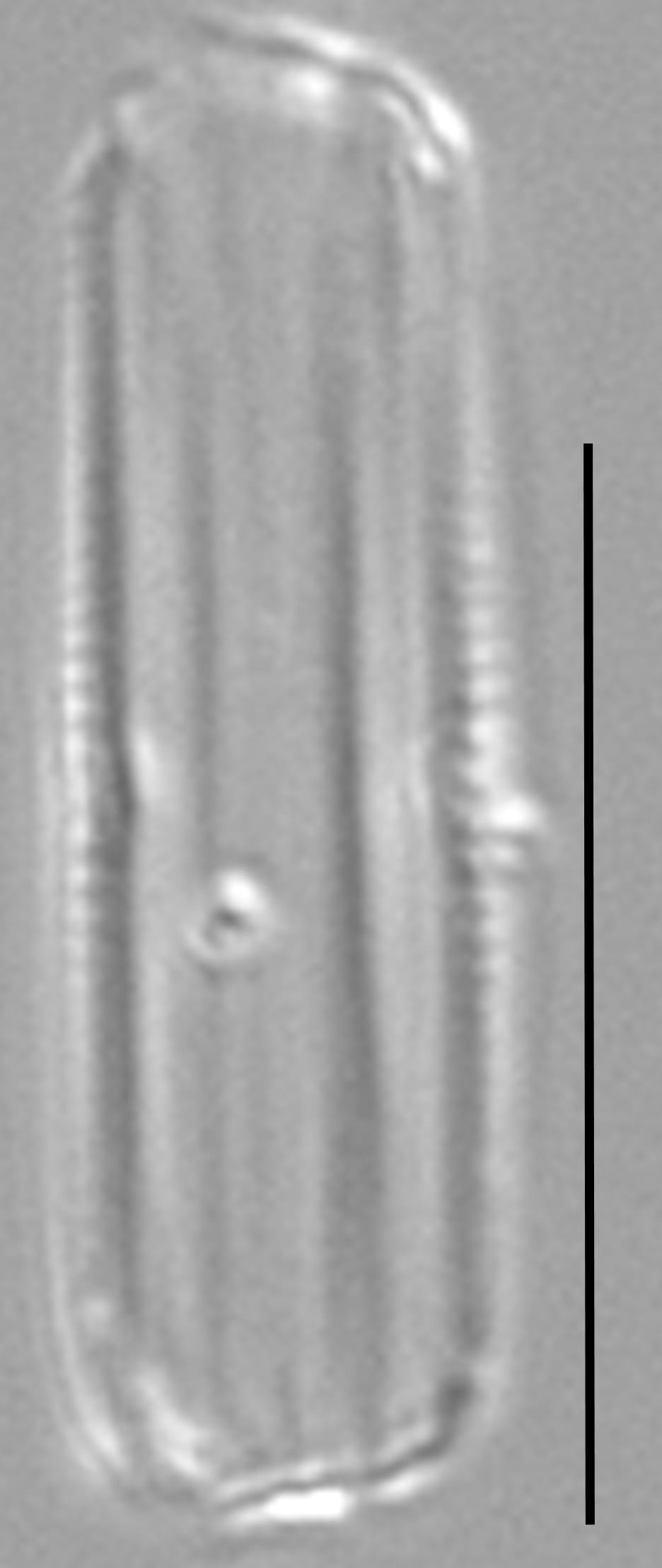
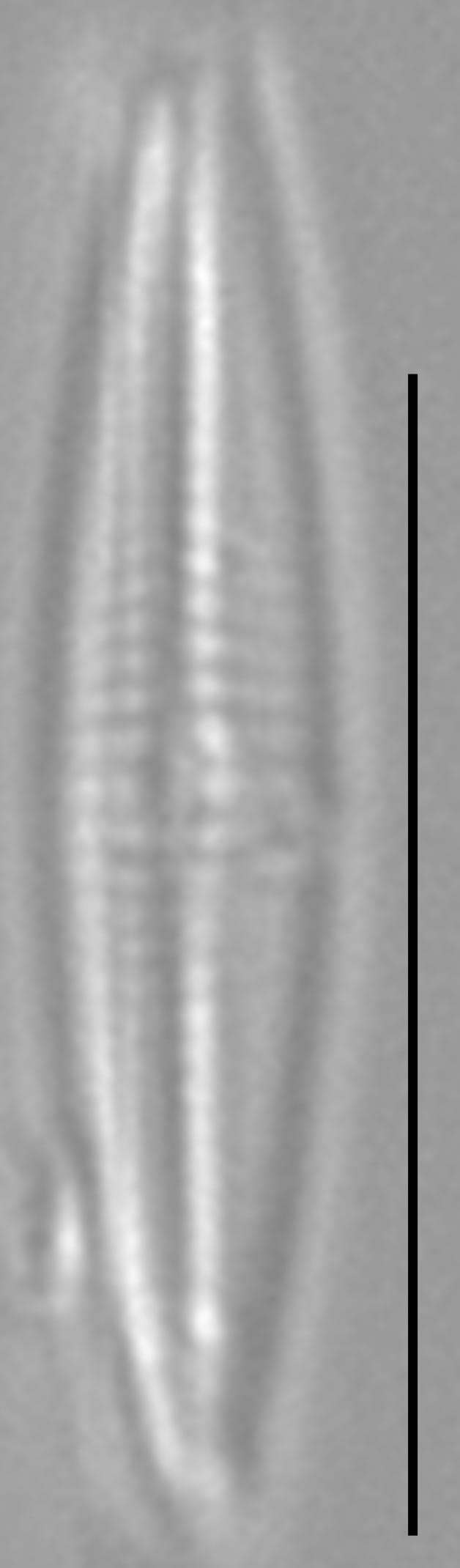
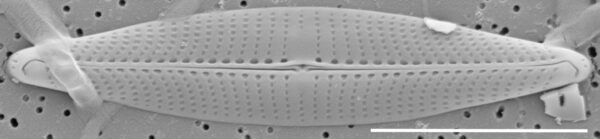
This taxon is only known to occur growing epizoically on sea turtles, manatees, and cetaceans.
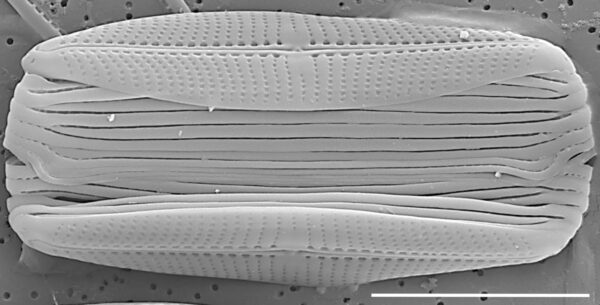
Frustules are small and rectangular in girdle view, with numerous copulae. Valves are narrowly lanceolate, with weakly protracted, cuneate subrostrate apices. The axial area is narrow, with a distinct raphe sternum. Fistula are present in the central area. The striae are only discernible near the central area.
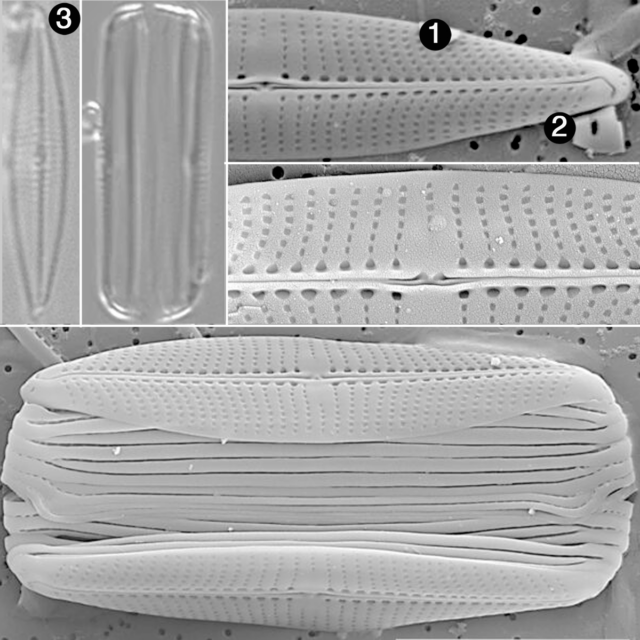
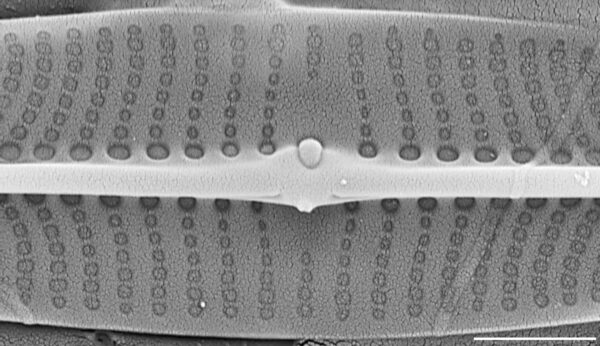
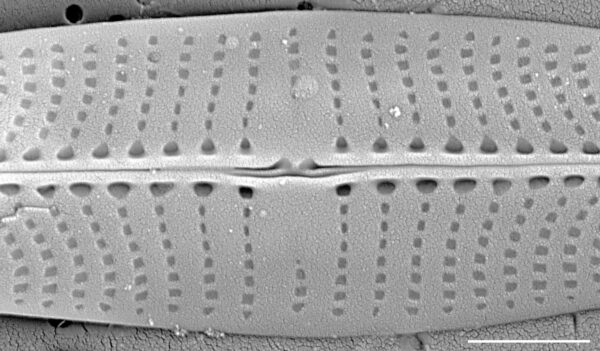
In SEM, striae are uniseriate, with increasing density toward the apices. Striae are composed of large rectangular areolae, decreasing in size toward the axial area. Striae are nearly parallel at the central area, becoming curved and strongly convergent toward the apices. The raphe is located between very narrow, central ridges in the central valve. The central area is rectangular, nearly symmetric, and formed by 1–2 shortened striae on each side of the sternum. Proximal raphe ends are closely spaced, spatulate, and slightly bent to the secondary side of the valve. A linear flange present next to the central area on the primary side of valve forms a hood, obscuring the external fistula opening. Distal raphe ends are strongly hooked toward the secondary side of valve. The raphe slit is visible only in the central area and at apices, opening laterally within a thick axial rib. Proximal raphe ends are simple and bent toward the fistula. A small knob-like structure protrudes laterally from the central nodule, opposite to the fistula. Simple helictoglossae are present at the apices. The cincture is composed of multiple, open copulae (up to 16). An unperforated pars exterior overlaps the perforated pars interior of adjacent copulae, producing an external appearance of the cincture as unperforated bands. Separated copulae reveal single row of rectangular pores on the pars interior. Longitudinal silica strips are absent.
This taxon is only known to occur growing epizoically on sea turtles, manatees, and cetaceans.
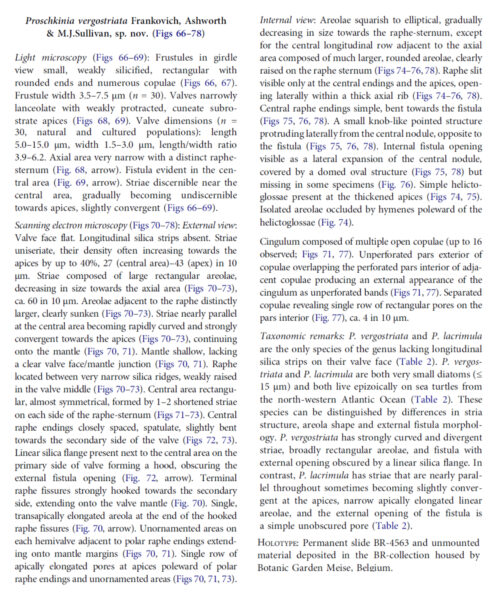
Proschkinia vergostriata Frankovich, Ashworth & M.J.Sullivan, sp. nov. (Figs 66–78)
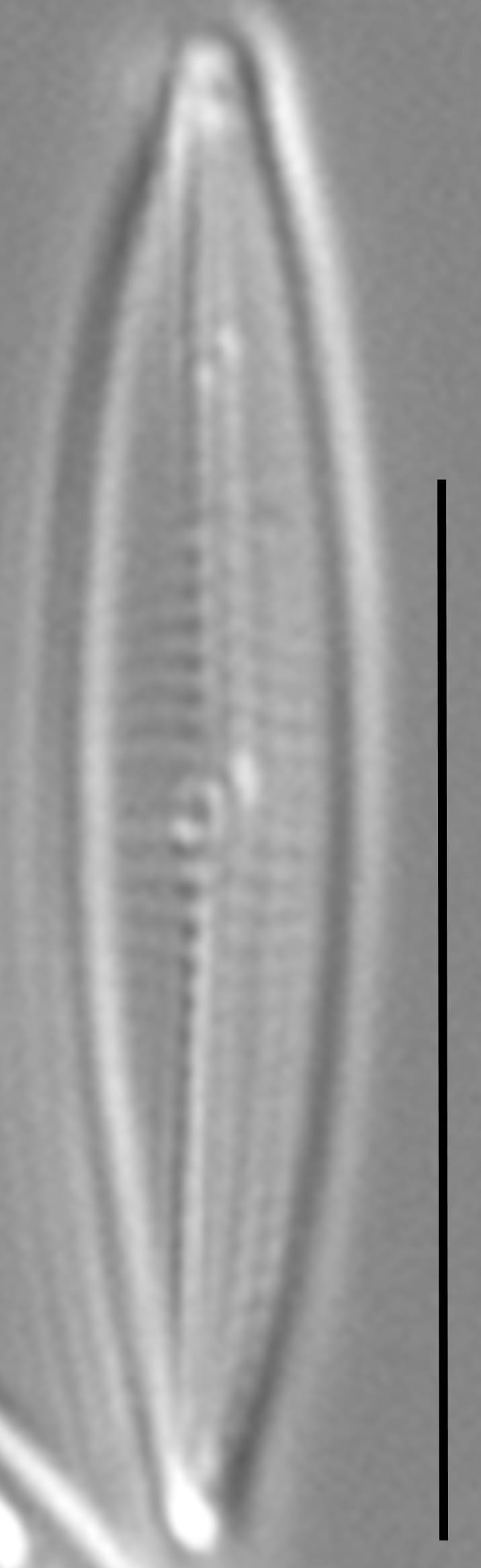
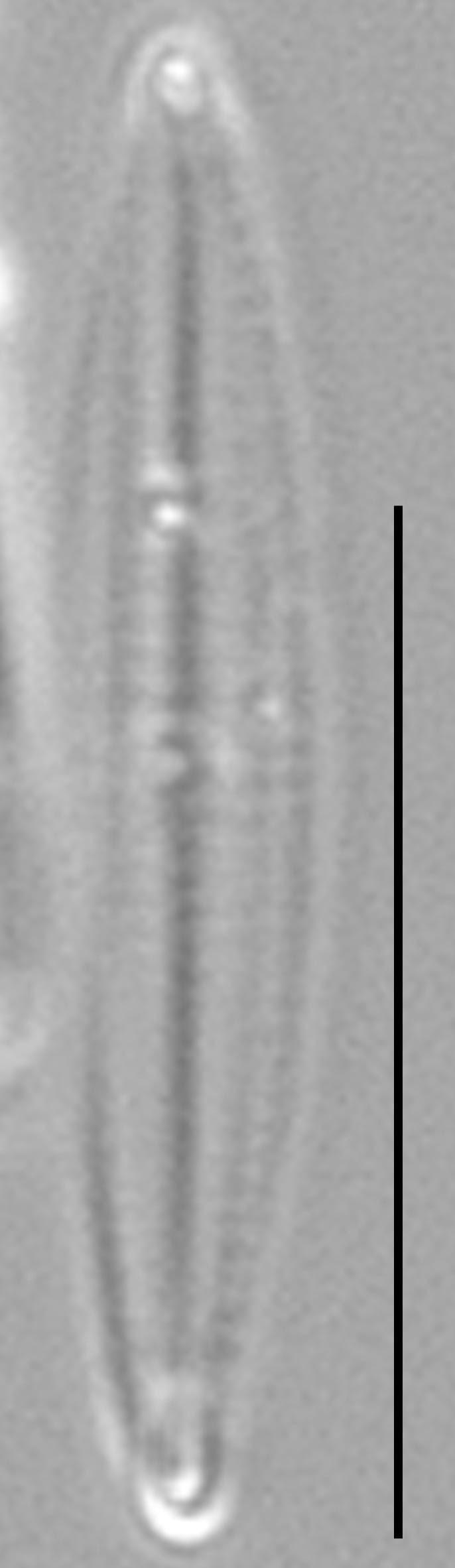
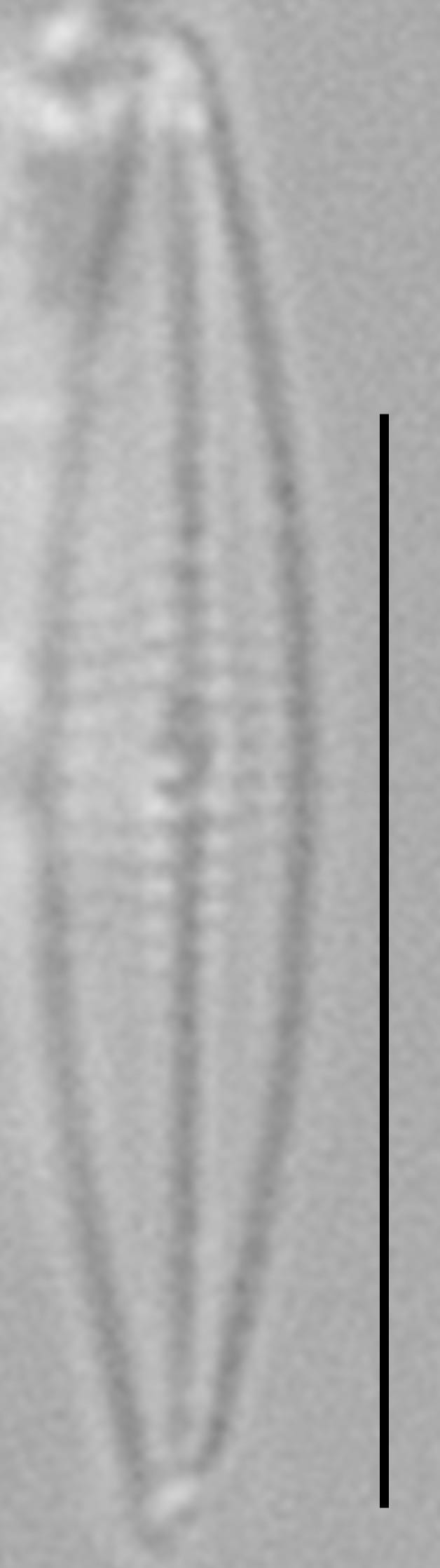
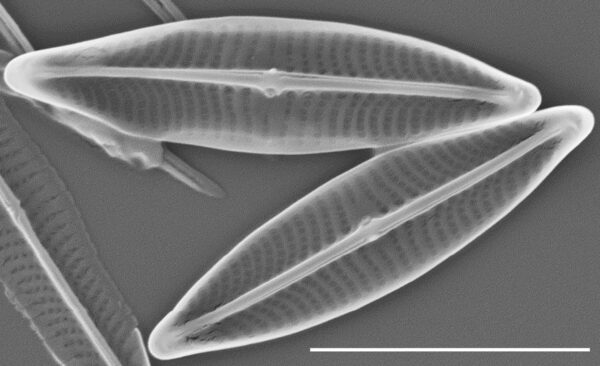
Light microscopy (Figs 66–69): Frustules in girdle view small, weakly silicified, rectangular with rounded ends and numerous copulae (Figs 66, 67). Frustule width 3.5–7.5 μm (n = 30). Valves narrowly lanceolate with weakly protracted, cuneate subrostrate apices (Figs 68, 69). Valve dimensions (n =30, natural and cultured populations): length 5.0–15.0 μm, width 1.5–3.0 μm, length/width ratio 3.9–6.2. Axial area very narrow with a distinct raphe-sternum (Fig. 68, arrow). Fistula evident in the central area (Fig. 69, arrow). Striae discernible near the central area, gradually becoming undiscernible towards apices, slightly convergent (Figs 66–69).
Scanning electron microscopy (Figs 70–78): External view: Valve face flat. Longitudinal silica strips absent. Striae uniseriate, their density often increasing towards the apices by up to 40%, 27 (central area)–43 (apex) in 10 μm. Striae composed of large rectangular areolae, decreasing in size towards the axial area (Figs 70–73), ca. 60 in 10 μm. Areolae adjacent to the raphe distinctly larger, clearly sunken (Figs 70–73). Striae nearly parallel at the central area becoming rapidly curved and strongly convergent towards the apices (Figs 70–73), continuing onto the mantle (Figs 70, 71). Mantle shallow, lacking a clear valve face/mantle junction (Figs 70, 71). Raphe located between very narrow silica ridges, weakly raised in the valve middle (Figs 70–73). Central area rectangular, almost symmetrical, formed by 1–2 shortened striae on each side of the raphe-sternum (Figs 71–73). Central raphe endings closely spaced, spatulate, slightly bent towards the secondary side of the valve (Figs 72, 73). Linear silica flange present next to the central area on the primary side of valve forming a hood, obscuring the external fistula opening (Fig. 72, arrow). Terminal raphe fissures strongly hooked towards the secondary side, extending onto the valve mantle (Fig. 70). Single, transapically elongated areola at the end of the hooked raphe fissures (Fig. 70, arrow). Unornamented areas on each hemivalve adjacent to polar raphe endings extending onto mantle margins (Figs 70, 71). Single row of apically elongated pores at apices poleward of polar raphe endings and unornamented areas (Figs 70, 71, 73). Internal view: Areolae squarish to elliptical, gradually decreasing in size towards the raphe-sternum, except for the central longitudinal row adjacent to the axial area composed of much larger, rounded areolae, clearly raised on the raphe sternum (Figs 74–76, 78). Raphe slit visible only at the central endings and the apices, opening laterally within a thick axial rib (Figs 74–76, 78). Central raphe endings simple, bent towards the fistula (Figs 75, 76, 78). A small knob-like pointed structure protruding laterally from the central nodule, opposite to the fistula (Figs 75, 76, 78). Internal fistula opening visible as a lateral expansion of the central nodule, covered by a domed oval structure (Figs 75, 78) but missing in some specimens (Fig. 76). Simple helictoglossae present at the thickened apices (Figs 74, 75). Isolated areolae occluded by hymenes poleward of the helictoglossae (Fig. 74). Cingulum composed of multiple open copulae (up to 16 observed; Figs 71, 77). Unperforated pars exterior of copulae overlapping the perforated pars interior of adjacent copulae producing an external appearance of the cingulum as unperforated bands (Figs 71, 77). Separated copulae revealing single row of rectangular pores on the pars interior (Fig. 77), ca. 4 in 10 μm.
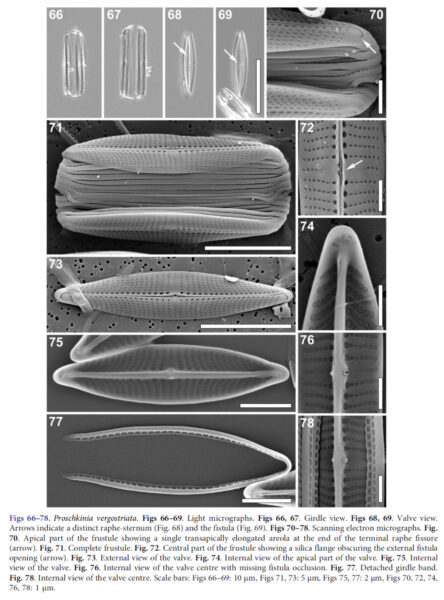
Frankovich, T. (2026). Proschkinia vergostriata. In Diatoms of North America. Retrieved October 11, 2026, from https://diatoms.org/species/366105/proschkinia-vergostriata
The 15 response plots show an environmental variable (x axis) against the relative abundance (y axis) of Proschkinia vergostriata from all the stream reaches where it was present. Note that the relative abundance scale is the same on each plot. Explanation of each environmental variable and units are as follows:
ELEVATION = stream reach elevation (meters)
STRAHLER = distribution plot of the Strahler Stream Order
SLOPE = stream reach gradient (degrees)
W1_HALL = an index that is a measure of streamside (riparian) human activity that ranges from 0 - 10, with a value of 0 indicating of minimal disturbance to a value of 10 indicating severe disturbance.
PHSTVL = pH measured in a sealed syringe sample (pH units)
log_COND = log concentration of specific conductivity (µS/cm)
log_PTL = log concentration of total phosphorus (µg/L)
log_NO3 = log concentration of nitrate (µeq/L)
log_DOC = log concentration of dissolved organic carbon (mg/L)
log_SIO2 = log concentration of silicon (mg/L)
log_NA = log concentration of sodium (µeq/L)
log_HCO3 = log concentration of the bicarbonate ion (µeq/L)
EMBED = percent of the stream substrate that is embedded by sand and fine sediment
log_TURBIDITY = log of turbidity, a measure of cloudiness of water, in nephelometric turbidity units (NTU).
DISTOT = an index of total human disturbance in the watershed that ranges from 1 - 100, with a value of 0 indicating of minimal disturbance to a value of 100 indicating severe disturbance.