
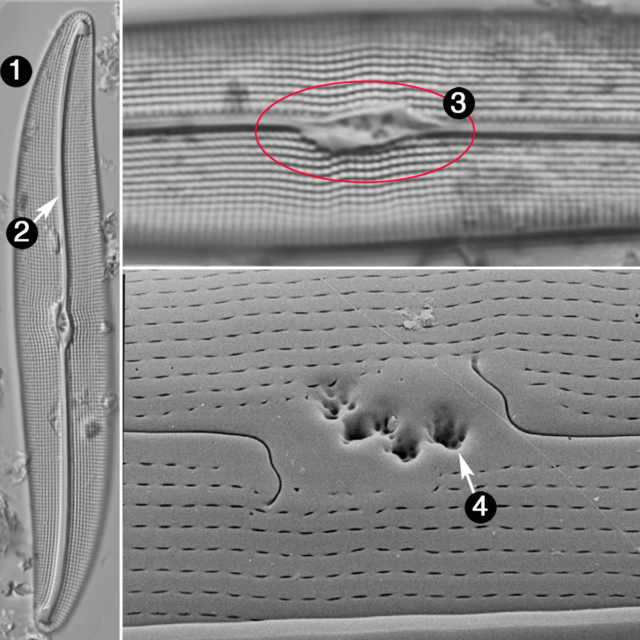






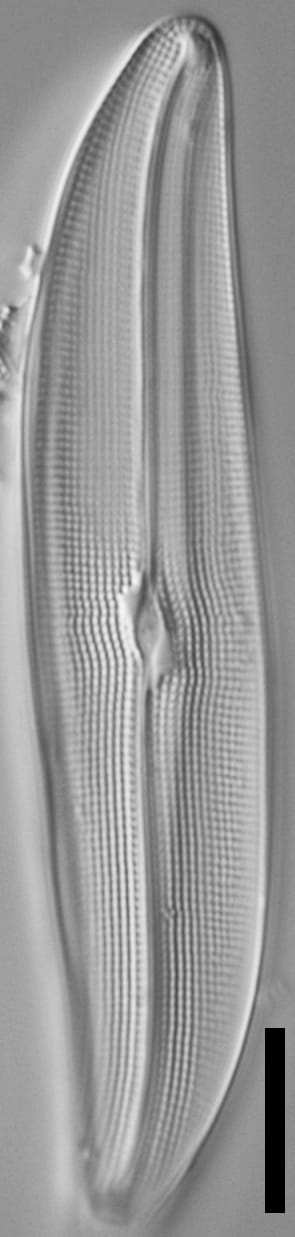
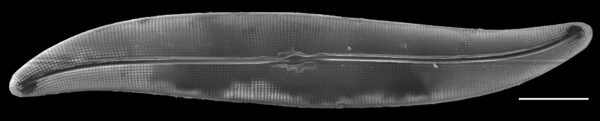


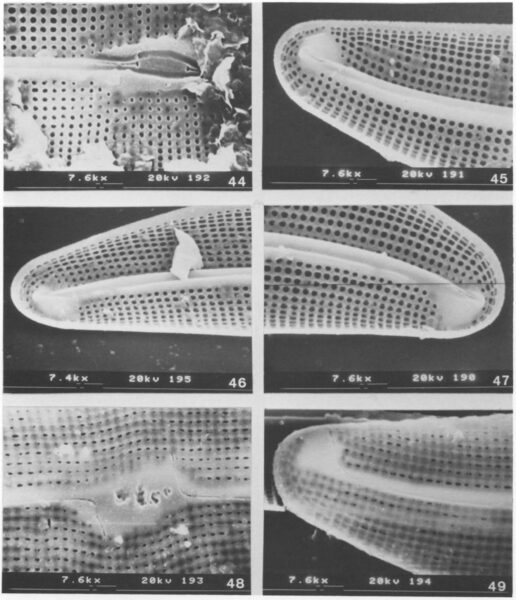
Valves are linear-lanceolate and moderately sigmoid, with broadly rounded apices. The central part of the valve is nearly straight. The axial area is narrow. The central area is apically elongated, rectangular to irregularly shaped and rotated with respect to the axial area. Several depressions on the external valve surface appear as distinct, dark spots in LM. The raphe is sigmoid, but almost straight in its central part. The proximal and the terminal raphe fissures are turned in opposite directions. Internal proximal raphe ends are straight. Terminal nodules are expanded. Transverse striae are very slightly curved in valve center and continue as short rows of 2-3 areolae around the terminal nodules at valve apices.
Note that before Sterrenburg established this species in 1994, it had been reported as Gyrosigma nodiferum (Grunow) G.S. West following Patrick and Reimer (1966).
As other Gyrosigma taxa, G. reimeri is epipelic (grows on the surface of fine sediments). We confirmed its occurrence in high-conductivity rivers of southern part of the United States: Texas, Florida, and California.
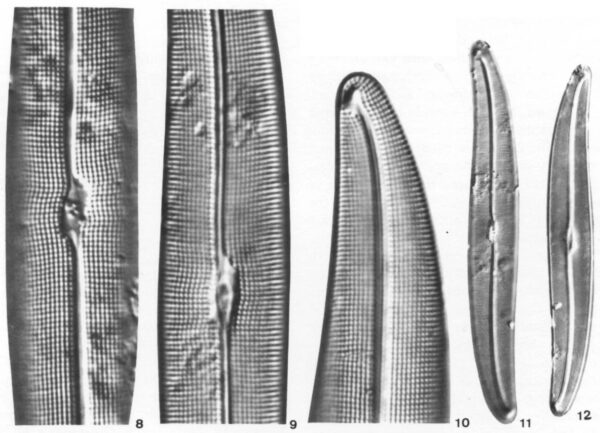
Valve slightly sigmoid, approximately parallel sided, with rather bluntly rounded ends, 65-145 µm long, 12-15 µm wide, vaulted. Colour in resin with darkfield: bright to fainter ultramarine. Raphe sternum with slight double curvature and a long straight section in the middle portion, raphe angle 0 to +5 deg., median or slightly displaced to its concavity at the ends. Axial area narrow, raphe just visible. Terminal raphe fissures abruptly deflected sideways, central area approximately rhombic, somewhat irregular, rotated toward the convexity, internal central raphe nodule rotated toward the concavity of the raphe sternum. Central area contains coarse puncta in the type populations. Terminal areas unilaterally dilated, of roughly triangular shape, position: lateral In the LM they appear to be rather wide at the valve margin (Fig. 10). Apical structure: a broad band of 2-3 puncta rows runs completely around the apex. Transverse striae centrally radiate, otherwise roughly parallel, 18-20 in 10 µm. Longitudinal striae 22-24 in 10 µm, somewhat condensed at the margin only.

Potapova, M. (2011). Gyrosigma reimeri. In Diatoms of North America. Retrieved October 10, 2026, from https://diatoms.org/species/45982/gyrosigma_reimeri
The 15 response plots show an environmental variable (x axis) against the relative abundance (y axis) of Gyrosigma reimeri from all the stream reaches where it was present. Note that the relative abundance scale is the same on each plot. Explanation of each environmental variable and units are as follows:
ELEVATION = stream reach elevation (meters)
STRAHLER = distribution plot of the Strahler Stream Order
SLOPE = stream reach gradient (degrees)
W1_HALL = an index that is a measure of streamside (riparian) human activity that ranges from 0 - 10, with a value of 0 indicating of minimal disturbance to a value of 10 indicating severe disturbance.
PHSTVL = pH measured in a sealed syringe sample (pH units)
log_COND = log concentration of specific conductivity (µS/cm)
log_PTL = log concentration of total phosphorus (µg/L)
log_NO3 = log concentration of nitrate (µeq/L)
log_DOC = log concentration of dissolved organic carbon (mg/L)
log_SIO2 = log concentration of silicon (mg/L)
log_NA = log concentration of sodium (µeq/L)
log_HCO3 = log concentration of the bicarbonate ion (µeq/L)
EMBED = percent of the stream substrate that is embedded by sand and fine sediment
log_TURBIDITY = log of turbidity, a measure of cloudiness of water, in nephelometric turbidity units (NTU).
DISTOT = an index of total human disturbance in the watershed that ranges from 1 - 100, with a value of 0 indicating of minimal disturbance to a value of 100 indicating severe disturbance.