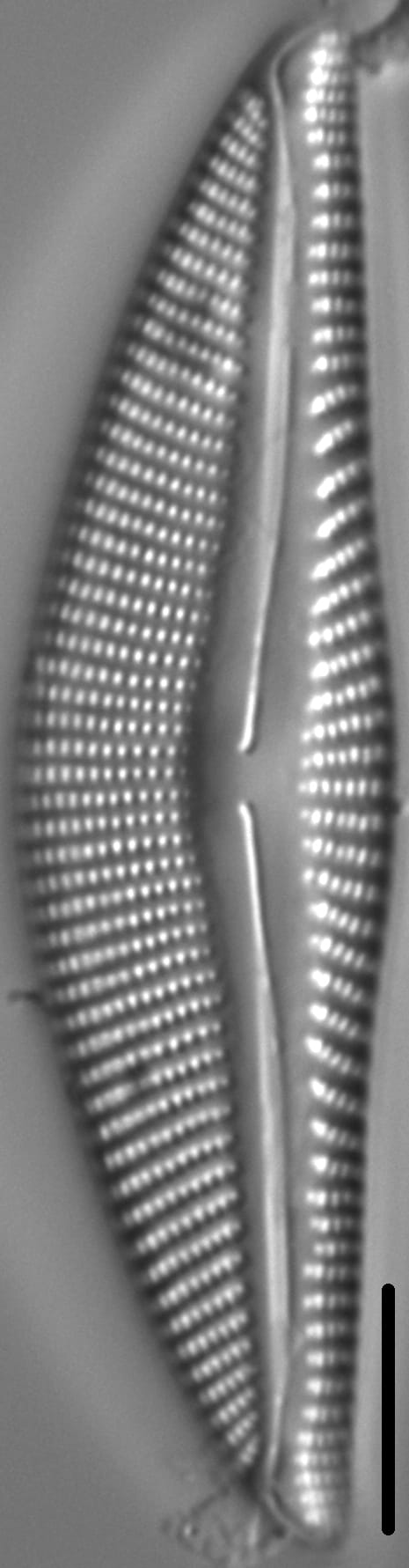
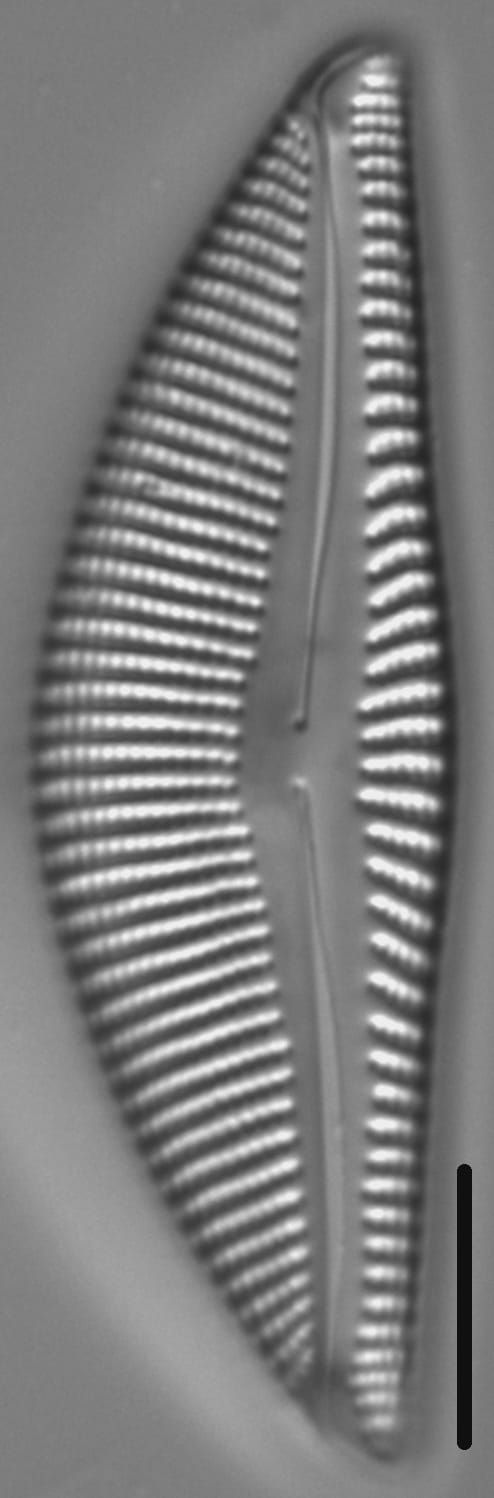
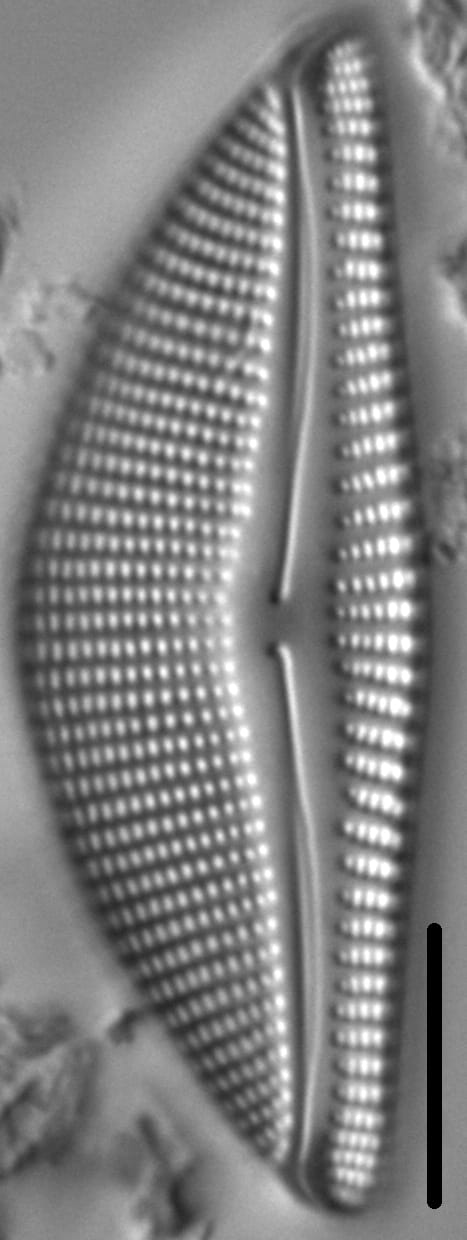
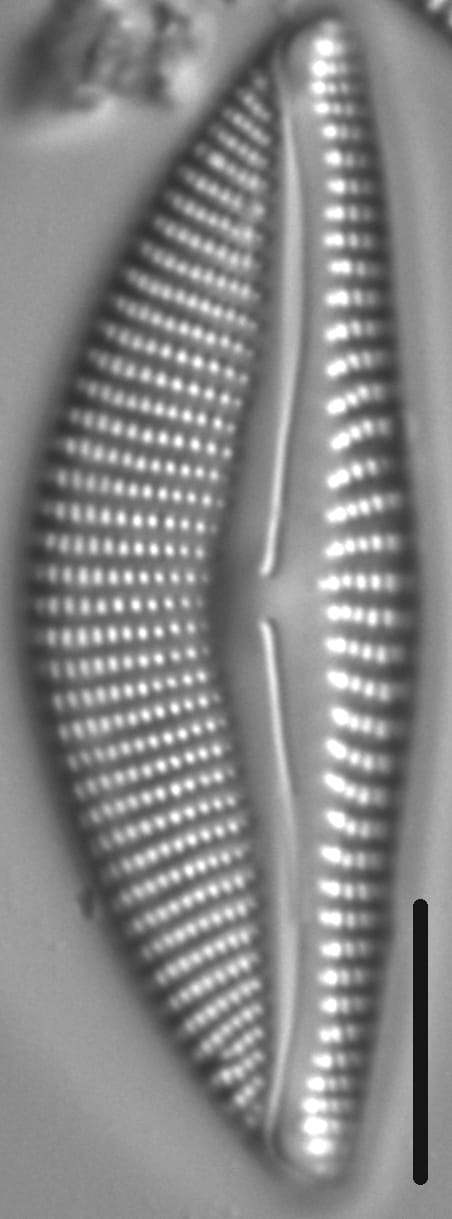
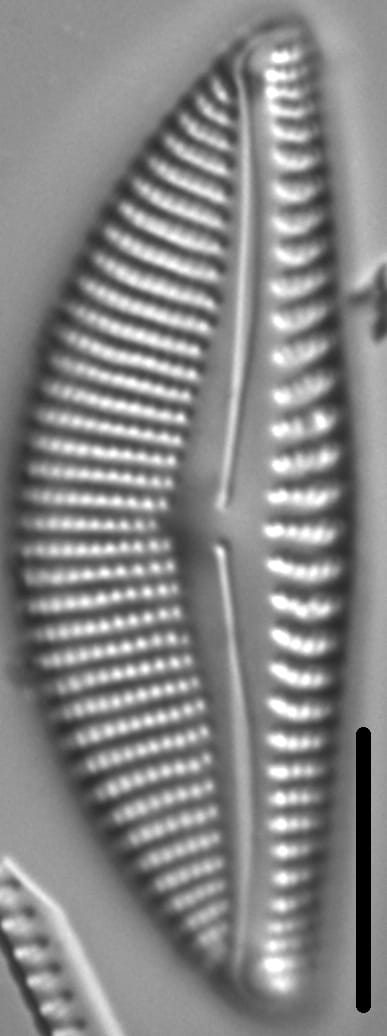
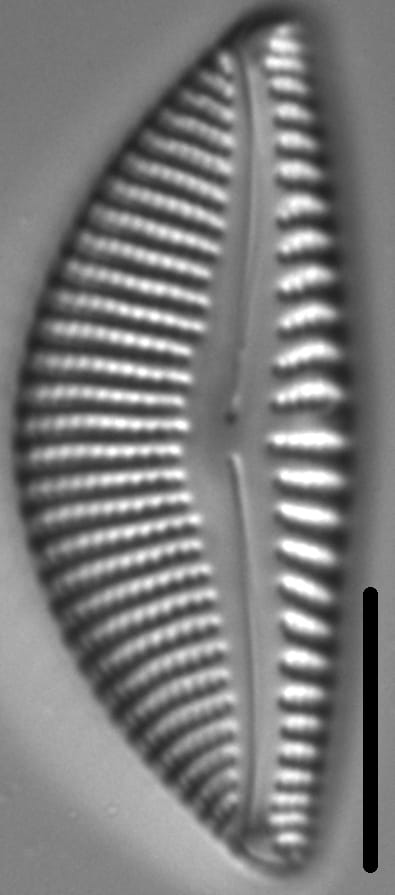

Credit: Loren Bahls
Mann Lake, Harney County, eastern Oregon.

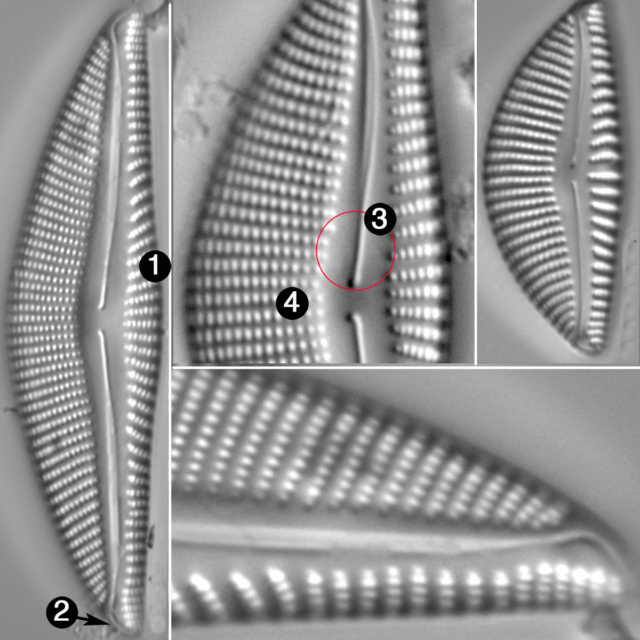
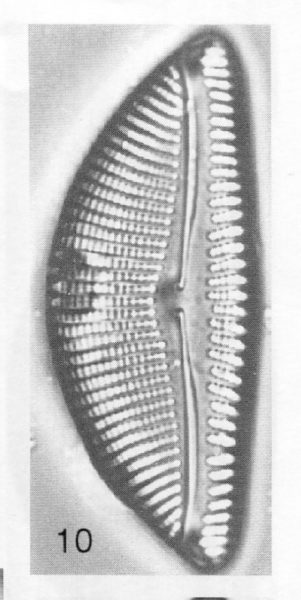
Valves are dorsiventral, with acutely rounded apices. The dorsal margins are strongly arched. The ventral margins are weakly convex. The axial area is wide and merges with the central area. The raphe is lateral, narrowing near the proximal and distal ends. Proximal raphe ends are upturned, with weakly inflated pores. The distal raphe ends are comma-shaped and deflected to the ventral side.
Dorsal striae are radiate. Ventral striae are radiate at the valve center and about 1/4 the valve width, transitioning to parallel near the apices. Areolae number 16-20 in 10 µm.
The specimens shown here are from a Cottonwood Creek, Twin Falls County, in southern Idaho and Mann Lake, Harney County, in eastern Oregon.
The species was originally described from material collected in Kamtschatka, Russia (Krammer 1997) and was also reported by Potapova (2014).


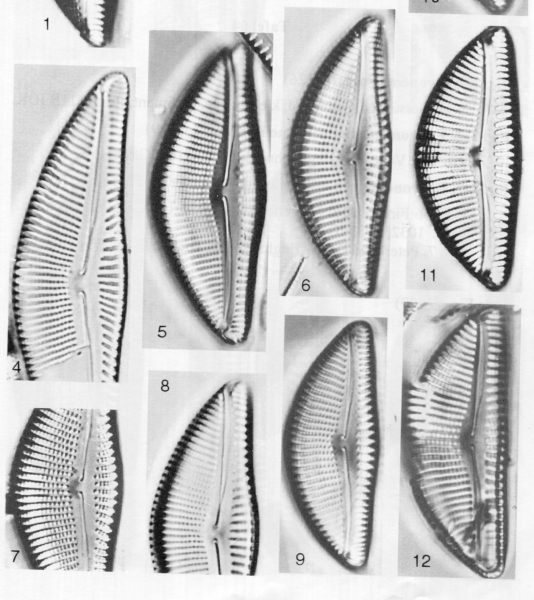
(66) Encyonema kamtschaticum Krammer nov. spec. (Fig. 63:4-11)
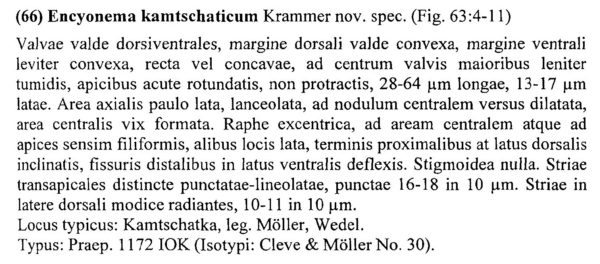
Valvae valde dorsiventrales, margine dorsali valde convexa, margine ventrali leviter convexa, recta vel concavae, ad centrum valvis maioribus leniter tumidis, apicibus acute rotundatis, non protractis, 28-64 µm longae, 13-17 µm latae. Area axialis paulo lata, lanceolata, ad nodulum centralem versus dilatata, area centralis vix formata. Raphe excentrica, ad aream centralem atque ad apices sensim filiformis, alibus locis lata, terminis proximalibus at latus dorsalis inclinatis, fissuris distalibus in latus ventralis deflexis. Stigmoidea nulla. Striae transapicales distincte punctatae-lineolatae, punctae 16-18 in 10 µm. Striae in latere dorsali modice radiantes, 10-11 in 10 µm.
Locus typicus: Kamtschatka, leg. Möller, Wedel.
ITypus: Praep. 1172 IOK (Isotypi: Cleve & Möller No. 30).
Bahls, L. (2018). Encyonema kamtschaticum. In Diatoms of North America. Retrieved October 11, 2026, from https://diatoms.org/species/94611/encyonema-kamtschaticum
The 15 response plots show an environmental variable (x axis) against the relative abundance (y axis) of Encyonema kamtschaticum from all the stream reaches where it was present. Note that the relative abundance scale is the same on each plot. Explanation of each environmental variable and units are as follows:
ELEVATION = stream reach elevation (meters)
STRAHLER = distribution plot of the Strahler Stream Order
SLOPE = stream reach gradient (degrees)
W1_HALL = an index that is a measure of streamside (riparian) human activity that ranges from 0 - 10, with a value of 0 indicating of minimal disturbance to a value of 10 indicating severe disturbance.
PHSTVL = pH measured in a sealed syringe sample (pH units)
log_COND = log concentration of specific conductivity (µS/cm)
log_PTL = log concentration of total phosphorus (µg/L)
log_NO3 = log concentration of nitrate (µeq/L)
log_DOC = log concentration of dissolved organic carbon (mg/L)
log_SIO2 = log concentration of silicon (mg/L)
log_NA = log concentration of sodium (µeq/L)
log_HCO3 = log concentration of the bicarbonate ion (µeq/L)
EMBED = percent of the stream substrate that is embedded by sand and fine sediment
log_TURBIDITY = log of turbidity, a measure of cloudiness of water, in nephelometric turbidity units (NTU).
DISTOT = an index of total human disturbance in the watershed that ranges from 1 - 100, with a value of 0 indicating of minimal disturbance to a value of 100 indicating severe disturbance.