
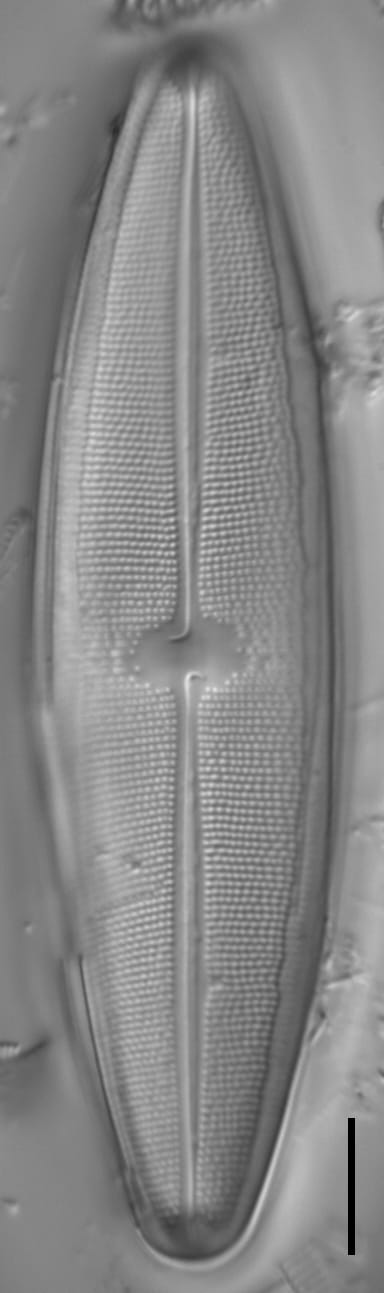
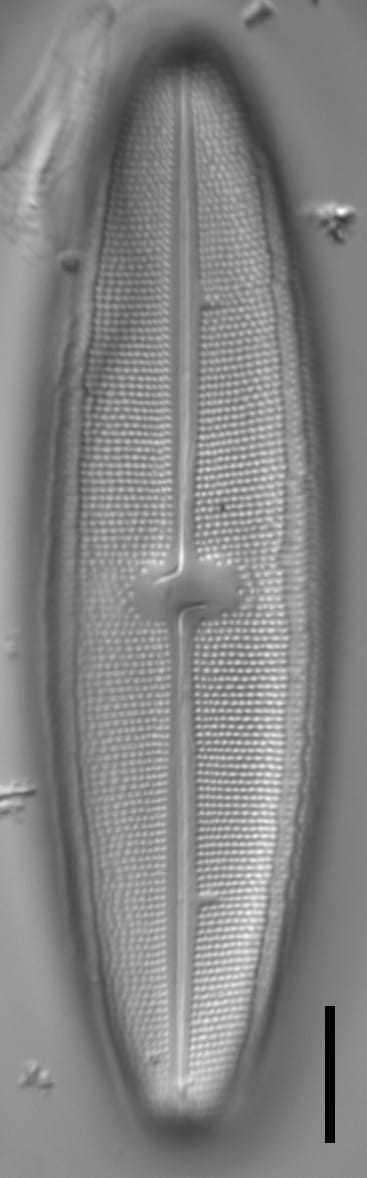
Credit: Lane Allen
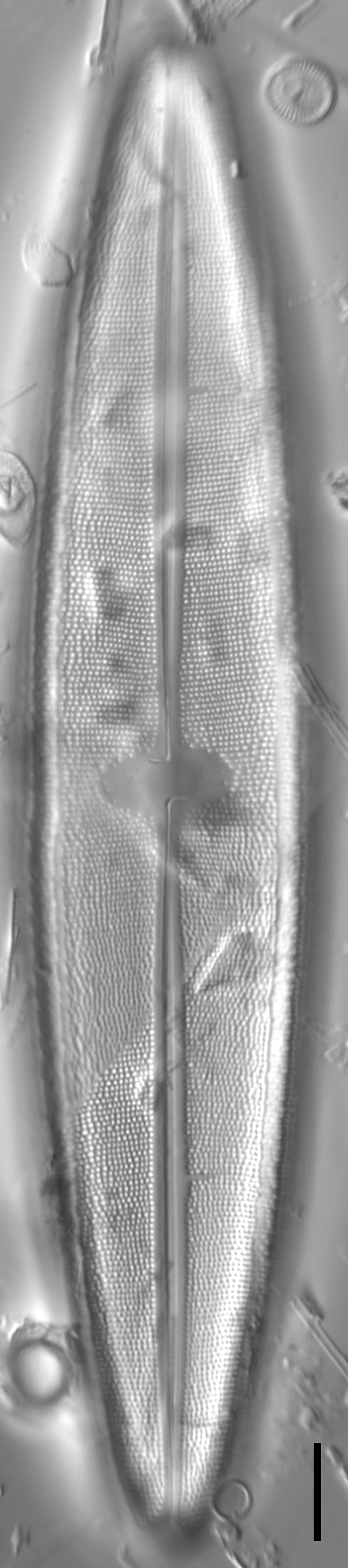
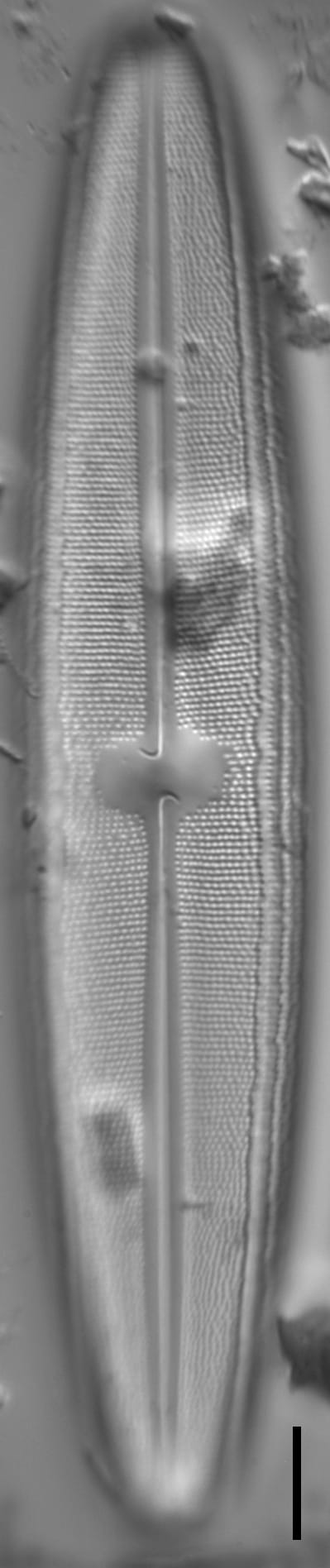
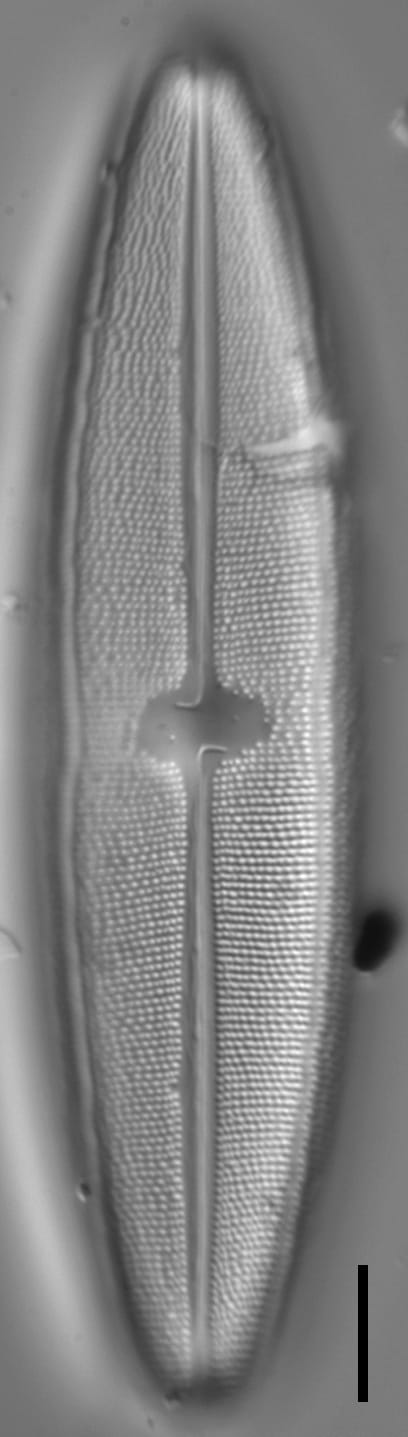
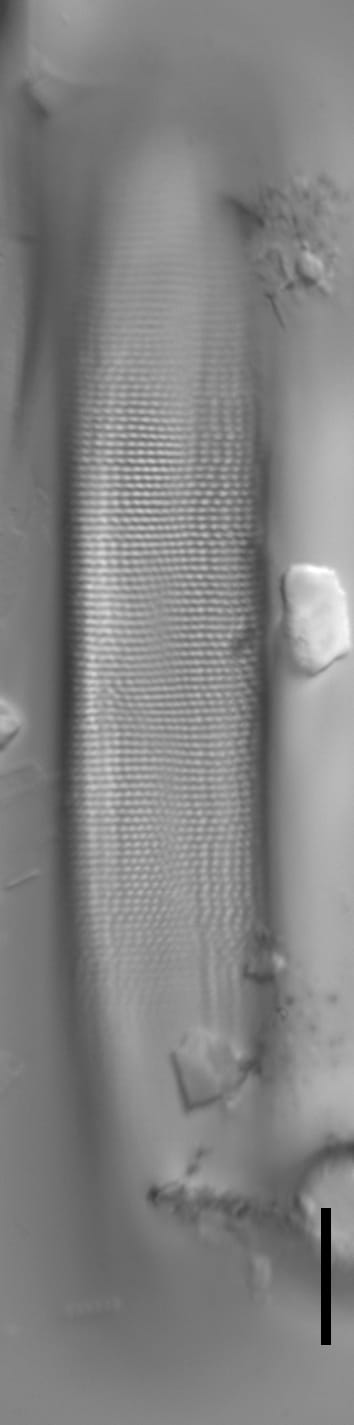
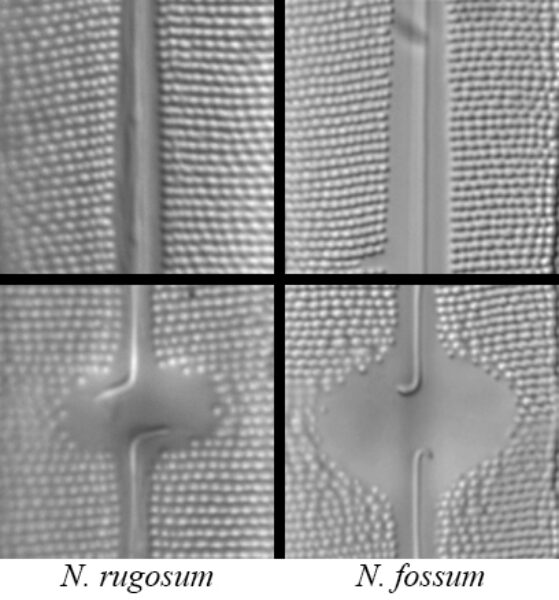
A guide to distinguishing N. rugosum (left) from N. fossum (right). Top images depict axial area, bottom images depict central area.

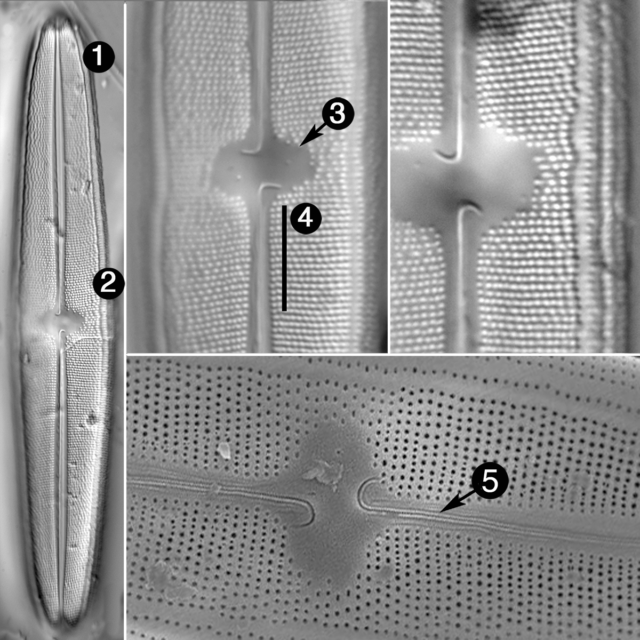
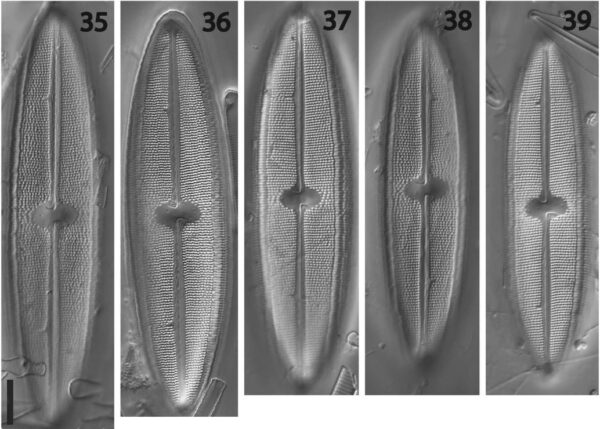
Valves are large, with convex valve margins. The valve face is relatively flat. Apices are rounded to acutely rounded. An internal, longitudinal canal is present at each margin. Striae are slightly radiate at the central area, becoming parallel toward the apices. Subtle voigt discontinuities are present. Areolae are coarse and nearly evenly sized from the axial area to the margin. Areola density is approximately 16 in 10 µm, measured near the central area.
The raphe is linear, with an oblique slit. Proximal raphe ends are large relative to the central area and strongly deflected. The central area is transapically expanded and elliptic to slightly rectangular.
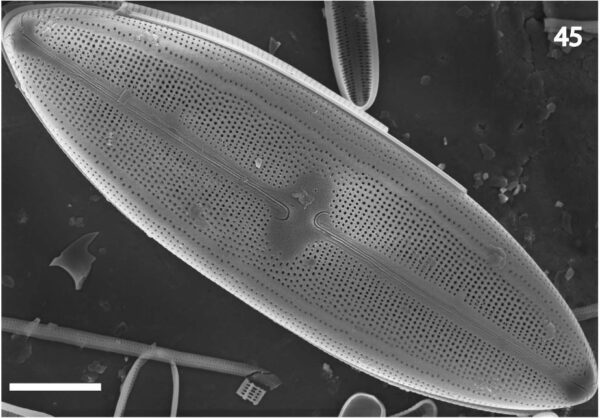
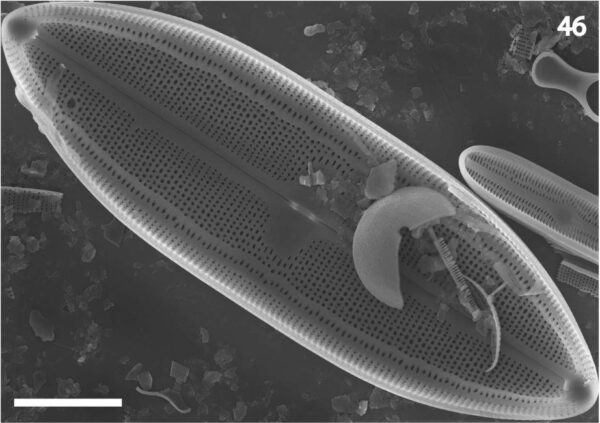
The axial area is slightly constricted near the apices and central area. In SEM, the axial area contains "longitudinal ridges" on both sides of the raphe. This feature is not readily apparent in LM. Internally, valves bear a rectelevatum and helictoglossa. Renilimbi are notably absent (Potapova et al. 2014).
Populations from North America are notably larger and broader than the type population from the Sakha (Yakutia) Republic), Russia. The authors of this page consider the taxa to be conspecific, despite the geographically disparate locations.
This taxon appears to have a circumboreal distribution. In North America, it has been reported with light micrographs from Alaska (Foged 1981, pg. 238, Pl. 25, Fig 2, as N. iridis), the Canadian Arctic Archipelago (Antoniades et al. 2008, pg. 592, Pl. 121, Figs 1-2,6, as N. ampliatum s.l.), the Great Lakes (Reavie 2022, pg. 387, Fig 392, as N. c.f. fossum), and Nunavut (Bahls 2023, pg. 293, Pl. 109, Figs 6-8). Due to confusion surrounding the identity of this taxon, as well as its low relative abundance in counts, the ecological preferences of this taxon are poorly understood.
In the Great Lakes National Parks (Edlund et al. 2011, 2012, 2013), this taxon is a minor component of the diatom community in the sediment of Shell Lake, and a trace component of the diatom community in the sediment of Bass Lake. Both lakes are within Sleeping Bear Dunes National Lakeshore, Michigan.
Large specimens belonging to the genus Neidium were historically associated with Neidium iridis, however examination of type material has resolved the identity of that taxon allowing many other large taxa to be described (Lefebvre and Hamilton 2015, Hamilton et al. 2019). Like many large taxa, it typically occurs in low abundance relative to smaller taxa in the community. Large taxa are typically underestimated using traditional counting techniques (Snoeijs et al. 2002). As originally suggested by Hustedt (1957), traditional counting techniques are likely insufficient for understanding large-celled diatoms. Because the importance of taxa with larger cell volumes is usually greater in communities (Snoeijs et al. 2002) more effort should be devoted to understanding the diversity, ecology and biogeography of large celled diatom taxa.
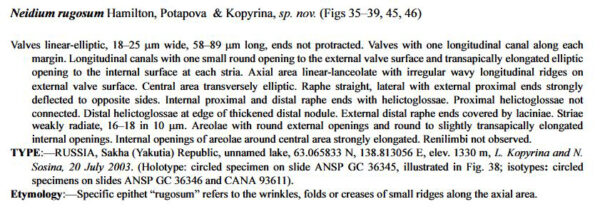
Valves linear-elliptic, 18–25 μm wide, 58–89 μm long, ends not protracted. Valves with one longitudinal canal along each margin. Longitudinal canals with one small round opening to the external valve surface and transapically elongated elliptic opening to the internal surface at each stria. Axial area linear-lanceolate with irregular wavy longitudinal ridges on external valve surface. Central area transversely elliptic. Raphe straight, lateral with external proximal ends strongly deflected to opposite sides. Internal proximal and distal raphe ends with helictoglossae. Proximal helictoglossae not connected. Distal helictoglossae at edge of thickened distal nodule. External distal raphe ends covered by laciniae. Striae weakly radiate, 16–18 in 10 μm. Areolae with round external openings and round to slightly transapically elongated internal openings. Internal openings of areolae around central area strongly elongated. Renilimbi not observed.
Allen, L., Edlund, M. (2025). Neidium rugosum. In Diatoms of North America. Retrieved October 14, 2026, from https://diatoms.org/species/340576/neidium-rugosum
The 15 response plots show an environmental variable (x axis) against the relative abundance (y axis) of Neidium rugosum from all the stream reaches where it was present. Note that the relative abundance scale is the same on each plot. Explanation of each environmental variable and units are as follows:
ELEVATION = stream reach elevation (meters)
STRAHLER = distribution plot of the Strahler Stream Order
SLOPE = stream reach gradient (degrees)
W1_HALL = an index that is a measure of streamside (riparian) human activity that ranges from 0 - 10, with a value of 0 indicating of minimal disturbance to a value of 10 indicating severe disturbance.
PHSTVL = pH measured in a sealed syringe sample (pH units)
log_COND = log concentration of specific conductivity (µS/cm)
log_PTL = log concentration of total phosphorus (µg/L)
log_NO3 = log concentration of nitrate (µeq/L)
log_DOC = log concentration of dissolved organic carbon (mg/L)
log_SIO2 = log concentration of silicon (mg/L)
log_NA = log concentration of sodium (µeq/L)
log_HCO3 = log concentration of the bicarbonate ion (µeq/L)
EMBED = percent of the stream substrate that is embedded by sand and fine sediment
log_TURBIDITY = log of turbidity, a measure of cloudiness of water, in nephelometric turbidity units (NTU).
DISTOT = an index of total human disturbance in the watershed that ranges from 1 - 100, with a value of 0 indicating of minimal disturbance to a value of 100 indicating severe disturbance.