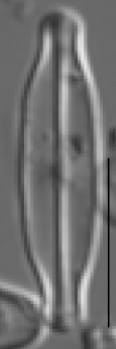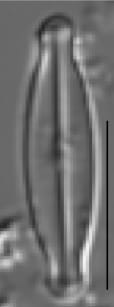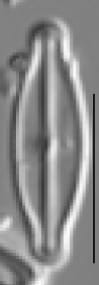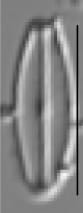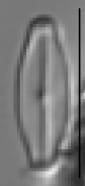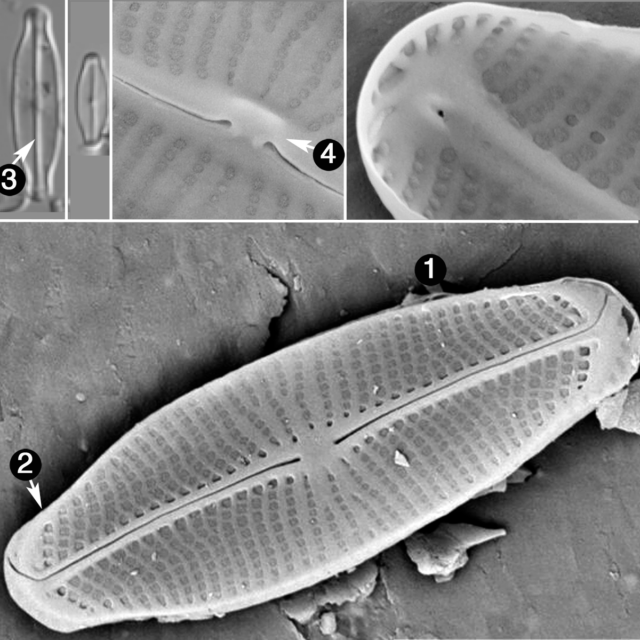
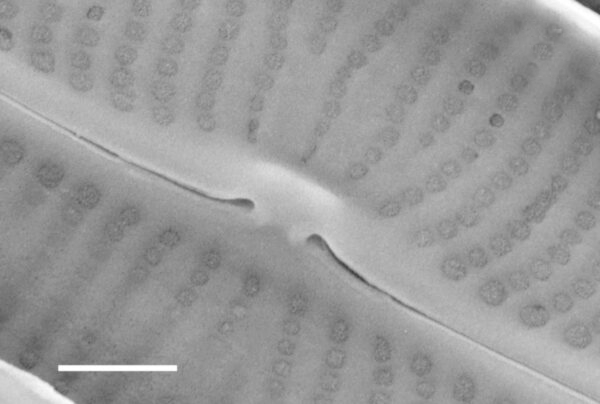
Valves are linear-elliptic to elliptic, with narrow, rostrate apices. Striae are more widely spaced around the central area and parallel throughout. The central area is weakly expanded, with 4-6 marginal striae between the proximal raphe ends such that 1-2 striae are shorter than the others. Striae are continuous around the apices.
Externally, the proximal raphe ends are expanded and deflected to the primary side. The raphe is curved, lacking a kink- like irregularity halfway between mid-valve and apex. Areolae round to rectangular, 8-10 per stria, with 3-4 at the apices. Terminal raphe fissures are bent down onto the upper region of mantle, opening into a small circular depression. Voigt discontinuities are indistinct.
Internally, the raphe is straight, lacking a kink-like irregularity. The proximal raphe fissures are teardrop-shaped and positioned on raised central nodule. The terminal fissures have a small helictoglossa, isolated from apex mantle.
Small, linear to linear-elliptic species within Adlafia, Eolimna and Sellaphora may be difficult to distinguish using light microscopy. An asymmetric central nodule distinguishes this taxon from some Adlafia and Eolimna species, however scanning electron microscopy may be needed to observe the features of Sellaphora species - recessed volate occlusions of the areolae, raised external axial and terminal areas, distinctly larger areolae along the axial area, and bent terminal raphe fissures that extend onto the valve mantle.
This species was found in two lakes in Québec 22-Z and 22-AA (Alibert et al. 2023). It reached 4.6% relative abundance in lake 22-AA and only 0.6% in 22-Z. The low number of occurrences prevented determining a relationships with lake chemistry, but both sites where this taxon occurred had circumneutral conditions, and Lake 22-AA had the highest TP concentration in the dataset.
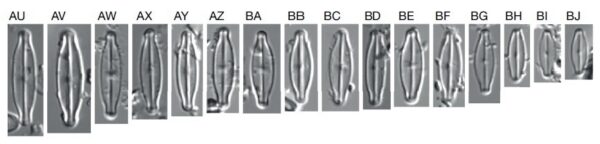
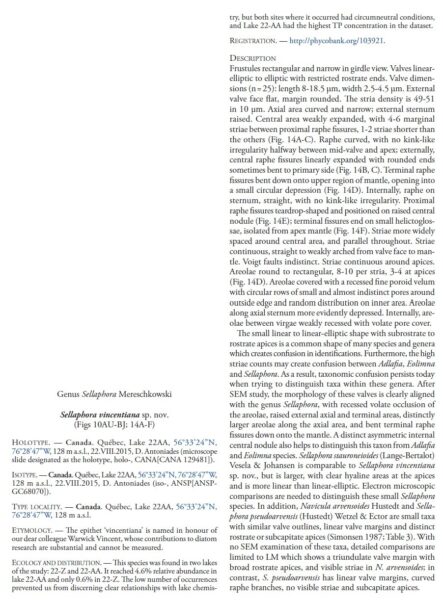
Sellaphora vincentiana sp. nov. (Figs 10AU-BJ; 14A-F)
Holotype. — Canada. Québec, Lake 22AA, 56°33’24”N,76°28’47”W, 128 m a.s.l., 22.VIII.2015, D. Antoniades (microscope slide designated as the holotype, holo-, CANA[CANA 129481]).
Isotype. — Canada. Québec, Lake 22AA, 56°33’24”N, 76°28’47”W, 128 m a.s.l., 22.VIII.2015, D. Antoniades (iso-, ANSP[ANSPGC68070]).
Type locality. — Canada. Québec, Lake 22AA, 56°33’24”N, 76°28’47”W, 128 m a.s.l.
Etymology. — The epithet ‘vincentiana’ is named in honour of our dear colleague Warwick Vincent, whose contributions to diatom research are substantial and cannot be measured.
Ecology and distribution. — This species was found in two lakes of the study: 22-Z and 22-AA. It reached 4.6% relative abundance in lake 22-AA and only 0.6% in 22-Z. The low number of occurrences prevented us from discerning clear relationships with lake chemistry, but both sites where it occurred had circumneutral conditions, and Lake 22-AA had the highest TP concentration in the dataset.
Registration. — http://phycobank.org/103921.
Description
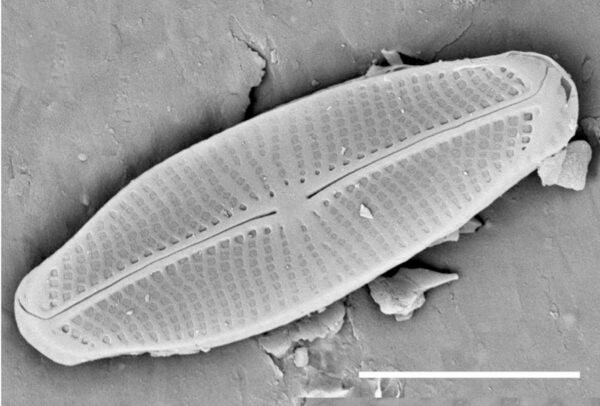
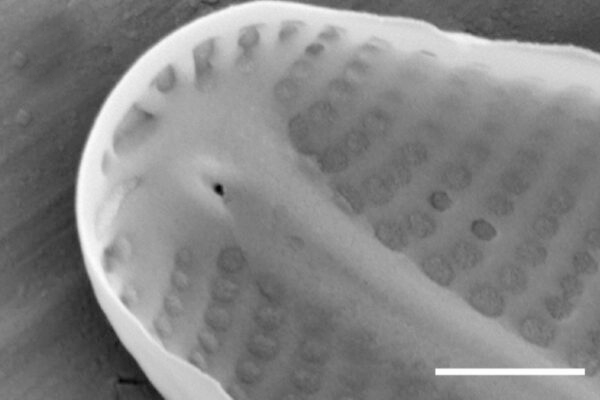
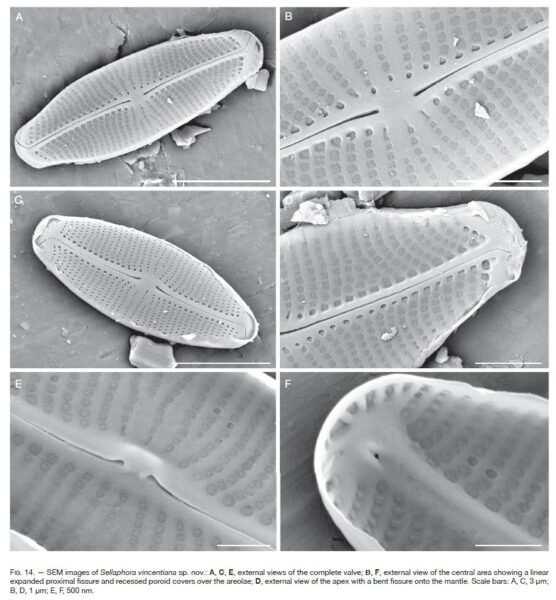
Frustules rectangular and narrow in girdle view. Valves linearelliptic to elliptic with restricted rostrate ends. Valve dimensions (n = 25): length 8-18.5 μm, width 2.5-4.5 μm. External valve face flat, margin rounded. The stria density is 49-51 in 10 μm. Axial area curved and narrow; external sternum raised. Central area weakly expanded, with 4-6 marginal striae between proximal raphe fissures, 1-2 striae shorter than the others (Fig. 14A-C). Raphe curved, with no kink-like irregularity halfway between mid-valve and apex; externally, central raphe fissures linearly expanded with rounded ends sometimes bent to primary side (Fig. 14B, C). Terminal raphe fissures bent down onto upper region of mantle, opening into a small circular depression (Fig. 14D). Internally, raphe on sternum, straight, with no kink-like irregularity. Proximal raphe fissures teardrop-shaped and positioned on raised central nodule (Fig. 14E); terminal fissures end on small helictoglossae, isolated from apex mantle (Fig. 14F). Striae more widely spaced around central area, and parallel throughout. Striae continuous, straight to weakly arched from valve face to mantle.
Voigt faults indistinct. Striae continuous around apices. Areolae round to rectangular, 8-10 per stria, 3-4 at apices (Fig. 14D). Areolae covered with a recessed fine poroid velum with circular rows of small and almost indistinct pores around outside edge and random distribution on inner area. Areolae along axial sternum more evidently depressed. Internally, areolae between virgae weakly recessed with volate pore cover.
The small linear to linear-elliptic shape with subrostrate to rostrate apices is a common shape of many species and genera which creates confusion in identifications. Furthermore, the high striae counts may create confusion between Adlafia, Eolimna and Sellaphora. As a result, taxonomic confusion persists today when trying to distinguish taxa within these genera. After SEM study, the morphology of these valves is clearly aligned with the genus Sellaphora, with recessed volate occlusion of the areolae, raised external axial and terminal areas, distinctly larger areolae along the axial area, and bent terminal raphe fissures down onto the mantle. A distinct asymmetric internal central nodule also helps to distinguish this taxon from Adlafia and Eolimna species. Sellaphora stauroneioides (Lange-Bertalot) Vesela & Johansen is comparable to Sellaphora vincentiana sp. nov., but is larger, with clear hyaline areas at the apices and is more linear than linear-elliptic. Electron microscopic comparisons are needed to distinguish these small Sellaphora species. In addition, Navicula arvensoides Hustedt and Sellaphora pseudoarvensis (Hustedt) Wetzel & Ector are small taxa with similar valve outlines, linear valve margins and distinct rostrate or subcapitate apices (Simonsen 1987; Table 3). With no SEM examination of these taxa, detailed comparisons are limited to LM which shows a triundulate valve margin with broad rostrate apices, and visible striae in N. arvensoides; in contrast, S. pseudoarvensis has linear valve margins, curved raphe branches, no visible striae and subcapitate apices.
Alibert, M. (2025). Sellaphora vincentiana. In Diatoms of North America. Retrieved October 22, 2026, from https://diatoms.org/species/345889/sellaphora-vincentiana
The 15 response plots show an environmental variable (x axis) against the relative abundance (y axis) of Sellaphora vincentiana from all the stream reaches where it was present. Note that the relative abundance scale is the same on each plot. Explanation of each environmental variable and units are as follows:
ELEVATION = stream reach elevation (meters)
STRAHLER = distribution plot of the Strahler Stream Order
SLOPE = stream reach gradient (degrees)
W1_HALL = an index that is a measure of streamside (riparian) human activity that ranges from 0 - 10, with a value of 0 indicating of minimal disturbance to a value of 10 indicating severe disturbance.
PHSTVL = pH measured in a sealed syringe sample (pH units)
log_COND = log concentration of specific conductivity (µS/cm)
log_PTL = log concentration of total phosphorus (µg/L)
log_NO3 = log concentration of nitrate (µeq/L)
log_DOC = log concentration of dissolved organic carbon (mg/L)
log_SIO2 = log concentration of silicon (mg/L)
log_NA = log concentration of sodium (µeq/L)
log_HCO3 = log concentration of the bicarbonate ion (µeq/L)
EMBED = percent of the stream substrate that is embedded by sand and fine sediment
log_TURBIDITY = log of turbidity, a measure of cloudiness of water, in nephelometric turbidity units (NTU).
DISTOT = an index of total human disturbance in the watershed that ranges from 1 - 100, with a value of 0 indicating of minimal disturbance to a value of 100 indicating severe disturbance.