
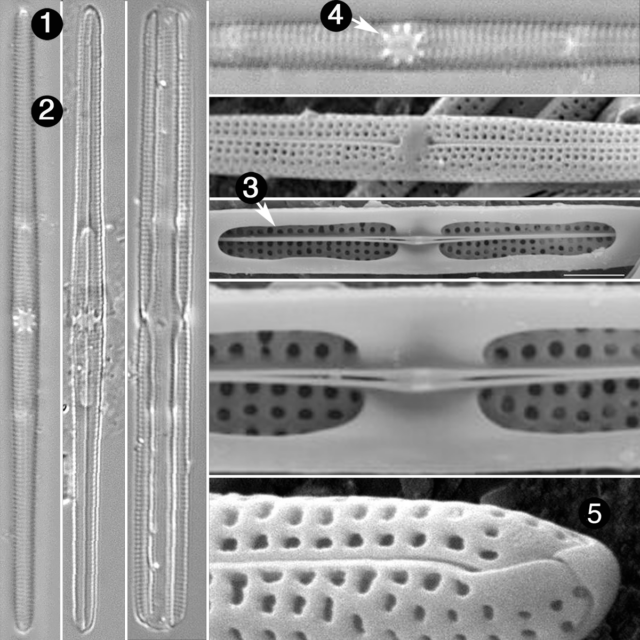











This species grows exclusively on the skin of West Indian manatees.
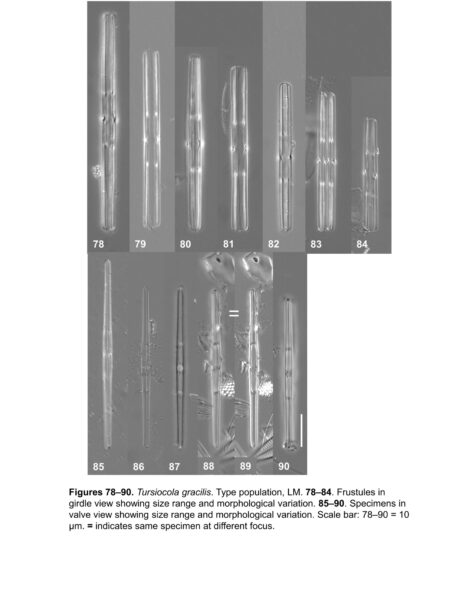
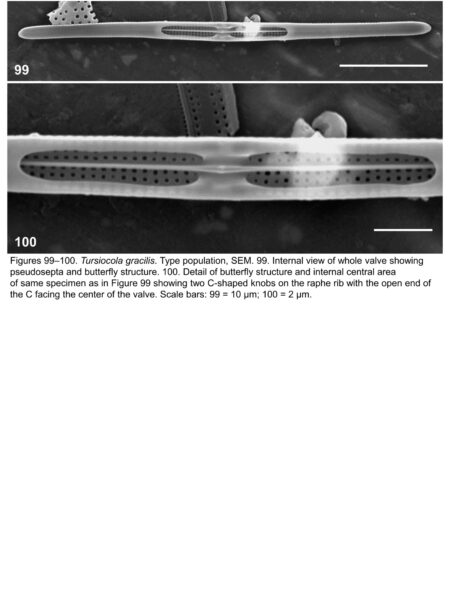
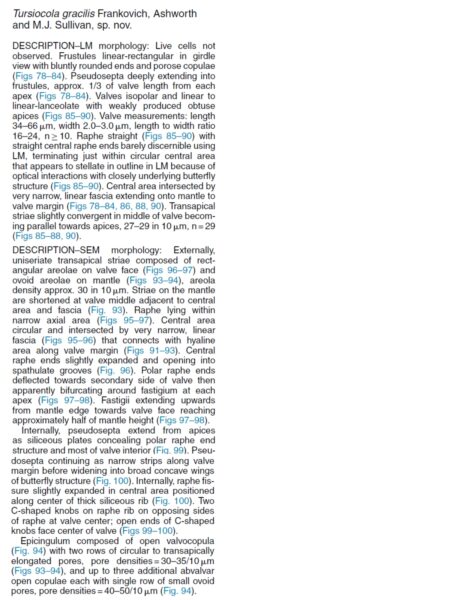
Frustules are linear-rectangular in girdle view, with a narrow cincture and porose copulae. Valves are linear to linear-lanceolate, with weakly produced obtuse apices. The raphe is straight, with straight proximal raphe ends. Proximal raphe ends terminate within a central area that appears stellate in outline in LM because of optical interactions with the closely underlying butterfly structure. The central area is intersected by a very narrow, linear stauros. Transapical striae are slightly convergent in the middle of the valve becoming parallel toward the apices. Pseudosepta extend deeply into the frustules for approximately 1/3 of the valve length from each apex.
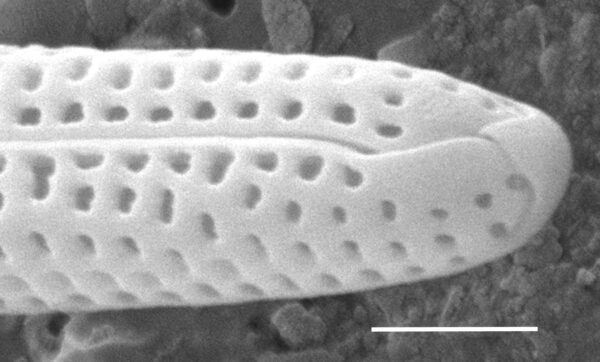
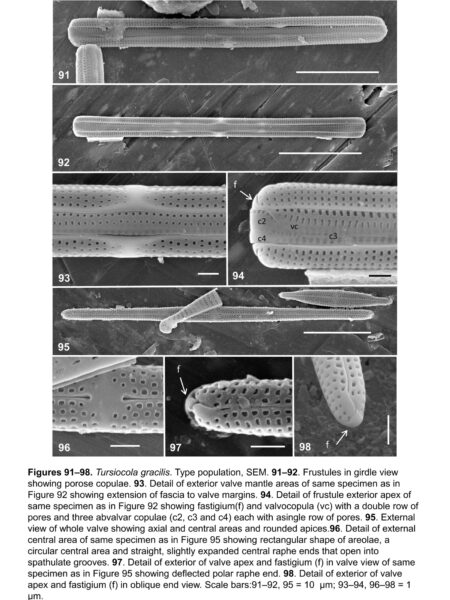
SEM: Externally, transapical striae are uniseriate. Proximal raphe ends are slightly expanded and open into spathulate grooves. Distal raphe ends are deflected toward the secondary side of the valve. Internally, pseudosepta extend from the apices concealing the distal raphe ends and most of the valve interior. Pseudosepta are narrow strips along the valve margin and widening at the butterfly-like structure. Internally, the raphe fissure is slightly expanded in the central area and is positioned along the center of a raphe rib. Two C-shaped knobs are present on the raphe rib on opposing sides of the raphe at the valve center.
This taxon occurs epizoically on the skin of West Indian manatees. Live cells have yet to be observed.
Frankovich, T. (2026). Tursiocola gracilis. In Diatoms of North America. Retrieved October 17, 2026, from https://diatoms.org/species/351133/tursiocola-gracilis?x-craft-preview=cab8b13ef68d1e257235fd2491770f51dfe0c9a6c0ad3b95411776e5316d603alxhbyabypv
The 15 response plots show an environmental variable (x axis) against the relative abundance (y axis) of Tursiocola gracilis from all the stream reaches where it was present. Note that the relative abundance scale is the same on each plot. Explanation of each environmental variable and units are as follows:
ELEVATION = stream reach elevation (meters)
STRAHLER = distribution plot of the Strahler Stream Order
SLOPE = stream reach gradient (degrees)
W1_HALL = an index that is a measure of streamside (riparian) human activity that ranges from 0 - 10, with a value of 0 indicating of minimal disturbance to a value of 10 indicating severe disturbance.
PHSTVL = pH measured in a sealed syringe sample (pH units)
log_COND = log concentration of specific conductivity (µS/cm)
log_PTL = log concentration of total phosphorus (µg/L)
log_NO3 = log concentration of nitrate (µeq/L)
log_DOC = log concentration of dissolved organic carbon (mg/L)
log_SIO2 = log concentration of silicon (mg/L)
log_NA = log concentration of sodium (µeq/L)
log_HCO3 = log concentration of the bicarbonate ion (µeq/L)
EMBED = percent of the stream substrate that is embedded by sand and fine sediment
log_TURBIDITY = log of turbidity, a measure of cloudiness of water, in nephelometric turbidity units (NTU).
DISTOT = an index of total human disturbance in the watershed that ranges from 1 - 100, with a value of 0 indicating of minimal disturbance to a value of 100 indicating severe disturbance.