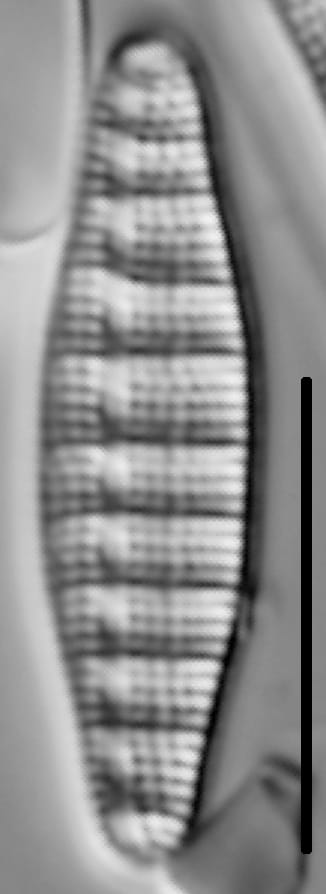
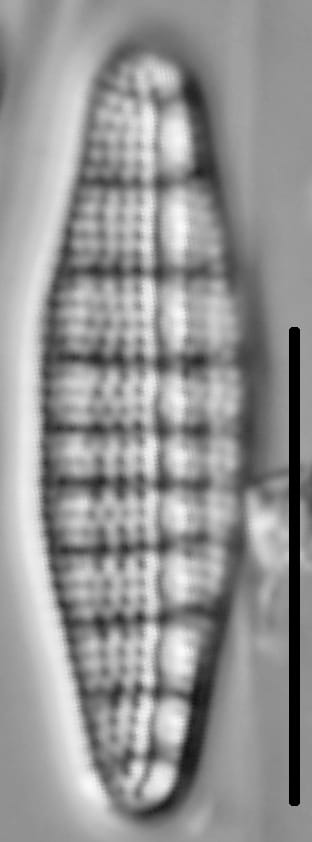
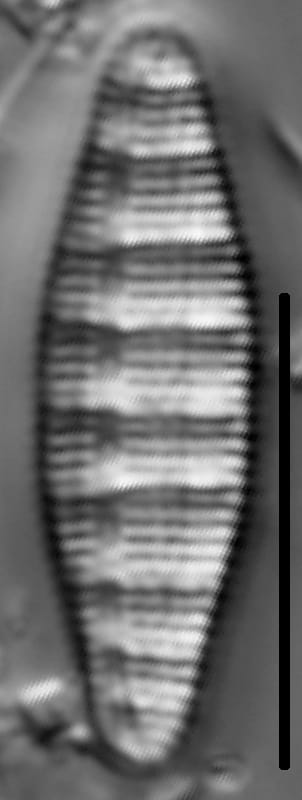
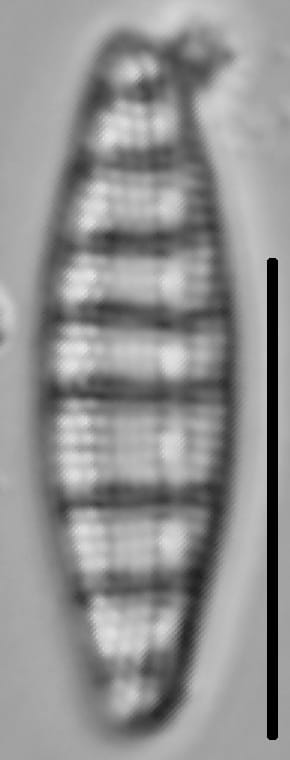
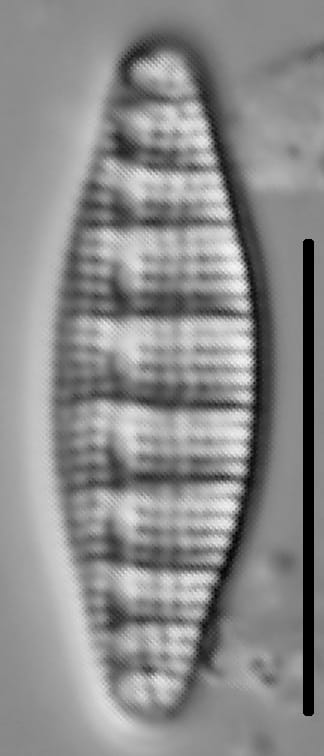
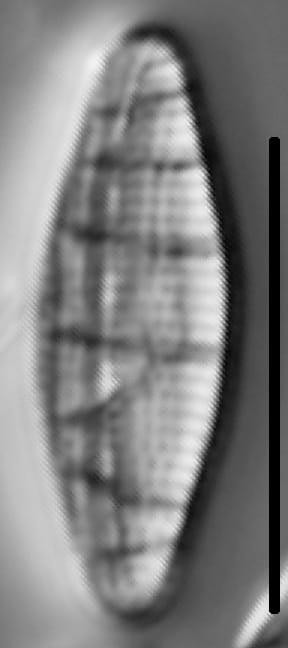
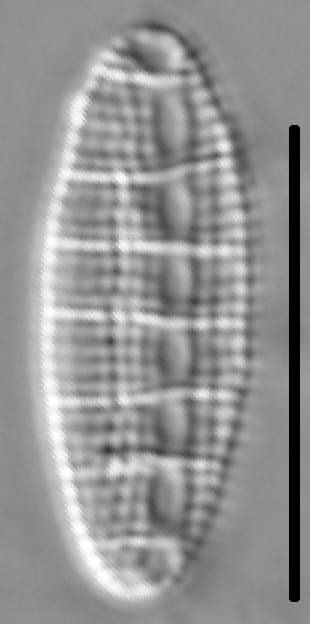
Valves are lanceolate to elliptical-lanceolate, with protracted apices. The raphe is distinct, positioned off center and contained within a canal. Transapical costae are distinct. The striae are punctate. Included in this concept is D. tenuis var. crassula (Naeg. ex Kützing) W. & G.S. West, which appears to represent valves at the lower size range of D. tenuis.
Specimens we have encountered occupy a narrow size range. Patrick and Reimer (1966) give the size range as 6-60 µm long, 3-7 µm broad. Found in alkaline waters across the United States.
This taxon has been reported with light micrographs from the Canadian Arctic Archipelago (Antoniades et al. 2008), Rocky Mountains, Great Plains, Great Basin, and California Central Valley (Bahls 2023).
In the Great Lakes National Parks (Edlund et al. 2009, 2011, 2012, 2013), this taxon is uncommon (1-5% abundance) to rare (0.1-1% abundance) at Sleeping Bear Dunes (Bass Lake) and Apostle Islands (Outer Lake).
This taxon is known to occur in rivers creeks lakes and springs with cool alkaline water of moderate conductivity and nutrient content (Bahls 2023)
Several research groups consider this taxon an indicator organism and published regional environmental optima and tolerances including:
Antoniades et al. (2008): pH - 8.2, Tolerance Range - 7.7-8.6, Conductivity - 138 µS/cm, Tolerance Range - 65-293 µS/cm, Dissolved Organic Carbon - 4.73 mg/L, Tolerance Range - 2.82-7.93 µS/cm for populations from the Canadian Arctic Archipelago.
Bahls (2023): Conductivity - 255 µS/cm, pH - 8.0, Temperature - 14.1°C, Total Nitrogen - 0.34 mg/L, Total Phosphorus - 20 µg/L for populations from Western North America.


From 2011 until 2026, the autecological information on this taxon page was limited. As of this update, information on ecology, biogeography, and environmental optima have been added. - Lane Allen and Mark Edlund
Kociolek, P., Edlund, M., Allen, L. (2011). Denticula tenuis. In Diatoms of North America. Retrieved October 11, 2026, from https://diatoms.org/species/46054/denticula_tenuis
The 15 response plots show an environmental variable (x axis) against the relative abundance (y axis) of Denticula tenuis from all the stream reaches where it was present. Note that the relative abundance scale is the same on each plot. Explanation of each environmental variable and units are as follows:
ELEVATION = stream reach elevation (meters)
STRAHLER = distribution plot of the Strahler Stream Order
SLOPE = stream reach gradient (degrees)
W1_HALL = an index that is a measure of streamside (riparian) human activity that ranges from 0 - 10, with a value of 0 indicating of minimal disturbance to a value of 10 indicating severe disturbance.
PHSTVL = pH measured in a sealed syringe sample (pH units)
log_COND = log concentration of specific conductivity (µS/cm)
log_PTL = log concentration of total phosphorus (µg/L)
log_NO3 = log concentration of nitrate (µeq/L)
log_DOC = log concentration of dissolved organic carbon (mg/L)
log_SIO2 = log concentration of silicon (mg/L)
log_NA = log concentration of sodium (µeq/L)
log_HCO3 = log concentration of the bicarbonate ion (µeq/L)
EMBED = percent of the stream substrate that is embedded by sand and fine sediment
log_TURBIDITY = log of turbidity, a measure of cloudiness of water, in nephelometric turbidity units (NTU).
DISTOT = an index of total human disturbance in the watershed that ranges from 1 - 100, with a value of 0 indicating of minimal disturbance to a value of 100 indicating severe disturbance.