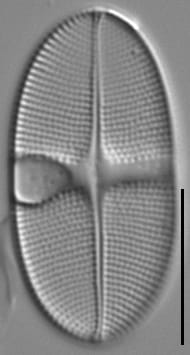
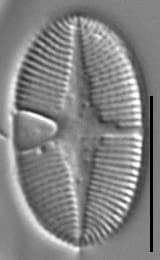
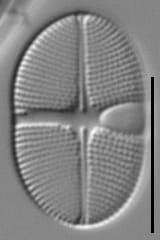
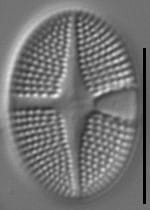
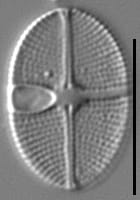
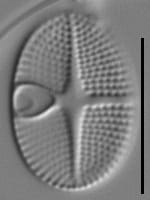
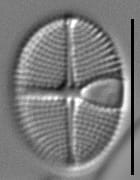
Valves are elliptic, although they may be slightly constricted in the center. The axial area is narrow and linear on the raphe valve; the axial area is narrow and rhomboid on the rapheless valve. The central area on both valves is asymmetric, expanded to valve margins and contains a cavum. The raphe is straight with sigmoid terminal fissures. The striae are fine, uniseriate and radiate throughout both valves.
This taxon has been reported with light micrographs from Alaska (Foged 1981), northwestern Québec (Fallu et al. 2000), Rocky Mountains and Cascades (Bahls 2021).
In the Great Lakes National Parks (Edlund et al. 2009, 2011, 2012, 2013), this taxon is rare (0.1-1% abundance) at Pictured Rocks (Beaver Lake) and Isle Royale (Richie Lake).
This taxon is reported to occur in mountain lakes and streams with cold, alkaline water of very low conductivity and nutrient content (Bahls 2021).
Several research groups consider this taxon an indicator organism and published regional environmental optima and tolerances including:
Bahls (2021): Conductivity - 61 µS/cm, pH - 7.5, Temperature - 9.7°C, Total Nitrogen - 0.17 mg/L, Total Phosphorus - 9 µg/L for populations from the Rocky Mountains and Cascades.
A. Calcar Cl. - Upper valve broadly elliptic, 0,012 m. m. in length and 0,009 m. m. in breadth, with about 24 striae in 0,01 m. m. It carries on the one side a horseshoe-like thickening, which is prolonged on the other half of the valve into a spur-like projection. The lower valve is not known with certainty, but in the same gathering, in which this species has been found, occurs a valve of similar outline and size, the striæ of which reach the raphe and are 25 in 0,01 m. m. That valve, which has a great resemblance to Diadesmis lucidula Grun. (V. H. XIV, 40) may possibly be the lower valve of A. Calcar. Pl. III, fig. 8, (9 ?). Ab. 45, 47.


The taxon, Planothidium calcar Edlund in Edlund, Soninkhishig, Williams and Stoermer 2001 appeared on this page. (Note that the citation missed attribution to Cleve). As of this date, the name and authorshop is shown as Gliwiczia calcar (Cleve) Kulikovskiy, Lange-Bertalot and Witkowski. - S. Spaulding
From 2011 until 2026, the autecological information on this taxon page was limited. As of this update, information on ecology, biogeography, and environmental optima have been added. - Lane Allen and Mark Edlund
Potapova, M., Edlund, M., Allen, L. (2011). Gliwiczia calcar. In Diatoms of North America. Retrieved October 14, 2026, from https://diatoms.org/species/47131/gliwiczia_calcar
The 15 response plots show an environmental variable (x axis) against the relative abundance (y axis) of Gliwiczia calcar from all the stream reaches where it was present. Note that the relative abundance scale is the same on each plot. Explanation of each environmental variable and units are as follows:
ELEVATION = stream reach elevation (meters)
STRAHLER = distribution plot of the Strahler Stream Order
SLOPE = stream reach gradient (degrees)
W1_HALL = an index that is a measure of streamside (riparian) human activity that ranges from 0 - 10, with a value of 0 indicating of minimal disturbance to a value of 10 indicating severe disturbance.
PHSTVL = pH measured in a sealed syringe sample (pH units)
log_COND = log concentration of specific conductivity (µS/cm)
log_PTL = log concentration of total phosphorus (µg/L)
log_NO3 = log concentration of nitrate (µeq/L)
log_DOC = log concentration of dissolved organic carbon (mg/L)
log_SIO2 = log concentration of silicon (mg/L)
log_NA = log concentration of sodium (µeq/L)
log_HCO3 = log concentration of the bicarbonate ion (µeq/L)
EMBED = percent of the stream substrate that is embedded by sand and fine sediment
log_TURBIDITY = log of turbidity, a measure of cloudiness of water, in nephelometric turbidity units (NTU).
DISTOT = an index of total human disturbance in the watershed that ranges from 1 - 100, with a value of 0 indicating of minimal disturbance to a value of 100 indicating severe disturbance.