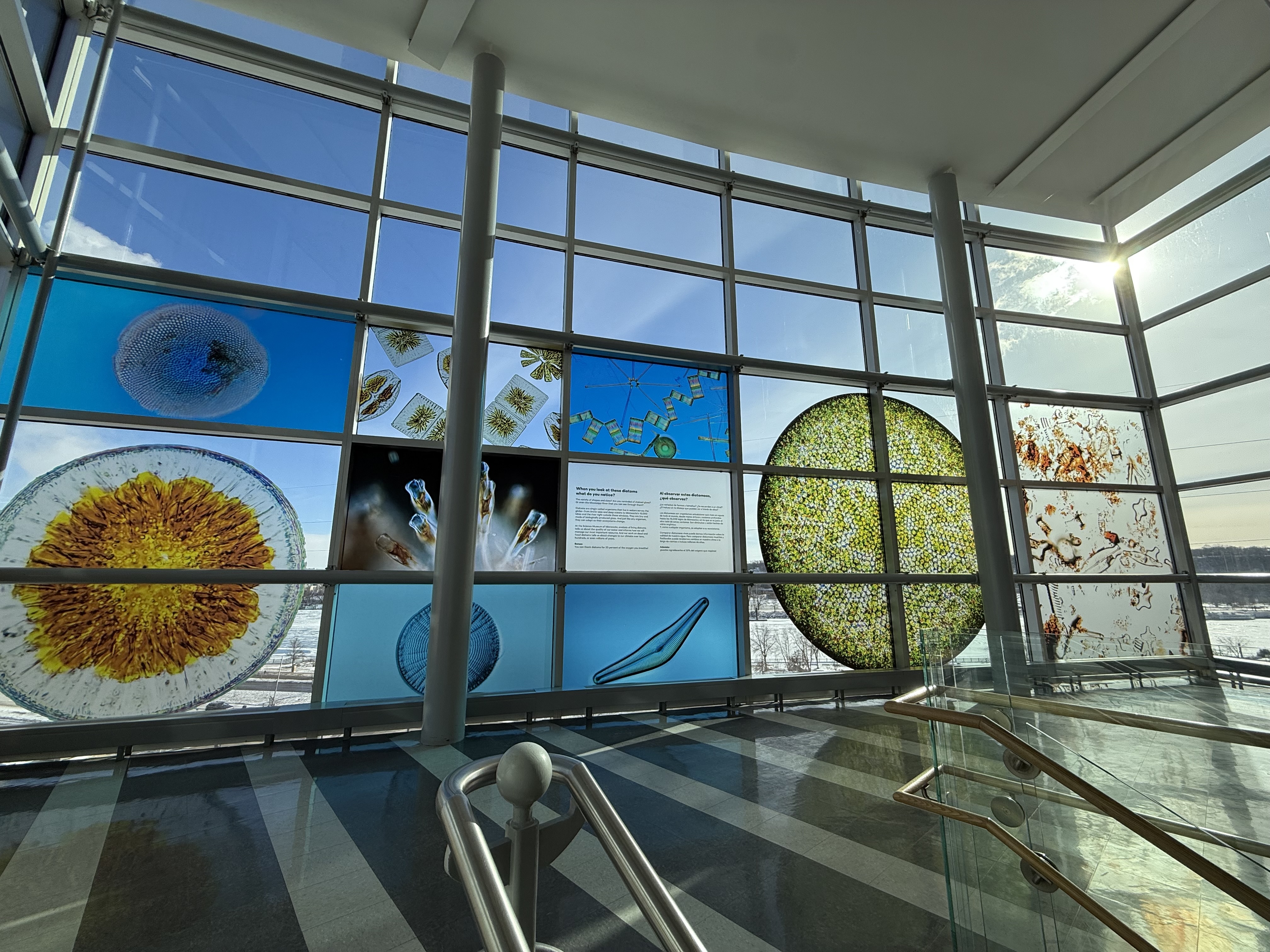
Diatoms of North America
At the Science Museum of Minnesota, microscopic diatoms have long played an outsized role in advancing the museum’s mission to inspire learning, improve lives, and inform policy. Now, they have become outsized in a more literal sense.
Diatoms—microscopic algae encased in intricately ornamented, biologically produced silica cell walls—are invisible to the naked eye. Yet despite their size, they are among the most powerful tools available for understanding aquatic ecosystems. As bioindicators, diatoms provide detailed snapshots of water quality through routine monitoring. As fossils preserved in lake sediments, they allow scientists to reconstruct environmental history through paleolimnology, revealing how lakes have changed over centuries.
In Minnesota, diatom research has directly informed public policy. Nutrient standards for lakes—including phosphorus thresholds—were established by comparing modern diatom communities with those preserved in mid-1800s sediments. These science-based benchmarks help protect water quality across the state and demonstrate how microscopic organisms can shape decisions that affect millions of people.
A stairwell transformed by diatoms
A striking new installation fills the stairwell connecting the museum’s three gallery floors with a montage spanning 18 window panes. The display features both living and fossil diatoms rendered at extraordinary scale. Illuminated by transmitted light, the installation evokes the experience of looking through a microscope—only on an architectural scale. The images include Miocene fossil assemblages, plankton burn mounts, sediment samples, and live Didymosphenia geminata (“didymo”), the nuisance non-native species affecting streams in Minnesota and beyond. The largest image—a living Coscinodiscus cell—is magnified approximately 37,000 times, expanding the microscopic organism to nearly 12 feet in diameter. Visitors ascending or descending the stairwell encounter diatoms as immersive works of art while still seeing beyond them to the flowing Mississippi River. The juxtaposition is intentional: the same organisms magnified in glass and light are also drifting in the river outside the museum walls.
From influencing nutrient policy to transforming architectural space, diatoms at the Science Museum of Minnesota continue to demonstrate that even the smallest organisms can have enormous impact.