Diatoms of North America
The Provasoli-Guillard National Center for Marine Algae and Microbiota (NCMA) is planning to offer the 10th U.S. training course on the identification of harmful algae in the U.S. marine waters during August 2026. Dates for the 2026 course are August 9th - 21st (inclusive of travel days).
The course will be held at the Bigelow Laboratory for Ocean Sciences Research and Education campus in East Boothbay, ME. The course is designed for current local, state tribal, and federal government employees and academics involved in all aspects of harmful algal bloom (HAB) monitoring, research, and management. The course is a tuition-based course. The tuition for this year’s course is $3,750 per student and includes course materials, housing in the Shimmield Residence Hall, and meals (breakfast, lunch, and several dinners where evening activities are planned) but not travel. The application process is fully competitive and not all applicants may be selected to participate.
Background and Course Content:
Harmful Algal Blooms (HABs) have negative impacts on human and environmental health and result in significant economic losses and are thus monitored and managed by local, state and federal agencies and studied by academic researchers. Regardless of the stakeholder agency all have a common need for accurate and timely identification of HAB related organisms to the species level.
The classic ‘gold-standard’ method of HAB detection is microscopic examination for HA species based on morphological characters. However, there is an increasing need for comprehensive training in HAB identification for U.S. HAB managers, scientists and technicians due to the following:
- rapidly expanding HAB taxonomy field
- retirement of many ‘classical’ taxonomists
- lack of dedicated U. S. HAB taxonomic training programs
- increased use of more rapid, but less direct non-traditional (i.e. optical, molecular and hybrid) methods of HAB identification
With the goal of developing and teaching a certified, recurring, and classical harmful algae taxonomy and identification course, instructors will provide the theoretical and hands-on training needed to effectively and accurately identify HAB Species. The course will draw upon the recognized scientific and teaching expertise of the established taxonomists involved.
The program will consist of pre-course preparatory reading material and a 10-day course which will cover the following topics:
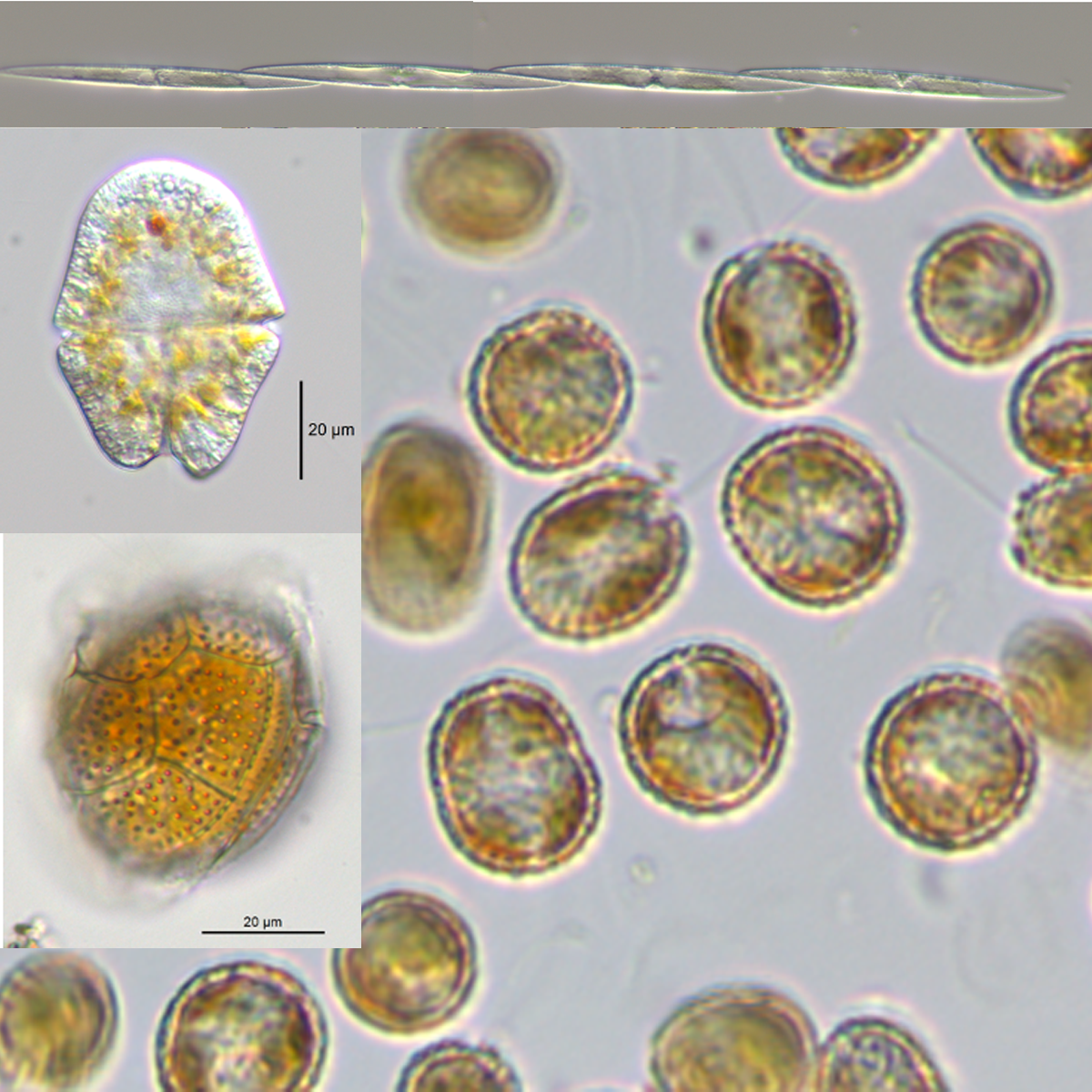
- identifying Bacillariophyceae, Dinophyceae, Prymnesiophyceae, Raphidophyceae, and Dictyochophyceae
- collection techniques
- statistical considerations
- specialized lectures on newer HAB identification and quantification methodologies
Course content will consist of:
- training material handouts
- lectures
- hands on demonstrations with live and preserved species
- demonstrations of methods for collection
- treatment of samples
- enumeration
- culturing techniques
Once you have taken the course you will have access to the course website where all of the course information can be found.
Many harmful algae species are either in the Provasoli-Guillard National Center for Marine Algae and Microbiota or available from the instructors. Over 60 HAB species will be demonstrated with many morphologically similar species for comparison and differentiation. Harmful algae species will include only those found in US marine waters. Certificates of proficiency will be provided for successful completion of the course and final examination. Students will be encouraged to continue their learning and ongoing networking between fellow students and Instructors facilitated through a course dedicated listserve.
Application Process:
Those interested in applying should click on the link below to complete the application form. The submission deadline is 1st May of the year of the course. Applicants will be notified by the end of May on the status of their application. Any further application/notification dates will be posted soon.
INSTRUCTORS
Thomas Frankovich, PhD, Florida International University
Michael Parsons, Professor, Florida Gulf Coast University
Ian Probert, PhD, Station Biologique de Roscoff
Peter Countway, PhD, Bigelow Laboratory for Ocean Sciences
Mike Lomas, PhD, Director of the National Center for Marine Algae and Microbiota (NCMA) at Bigelow Laboratory