Diatoms of North America
The slow-burning fuse of diatom evolution yields a new, natural classification for the group
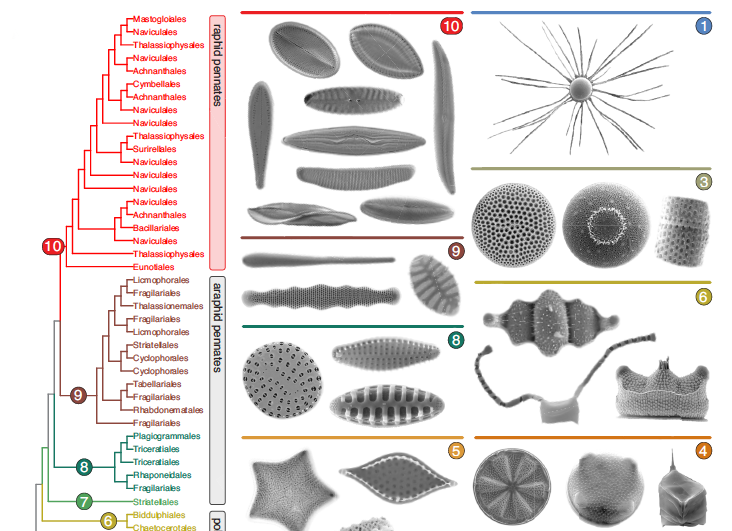
Description: For nearly two centuries, taxonomic classifications of diatoms have been based on interpretations of their feature-rich, silica cell walls. These classifications, in turn, have been used to make broad inferences about diatom ecology and evolution, but decades of molecular phylogenetic research have shown that historical and contemporary classification systems do not reflect evolutionary history, severely limiting their utility and insights. We combined fossil information with newly sequenced transcriptomes from 181 diverse diatom species to reconstruct the pattern, timing, and genomic context of major evolutionary transitions. Diatoms originated 270 Mya, and after >100 My of relative stasis in morphology and ecology, a radiation near the Jurassic–Cretaceous boundary led to the diversity of habitats and cell wall architectures characteristic of modern diatoms. The strongly supported relationships provided a framework for establishing a phylogenetic classification diatoms, in which only monophyletic groups were named. The classification is comprehensive, dividing 431 genera among 68 families, 44 orders, and 10 classes. Among these, 7 classes, 13 orders, 3 families and one genus are proposed as new. Although the new classification includes many areas of overlap with previous systems, one principal departure is the increased number of classes, which reflects that “centric” and “araphid” diatoms are comprised of multiple lineages recognized here as distinct classes. By providing a more accurate representation of phylogenetic relationships, the proposed classification facilitates clearer communication about all aspects of diatom biology.
Target Audience: This seminar is directed at more of a scientific audience than many of the seminars. It represents a major contribution to understanding of diatom evolution, so is important to practitioners across levels of expertise.