Diatoms of North America
For over 50 years, Iowa Lakeside Lab, the University of Iowa and Iowa State University’s biological field station, had offered a class unique in the world. Ecology and Systematics of Diatoms had been taught annually from 1963 to 2019, but even the diatoms couldn’t predict the fallout from the covid pandemic. Diatoms are one group of microscopic algae that are characterized by having a cell well made of biologically produced glass. While microscopic, diatoms are super important. Their photosynthesis accounts for nearly 25% of the oxygen production on earth—that’s one out of every four breaths we take!—and they form the base of our aquatic food webs that support our beautiful lakes. They also are an important monitoring tool for understanding the condition of our lakes and streams. That’s why a specialty class exists at Lakeside!
Like so many things, class was cancelled in 2020, and in 2021, with the world slowly emerging from shutdowns and masking, a tough decision was made. Ecology and Systematics of Diatoms was offered as a virtual four-week class taught by Dr Sylvia Lee. Ten students, from undergraduates to tenured professors, from California to Vermont to Ireland and the Phillipines, signed up to hear multiple lectures each day, and work on assigned readings, exercises, and personal projects (Fig. 1). In the midst of covid, the diatoms were still speaking to the students. There was learning to be done, even if students couldn’t spend their days at Lakeside Lab.
Following a guest lecture on the life history of diatoms by Dr Mark Edlund, one student reached out with a problem: some of her diatom cultures looked weird. Heidi Abresch, a PhD student at the University of Montana, was culturing diatoms in the genus Epithemia to better understand the relationship between their endosymbiontic cyanobacteria and nitrogen dynamics.
“Endosymbiotic and nitrogen dynamics”—What does that mean? The diatom group that contains Epithemia is very special. They contain a special friend inside their cells called a “sphaeroid body”, which is an endosymbiotic (endo=inside, symbiotic=shared life) blue-green alga or cyanobacterium. The blue-green bacteria gets a nice, safe place to live, but what make it so special is that, only with the sphaeroid body can Epithemia cells fix nitrogen. They absorb atmospheric nitrogen, or N2, and convert it to ammonia to feed biological processes. That is the same process that legumes use—by having N-fixing bacteria in their root nodules—to enhances nitrogen in soils following crop rotation. Like so many other non-legume plants, all the other diatoms in the world can’t do N-fixation either, giving Epithemia species a huge competitive advantage when nitrogen is scarce.
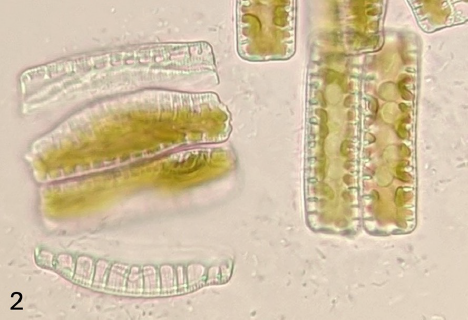
What Abresch saw in her cultures just looked weird. In addition to lots of cells with normal yellow-brown cell contents and sphaeroid bodies surrounded by their two glass cell wall halves—typical Epithemia cells (Fig. 2, right)—others had strange extra valves inside the cells, or empty cells, or cells with extra cell walls (Fig. 2, left).
Edlund had noted in his lecture some strange twists in the diatom life cycle that rang a bell with Abresch. Her cultures were undergoing a process called internal valve formation, which is a cellular response by some diatoms when things start going poorly. Cells are essentially setting themselves up to go to sleep for awhile until environmental conditions get nice again.
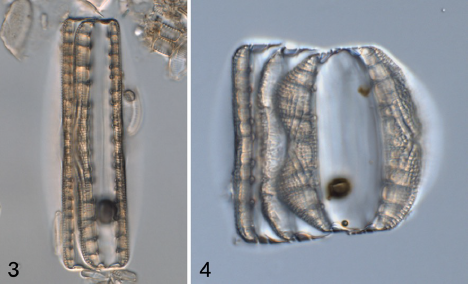
The process of internal valve formation was understood by the 1920s in a handful of species, but had never been noted in the species that Abresch was studying. What Abresch’s data showed, along with consulting some older reports and new records of internal valve formation in Edlund’s museum collections (Figs 3, 4) from Minnesota to Mongolia, was that internal valve formation was exceptionally common in this Epithemia-group of diatoms, a group that is currently the subject of extensive research given its keen ability to fix nitrogen. In fact, their recent paper in the journal Fottea suggests internal valve formation is a potential defining character of this important group. In addition to having N-fixing abilities, they have also developed a special ability to survive tough times.
So when the going gets tough for diatoms, this group is specialized and ready to undergo internal valve formation. And when the going got tough at Lakeside, our students figured out how to learn diatoms even in the midst of a global pandemic.