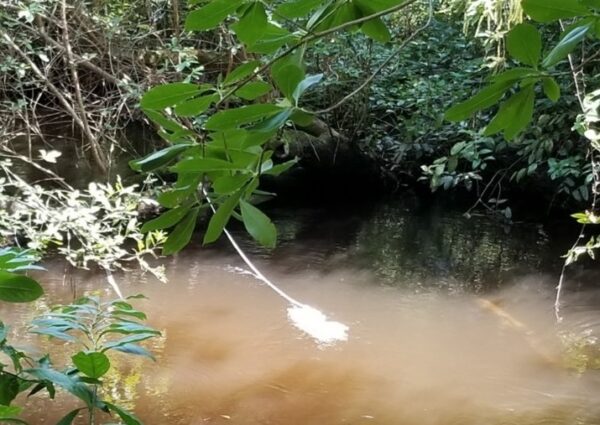
Credit: KM Johnson

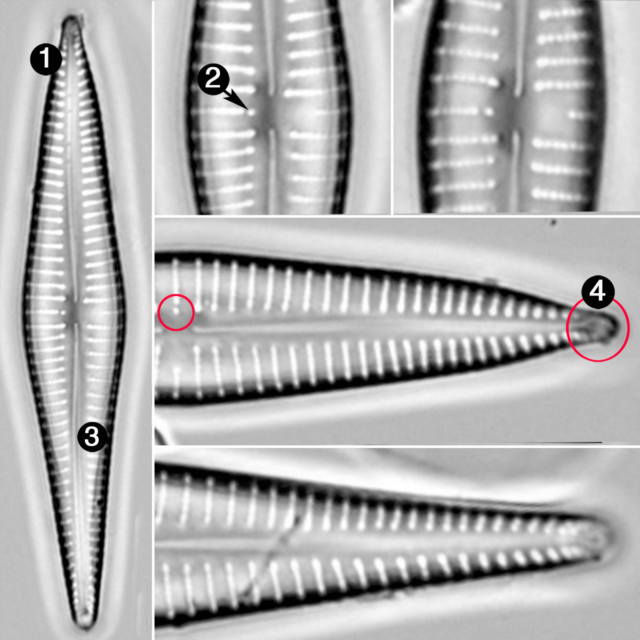
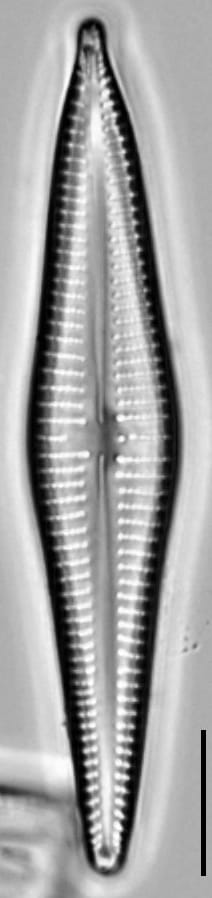
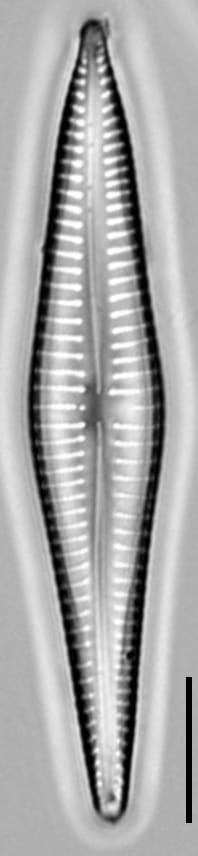
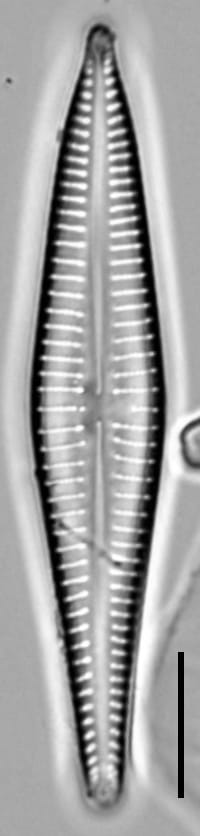
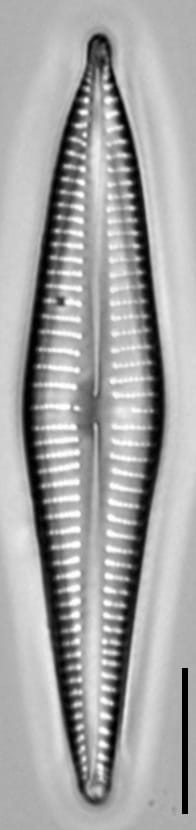
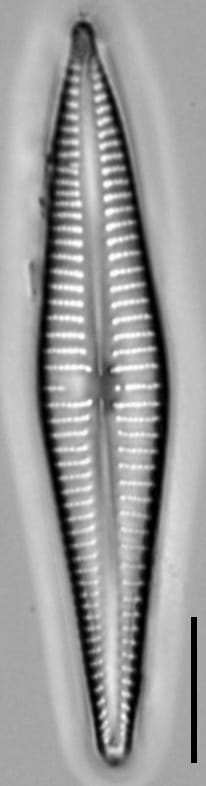
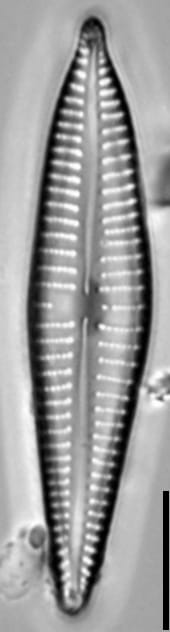
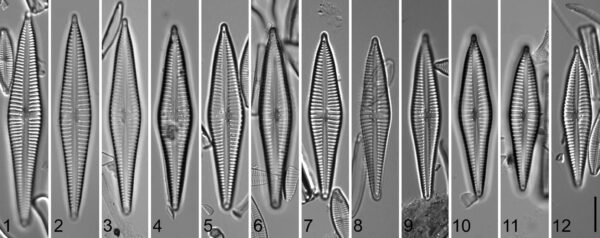
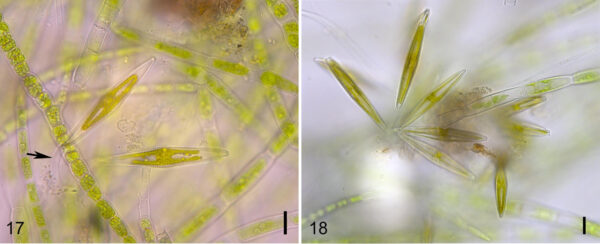
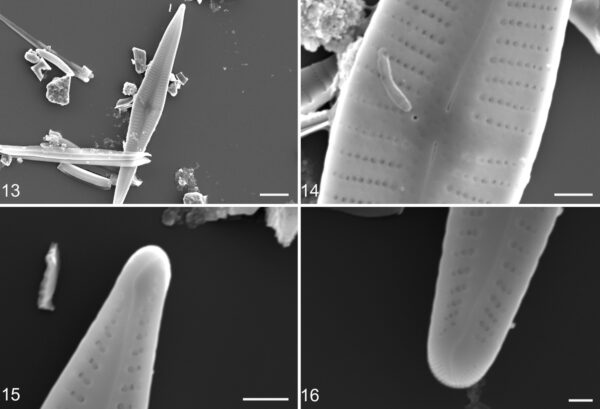
Valves are rhombic, widest at the center, and heteropolar. Near the apex, the valve margin is somewhat undulate. The terminus of the apex is distinctly tapered. The footpole is somewhat wedge-shaped to sharply rounded. The axial area is narrow and almost linear. The axial area is widest at the center and becomes more narrow near the apices. The central area is narrow to moderate and somewhat rectangular. The central area is wider on the secondary valve side and the stigmoid is near the end of a somewhat “off-center” shortened median stria. The raphe is lateral. In SEM, the proximal raphe ends are somewhat expanded. Terminal raphe fissures are long. Striae are parallel and radiate slightly near the apices, but variable around the central area. Striae are uniseriate with punctate areolae. Areolae are barely visible in LM. In SEM, areolae are variably round and elongated with sometimes overlapping occlusions around them. Areola density is 15–25 in 10 μm. Cells are wedge-shaped in girdle view, with a narrow footpole. Living cells have a single H-shaped chloroplast.
In the past, this species has been reported as G. gracile. Live G. marriae cells have notably shorter branching length, differ in chloroplast structure, and have a more elongated wedge shape than the original illustration of G. gracile. This taxon could be considered within the highly variable Gomphonema gracile species complex (Krammer and Lange-Bertalot 2004). In 2015, Reichardt examined Ehrenberg's material. He reported that the Gomphonema gracile of later authors (Patrick and Reimer 1975, Krammer and Lange-Bertalot 2004) did not align with Ehrenberg's type material. To date, several taxa that had been included within Gomphonema gracile sensu lato
have been described as distinct species. Two of these species have been reported in
North America: Gomphonema graciledictum E.Reichardt 2015 and Gomphonema acidoclinatum Lange-Bertalot and E.Reichardt 2004.
Others have not been reported from North America: Gomphonema stagnorum E.Reichardt 2015, Gomphonema disgracile E.Reichardt 2015, Gomphonema campodunense E.Reichardt 2015.
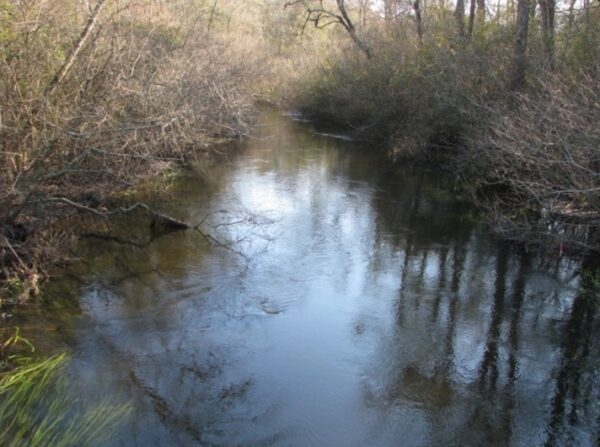
This species was observed in Upper Three Runs Creek (UTRC), a headwater stream to the Savannah River in South Carolina. G. marriae forms mucilage stalks and was collected while growing in epiphytic mats of Stigeoclonium sp. The UTRC population was observed in acidic environment with a pH from 4.2-5.3. UTRC is high in tannic acid and, typical of many southeastern streams, has a silty and sandy bottom. G. marriae has also been observed in other South Carolina freshwater ponds and wetlands with an abundance-weighted mean water depth optimum of 28 cm and pH optimum of 5.2 (Gaiser and Johansen 2000). The authors considered this species uncommon, but is often associated with Encyonema silesiacum (Bleisch) D.G.Mann. In the UTRC samples, this species was not rare.
This taxon could be considered within the highly variable Gomphonema gracile species complex (Krammer and Lange-Bertalot 2004). In 2015, Reichardt examined Ehrenberg's material for Gomphonema and reported that concepts of Gomphonema gracile of later authors (Patrick and Reimer 1975, Krammer and Lange-Bertalot 2004) did not align with Ehrenberg's type material. Taxa that had been included within Gomphonema gracile sensu lato have been described as distinct species, including: Gomphonema graciledictum E.Reichardt 2015, Gomphonema stagnorum E.Reichardt 2015, Gomphonema acidoclinatum Lange-Bertalot & E.Reichardt 2004, Gomphonema disgracile E.Reichardt 2015, Gomphonema campodunense E.Reichardt 2015.
Images below show the Upper Three Runs Creek site during a study over two seasons where G. marriae was collected (Johnson et al. 2023).
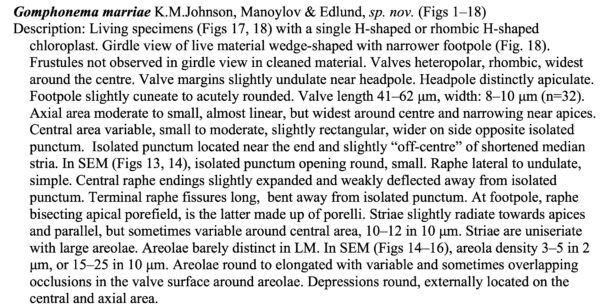
Living specimens (Figs 17, 18) with a single H-shaped or rhombic H-shaped chloroplast. Girdle view of live material wedge-shaped with narrower footpole (Fig. 18). Frustules not observed in girdle view in cleaned material. Valves heteropolar, rhombic, widest around the centre. Valve margins slightly undulate near headpole. Headpole distinctly apiculate. Footpole slightly cuneate to acutely rounded. Valve length 41–62 μm, width: 8–10 μm (n=32). Axial area moderate to small, almost linear, but widest around centre and narrowing near apices. Central area variable, small to moderate, slightly rectangular, wider on side opposite isolated punctum. Isolated punctum located near the end and slightly “off-centre” of shortened median stria. In SEM (Figs 13, 14), isolated punctum opening round, small. Raphe lateral to undulate, simple. Central raphe endings slightly expanded and weakly deflected away from isolated punctum. Terminal raphe fissures long, bent away from isolated punctum. At footpole, raphe bisecting apical porefield, is the latter made up of porelli. Striae slightly radiate towards apices and parallel, but sometimes variable around central area, 10–12 in 10 μm. Striae are uniseriate with large areolae. Areolae barely distinct in LM. In SEM (Figs 14–16), areola density 3–5 in 2 μm, or 15–25 in 10 μm. Areolae round to elongated with variable and sometimes overlapping occlusions in the valve surface around areolae. Depressions round, externally located on the central and axial area.
Johnson, K. (2024). Gomphonema marriae. In Diatoms of North America. Retrieved October 10, 2026, from https://diatoms.org/species/324103/gomphonema-marriae
The 15 response plots show an environmental variable (x axis) against the relative abundance (y axis) of Gomphonema marriae from all the stream reaches where it was present. Note that the relative abundance scale is the same on each plot. Explanation of each environmental variable and units are as follows:
ELEVATION = stream reach elevation (meters)
STRAHLER = distribution plot of the Strahler Stream Order
SLOPE = stream reach gradient (degrees)
W1_HALL = an index that is a measure of streamside (riparian) human activity that ranges from 0 - 10, with a value of 0 indicating of minimal disturbance to a value of 10 indicating severe disturbance.
PHSTVL = pH measured in a sealed syringe sample (pH units)
log_COND = log concentration of specific conductivity (µS/cm)
log_PTL = log concentration of total phosphorus (µg/L)
log_NO3 = log concentration of nitrate (µeq/L)
log_DOC = log concentration of dissolved organic carbon (mg/L)
log_SIO2 = log concentration of silicon (mg/L)
log_NA = log concentration of sodium (µeq/L)
log_HCO3 = log concentration of the bicarbonate ion (µeq/L)
EMBED = percent of the stream substrate that is embedded by sand and fine sediment
log_TURBIDITY = log of turbidity, a measure of cloudiness of water, in nephelometric turbidity units (NTU).
DISTOT = an index of total human disturbance in the watershed that ranges from 1 - 100, with a value of 0 indicating of minimal disturbance to a value of 100 indicating severe disturbance.