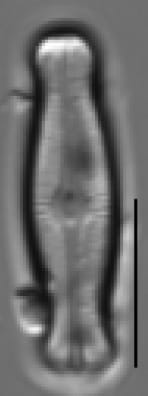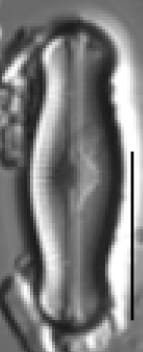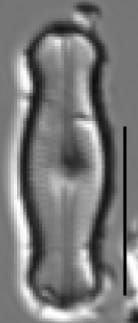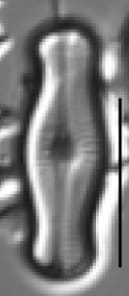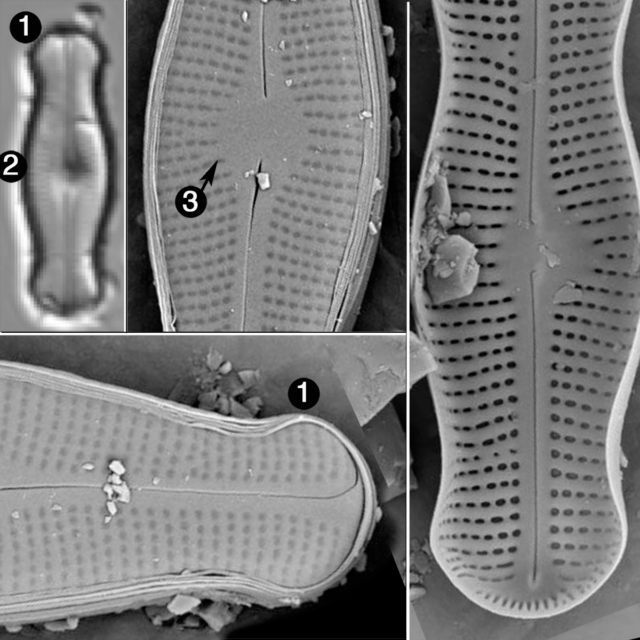
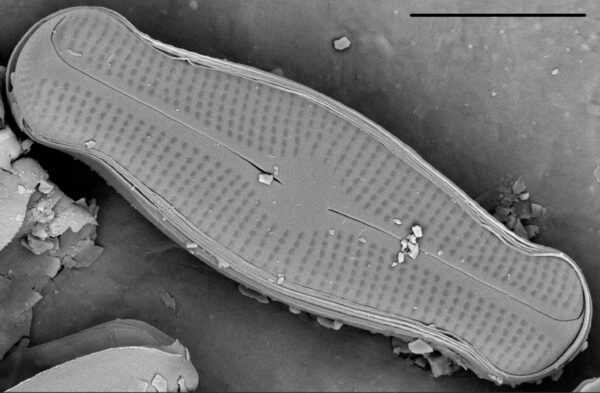
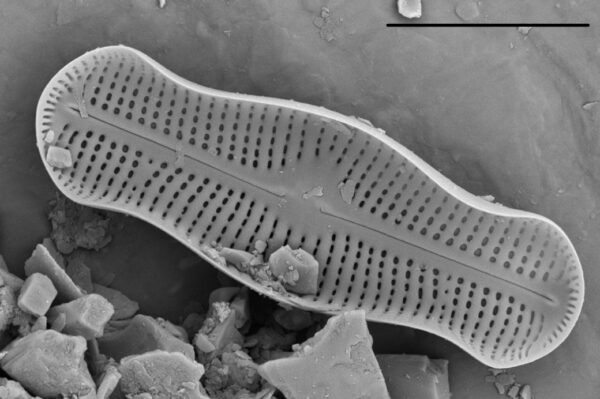
Valves are elliptic, with broad, capitate ends. The external valve face is flat, with rounded valve/mantle interface. The axial area is slightly curved, to linear and narrow. The central area is round to elliptic. The raphe is linear and narrow.
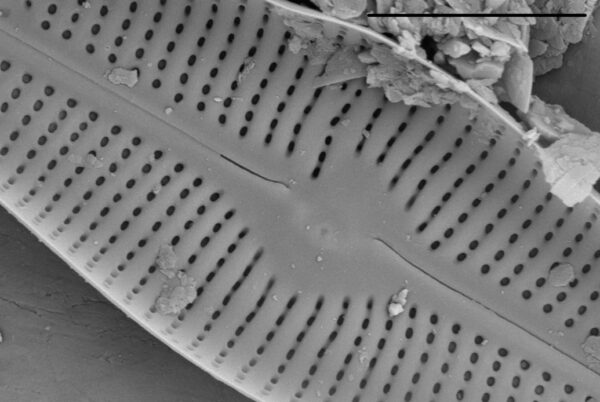
Externally, the proximal raphe ends are relatively widely spaced from one another. Terminal raphe fissures are strongly over the upper mantle.
Internally, the raphe is straight. Proximal raphe ends are positioned on the central nodule, with slightly deflected ends. Terminal raphe fissures have a small, elongated helictoglossa.
This taxon was described from a lake in Québec (Lake 22AA, Latitude: 56.55667, Longitude: –76.47972, 128 m a.s.l.). It was also identified as Navicula ventralis by Fallu et al. (2000).
This taxon represented 4% of the diatom assemblage in the sediments of Lake 22AA. This lake had a relatively high total phosphorus concentration, of 23.4 μg/L.
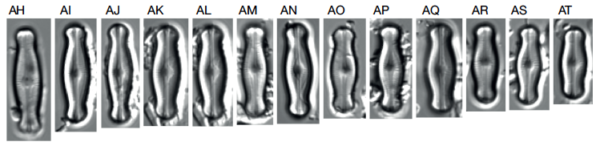
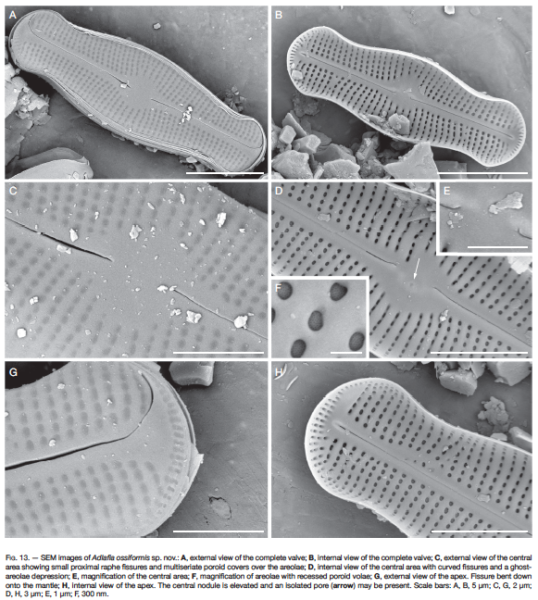
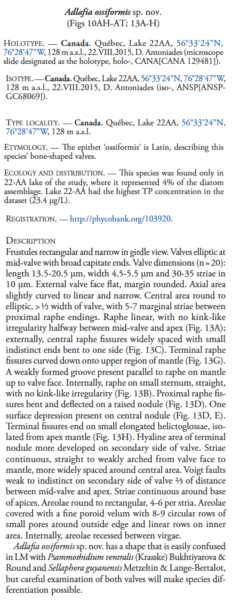
Adlafia ossiformis sp. nov. (Figs 10AH-AT; 13A-H)
Holotype. — Canada. Québec, Lake 22AA, 56°33’24”N, 76°28’47”W, 128 m a.s.l., 22.VIII.2015, D. Antoniades (microscopeslide designated as the holotype, holo-, CANA[CANA 129481]).
Isotype. — Canada. Québec, Lake 22AA, 56°33’24”N, 76°28’47”W, 128 m a.s.l., 22.VIII.2015, D. Antoniades (iso-, ANSP[ANSPGC68069]).
Type locality. — Canada. Québec, Lake 22AA, 56°33’24”N, 76°28’47”W, 128 m a.s.l.
Etymology. — The epithet ‘ossiformis’ is Latin, describing this species’ bone-shaped valves.
Ecology and distribution. — This species was found only in 22-AA lake of the study, where it represented 4% of the diatom assemblage. Lake 22-AA had the highest TP concentration in the dataset (23.4 μg/L).
Registration. — http://phycobank.org/103920.
Description
Frustules rectangular and narrow in girdle view. Valves elliptic at mid-valve with broad capitate ends. Valve dimensions (n = 20): length 13.5-20.5 μm, width 4.5-5.5 μm and 30-35 striae in 10 μm. External valve face flat, margin rounded. Axial area slightly curved to linear and narrow. Central area round to elliptic, > 1/2 width of valve, with 5-7 marginal striae between proximal raphe endings. Raphe linear, with no kink-like irregularity halfway between mid-valve and apex (Fig. 13A); externally, central raphe fissures widely spaced with small indistinct ends bent to one side (Fig. 13C). Terminal raphe fissures curved down onto upper region of mantle (Fig. 13G). A weakly formed groove present parallel to raphe on mantle up to valve face. Internally, raphe on small sternum, straight, with no kink-like irregularity (Fig. 13B). Proximal raphe fissures bent and deflected on a raised nodule (Fig. 13D). One surface depression present on central nodule (Fig. 13D, E).
Terminal fissures end on small elongated helictoglossae, isolated from apex mantle (Fig. 13H). Hyaline area of terminal nodule more developed on secondary side of valve. Striae continuous, straight to weakly arched from valve face to mantle, more widely spaced around central area. Voigt faults weak to indistinct on secondary side of valve 2/3 of distance between mid-valve and apex. Striae continuous around base of apices. Areolae round to rectangular, 4-6 per stria. Areolae covered with a fine poroid velum with 8-9 circular rows of small pores around outside edge and linear rows on inner area. Internally, areolae recessed between virgae.
Adlafia ossiformis sp. nov. has a shape that is easily confused in LM with Psammothidium ventralis (Krasske) Bukhtiyarova & Round and Sellaphora guyanensis Metzeltin & Lange-Bertalot, but careful examination of both valves will make species differentiation possible.
Alibert, M. (2025). Adlafia ossiformis. In Diatoms of North America. Retrieved October 11, 2026, from https://diatoms.org/species/345618/adlafia-ossiformis
The 15 response plots show an environmental variable (x axis) against the relative abundance (y axis) of Adlafia ossiformis from all the stream reaches where it was present. Note that the relative abundance scale is the same on each plot. Explanation of each environmental variable and units are as follows:
ELEVATION = stream reach elevation (meters)
STRAHLER = distribution plot of the Strahler Stream Order
SLOPE = stream reach gradient (degrees)
W1_HALL = an index that is a measure of streamside (riparian) human activity that ranges from 0 - 10, with a value of 0 indicating of minimal disturbance to a value of 10 indicating severe disturbance.
PHSTVL = pH measured in a sealed syringe sample (pH units)
log_COND = log concentration of specific conductivity (µS/cm)
log_PTL = log concentration of total phosphorus (µg/L)
log_NO3 = log concentration of nitrate (µeq/L)
log_DOC = log concentration of dissolved organic carbon (mg/L)
log_SIO2 = log concentration of silicon (mg/L)
log_NA = log concentration of sodium (µeq/L)
log_HCO3 = log concentration of the bicarbonate ion (µeq/L)
EMBED = percent of the stream substrate that is embedded by sand and fine sediment
log_TURBIDITY = log of turbidity, a measure of cloudiness of water, in nephelometric turbidity units (NTU).
DISTOT = an index of total human disturbance in the watershed that ranges from 1 - 100, with a value of 0 indicating of minimal disturbance to a value of 100 indicating severe disturbance.