
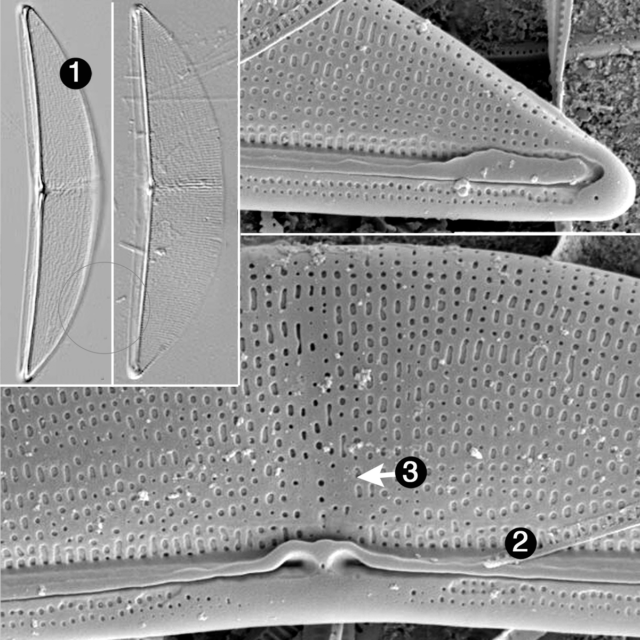
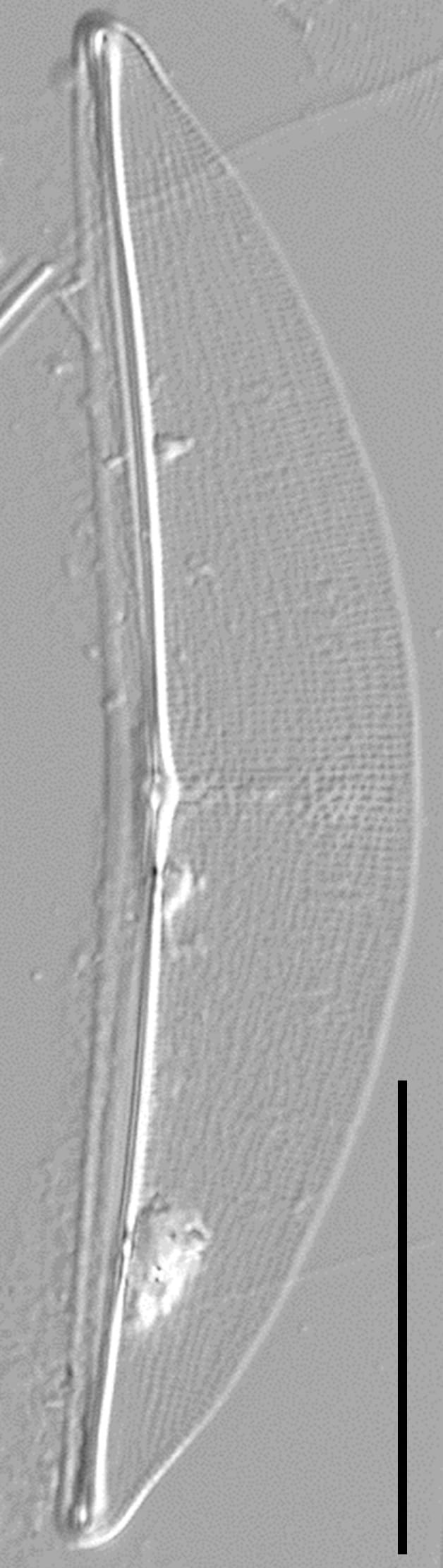
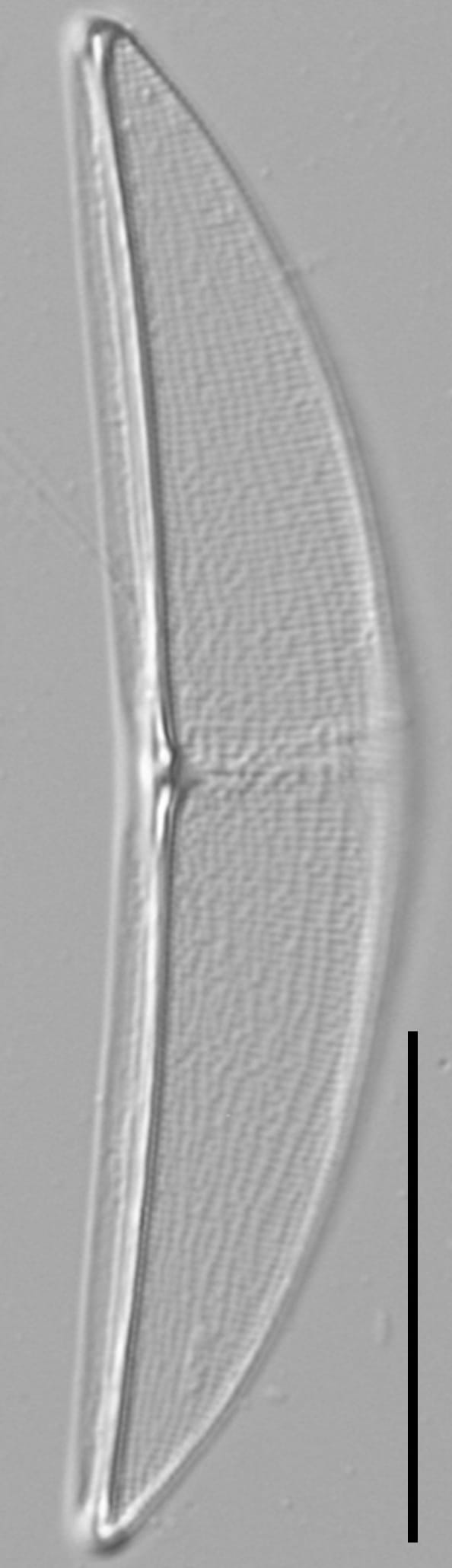
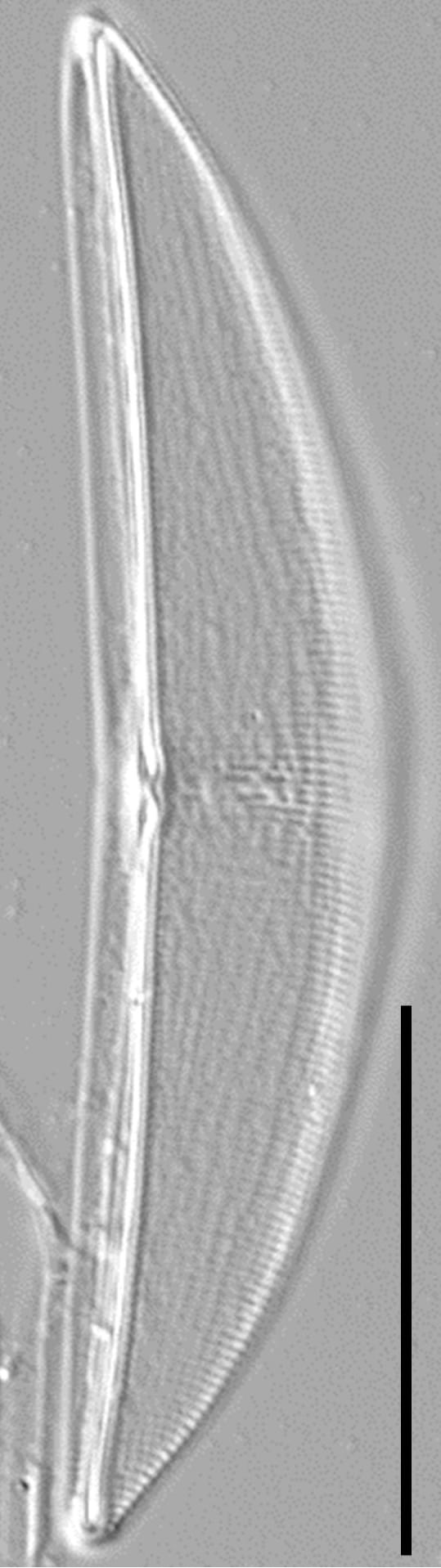
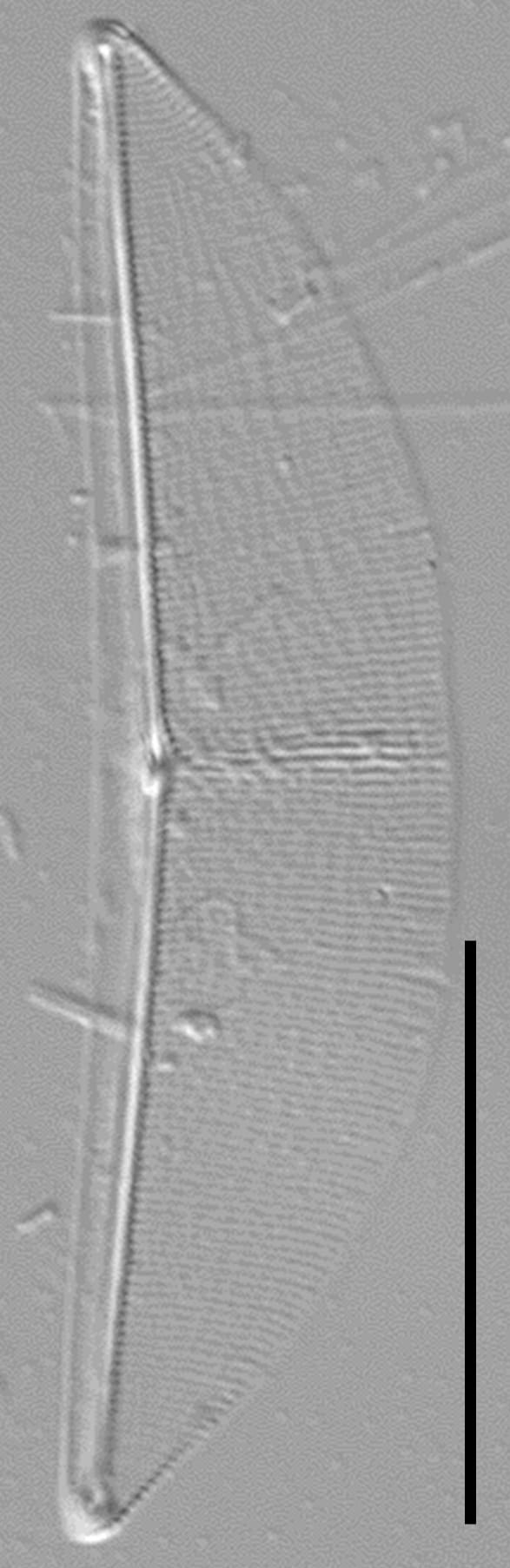
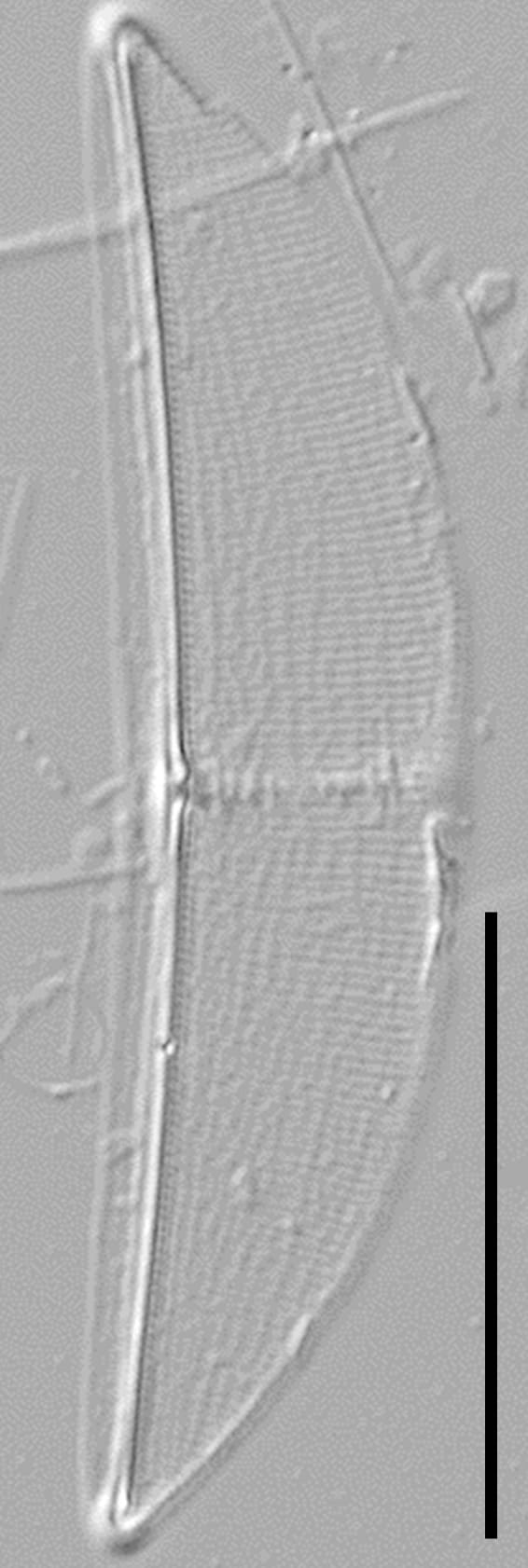
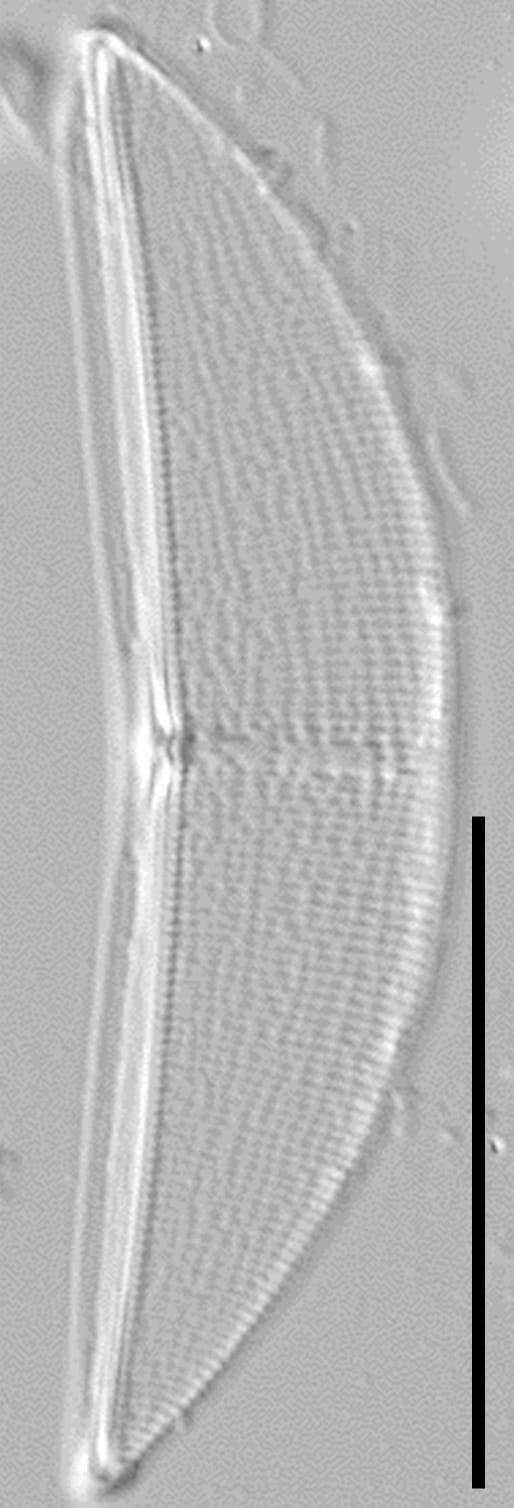
This taxon has only been observed from the baleen of a humpback whale.
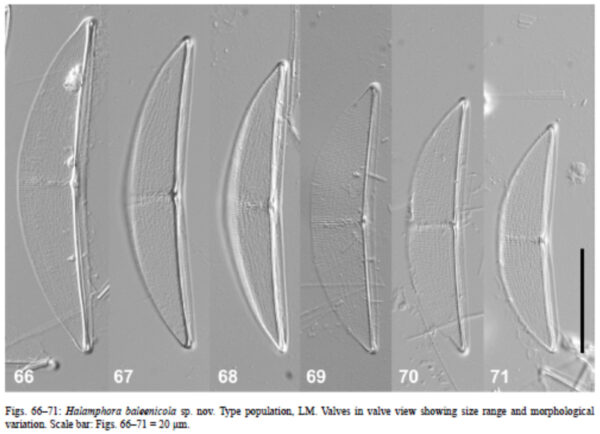
Valves are semi-elliptic and strongly dorsiventral. The dorsal margin is broadly arched and the ventral margin is slightly concave. Valve apices are rounded and, in some specimens, slightly protracted. The raphe is weakly arched. Proximal raphe ends are positioned close to each other, dilated, and dorsally deflected. Distal raphe ends are dorsally deflected. The axial area is narrow. Dorsal striae are finely areolate, parallel near the valve center, and slightly radiate near the apices. The stria pattern is interrupted at the central, dorsal valve with coarser striae and increased spacing of areola. The ventral valve is narrow, with fine striae that cannot be resolved using light microscopy.
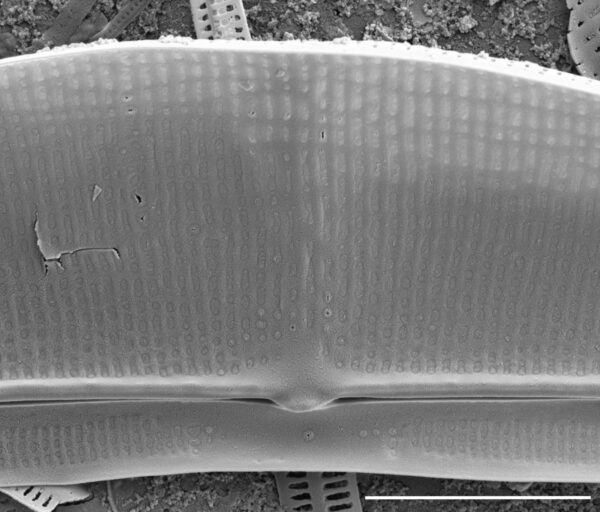
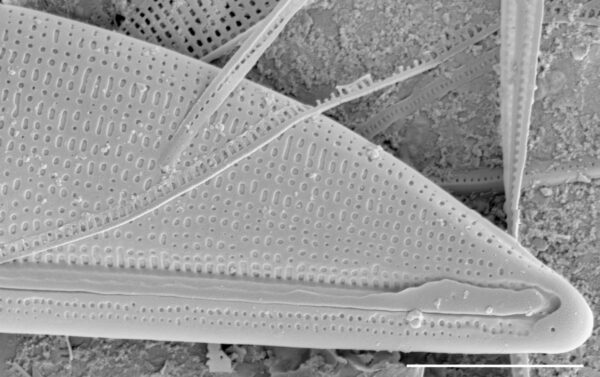
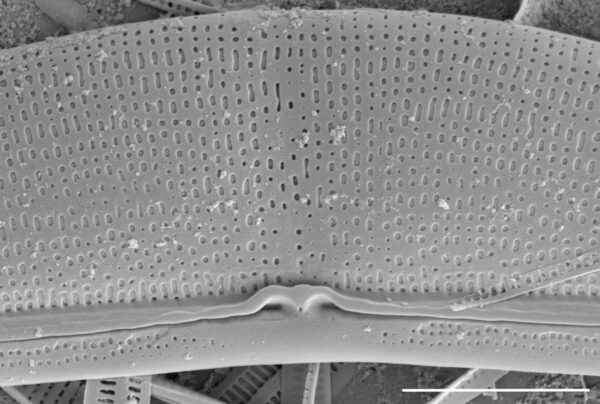
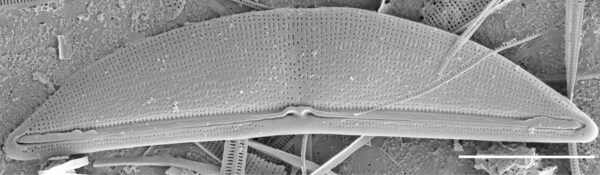
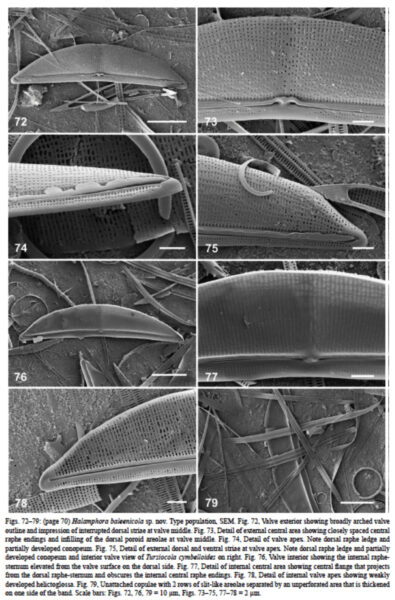
Externally, dorsal stria areolae are small and circular to transapically elongated. Dorsal areolae are irregularly spaced near the valve middle due to silica infilling of areolae. Ventral striae consist of 2-3 rows of small areolae that are finer and more closely spaced than the dorsal striae. Ventral striae are interrupted at the valve middle and, in some specimens, a distinct unornamented area. A dorsal marginal ridge is absent. Distal raphe ends are partially obscured by a raphe ledge. The dorsal raphe ledge is continuous and more fully developed near the apices and valve center. A ventral raphe ledge is absent.
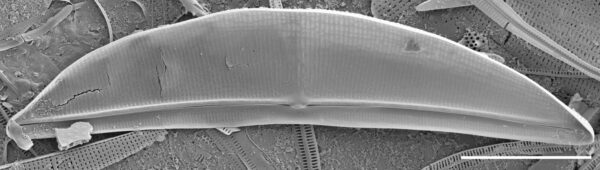
Internally, areolae are occluded by hymenes. The internal raphe-sternum is elevated from valve surface on the dorsal side. A flange-like structure projects toward the cell interior from the dorsal sternum at the central nodule. Distal raphe ends have weakly developed helictoglossae. Copulae (separated from the cincture) are open, broader dorsally than ventrally, and are perforated by two rows of slit-like areolae separated by an unperforated area that is thickened on one side of the band. Copula areola density is 39 - 45 in 10 μm.
NOTE: This taxon closely resembles some species of Amphora, but the lack of a longitudinal costa or marginal ridge and a raphe ledge that is only present on the dorsal side of the raphe indicate that this species is aligned with Halamphora.
This taxon has yet to be observed outside of its originally described occurrence on the baleen of a humpback whale. Though it has been observed in abundance, observations are limited to samples from a single whale. Therefore, its status as an obligate epizoic diatom or as an incidental diatom originating from nearby benthos or plankton habitats remains to be determined by future studies.
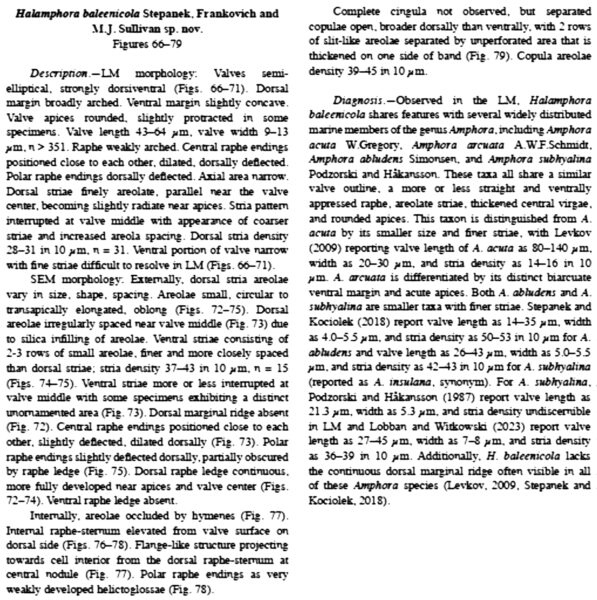
Description.—LM morphology: Valves semielliptical, strongly dorsiventral (Figs. 66–71). Dorsal margin broadly arched. Ventral margin slightly concave. Valve apices rounded, slightly protracted in some specimens. Valve length 43–64 μm, valve width 9–13 μm, n > 351. Raphe weakly arched. Central raphe endings positioned close to each other, dilated, dorsally deflected. Polar raphe endings dorsally deflected. Axial area narrow. Dorsal striae finely areolate, parallel near the valve center, becoming slightly radiate near apices. Stria pattern interrupted at valve middle with appearance of coarser striae and increased areola spacing. Dorsal stria density 28–31 in 10 μm, n = 31. Ventral portion of valve narrow with fine striae difficult to resolve in LM (Figs. 66–71). SEM morphology: Externally, dorsal stria areolae vary in size, shape, spacing. Areolae small, circular to transapically elongated, oblong (Figs. 72–75). Dorsal areolae irregularly spaced near valve middle (Fig. 73) due to silica infilling of areolae. Ventral striae consisting of 2-3 rows of small areolae, finer and more closely spaced than dorsal striae; stria density 37–43 in 10 μm, n = 15 (Figs. 74–75). Ventral striae more or less interrupted at valve middle with some specimens exhibiting a distinct unornamented area (Fig. 73). Dorsal marginal ridge absent (Fig. 72). Central raphe endings positioned close to each other, slightly deflected, dilated dorsally (Fig. 73). Polar raphe endings slightly deflected dorsally, partially obscured by raphe ledge (Fig. 75). Dorsal raphe ledge continuous, more fully developed near apices and valve center (Figs. 72–74). Ventral raphe ledge absent. Internally, areolae occluded by hymenes (Fig. 77). Internal raphe-sternum elevated from valve surface on dorsal side (Figs. 76–78). Flange-like structure projecting towards cell interior from the dorsal raphe-sternum at central nodule (Fig. 77). Polar raphe endings as very weakly developed helictoglossae (Fig. 78). Complete cingula not observed, but separated copulae open, broader dorsally than ventrally, with 2 rows of slit-like areolae separated by unperforated area that is thickened on one side of band (Fig. 79). Copula areolae
density 39–45 in 10 μm.
Diagnosis.—Observed in the LM, Halamphora baleenicola shares features with several widely distributed marine members of the genus Amphora, including Amphora acuta W.Gregory, Amphora arcuata A.W.F.Schmidt, Amphora abludens Simonsen, and Amphora subhyalina Podzorski and Håkansson. These taxa all share a similar valve outline, a more or less straight and ventrally appressed raphe, areolate striae, thickened central virgae, and rounded apices. This taxon is distinguished from A. acuta by its smaller size and finer striae, with Levkov (2009) reporting valve length of A. acuta as 80–140 μm, width as 20–30 μm, and stria density as 14–16 in 10 μm. A. arcuata is differentiated by its distinct biarcuate ventral margin and acute apices. Both A. abludens and A. subhyalina are smaller taxa with finer striae. Stepanek and Kociolek (2018) report valve length as 14–35 μm, width as 4.0–5.5 μm, and stria density as 50–53 in 10 μm for A. abludens and valve length as 26–43 μm, width as 5.0–5.5 μm, and stria density as 42–43 in 10 μm for A. subhyalina (reported as A. insulana, synonym). For A. subhyalina, Podzorski and Håkansson (1987) report valve length as 21.3 μm, width as 5.3 μm, and stria density undiscernible in LM and Lobban and Witkowski (2023) report valve length as 27–45 μm, width as 7–8 μm, and stria density as 36–39 in 10 μm. Additionally, H. baleenicola lacks the continuous dorsal marginal ridge often visible in all of these Amphora species (Levkov, 2009, Stepanek and Kociolek, 2018).
Frankovich, T. (2026). Halamphora baleenicola. In Diatoms of North America. Retrieved October 17, 2026, from https://diatoms.org/species/352472/halamphora-baleenicola?x-craft-preview=409442409a997390693ff24c7010fd6f1c96fb56f8f091fa016a63de9a54aaccecpiqubknd
The 15 response plots show an environmental variable (x axis) against the relative abundance (y axis) of Halamphora baleenicola from all the stream reaches where it was present. Note that the relative abundance scale is the same on each plot. Explanation of each environmental variable and units are as follows:
ELEVATION = stream reach elevation (meters)
STRAHLER = distribution plot of the Strahler Stream Order
SLOPE = stream reach gradient (degrees)
W1_HALL = an index that is a measure of streamside (riparian) human activity that ranges from 0 - 10, with a value of 0 indicating of minimal disturbance to a value of 10 indicating severe disturbance.
PHSTVL = pH measured in a sealed syringe sample (pH units)
log_COND = log concentration of specific conductivity (µS/cm)
log_PTL = log concentration of total phosphorus (µg/L)
log_NO3 = log concentration of nitrate (µeq/L)
log_DOC = log concentration of dissolved organic carbon (mg/L)
log_SIO2 = log concentration of silicon (mg/L)
log_NA = log concentration of sodium (µeq/L)
log_HCO3 = log concentration of the bicarbonate ion (µeq/L)
EMBED = percent of the stream substrate that is embedded by sand and fine sediment
log_TURBIDITY = log of turbidity, a measure of cloudiness of water, in nephelometric turbidity units (NTU).
DISTOT = an index of total human disturbance in the watershed that ranges from 1 - 100, with a value of 0 indicating of minimal disturbance to a value of 100 indicating severe disturbance.