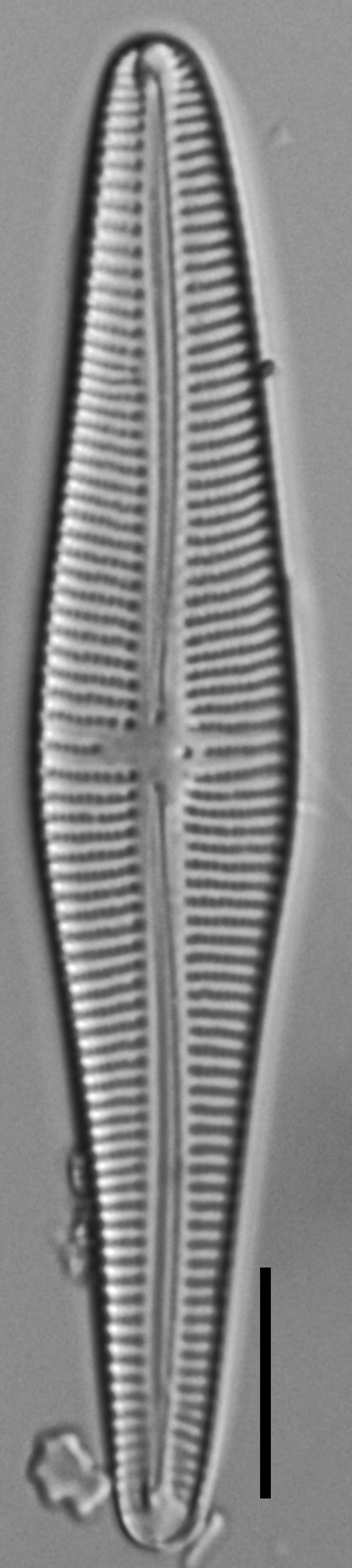
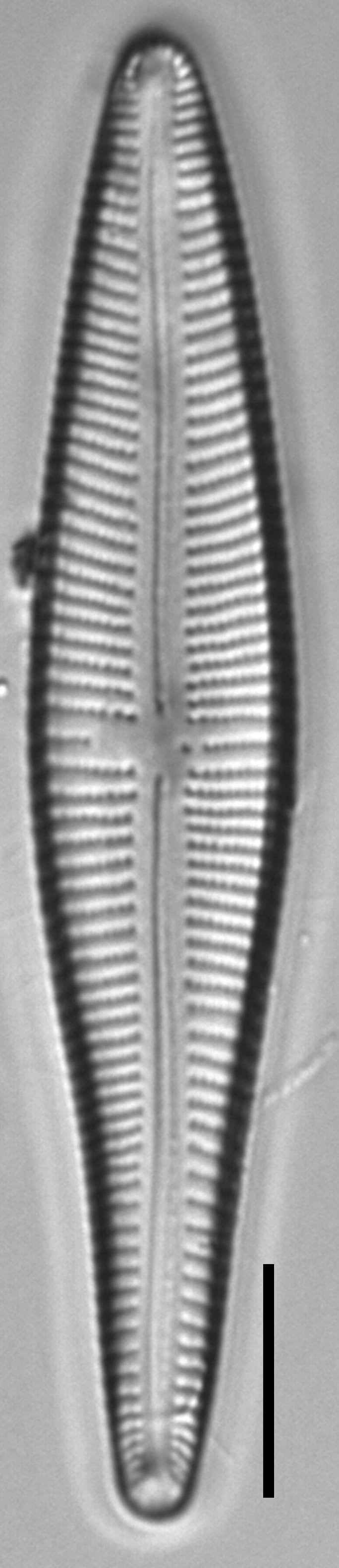
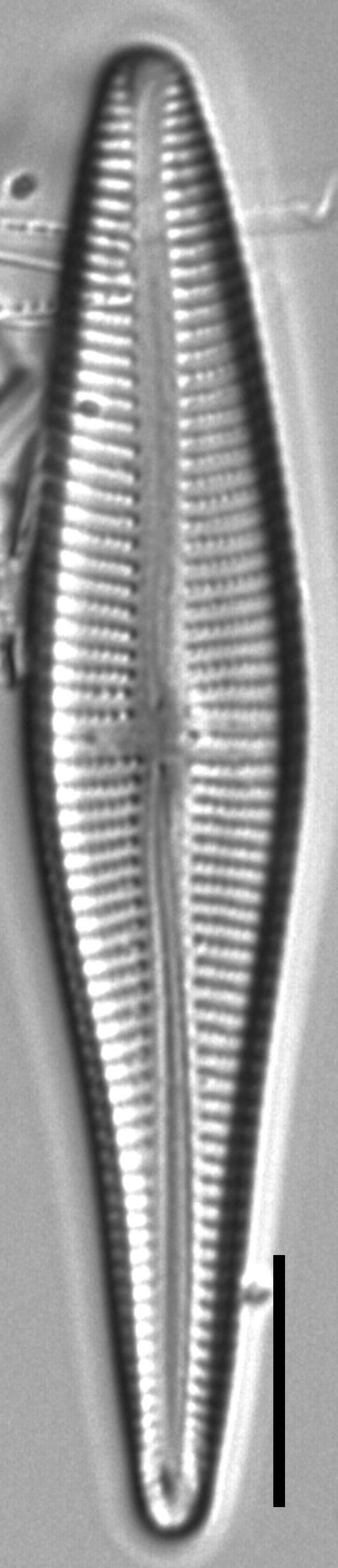
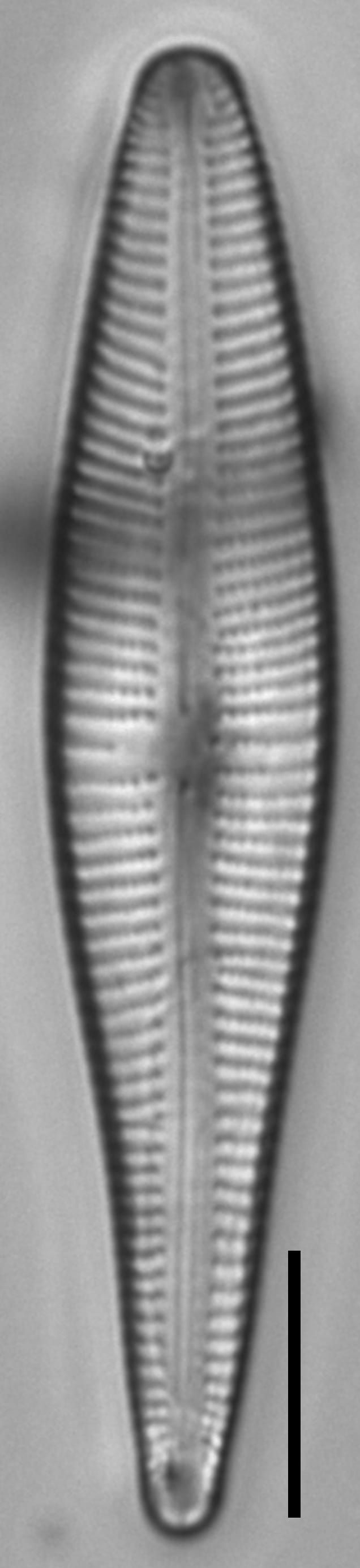
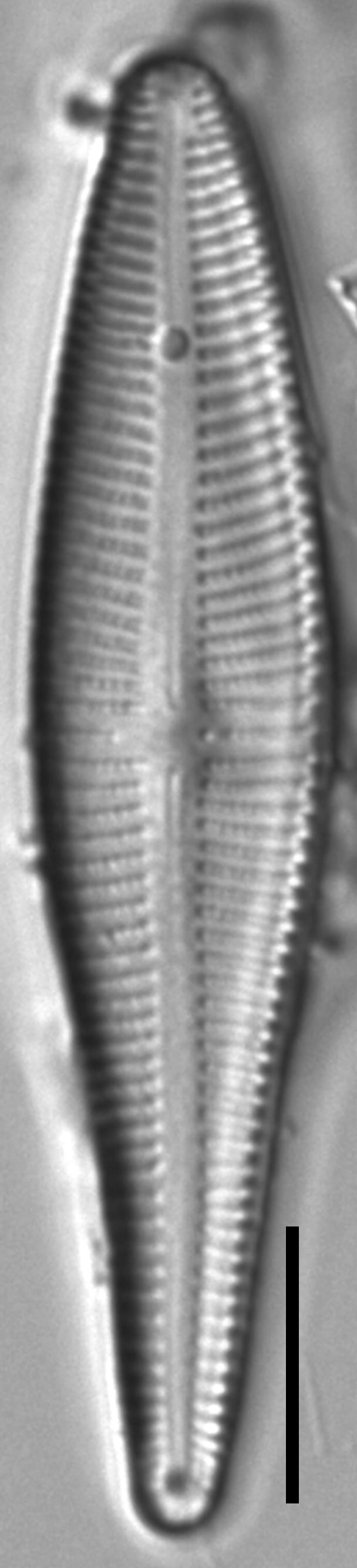
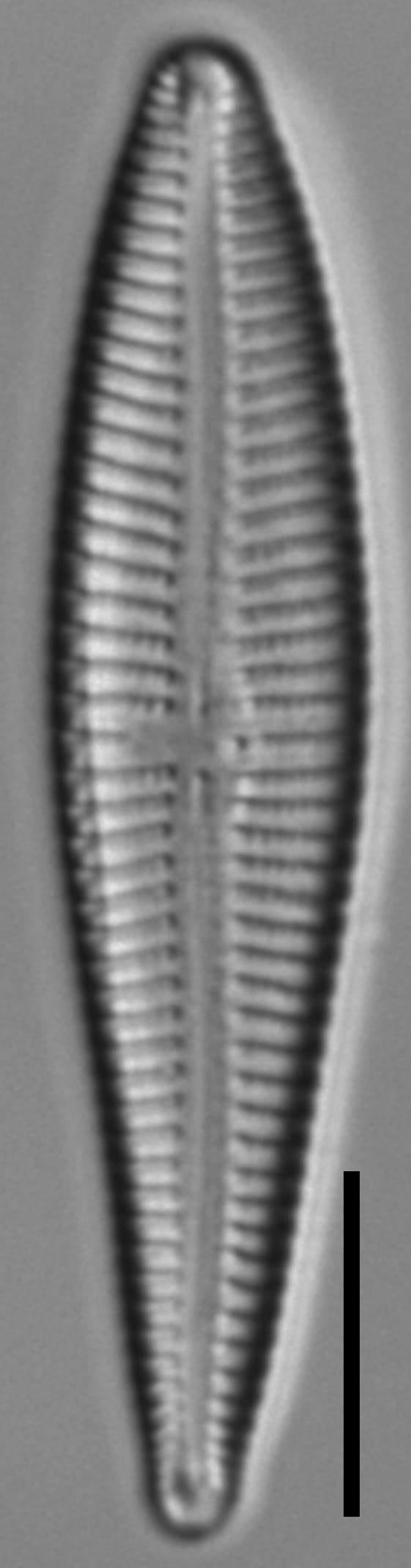
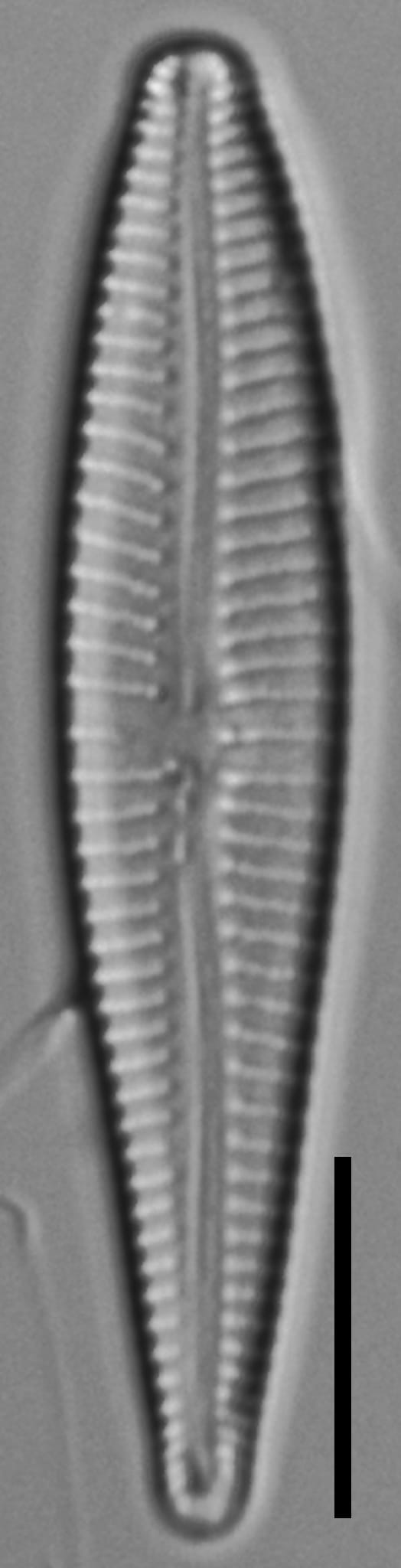
Credit: Gaiser et al. in Morales 2002

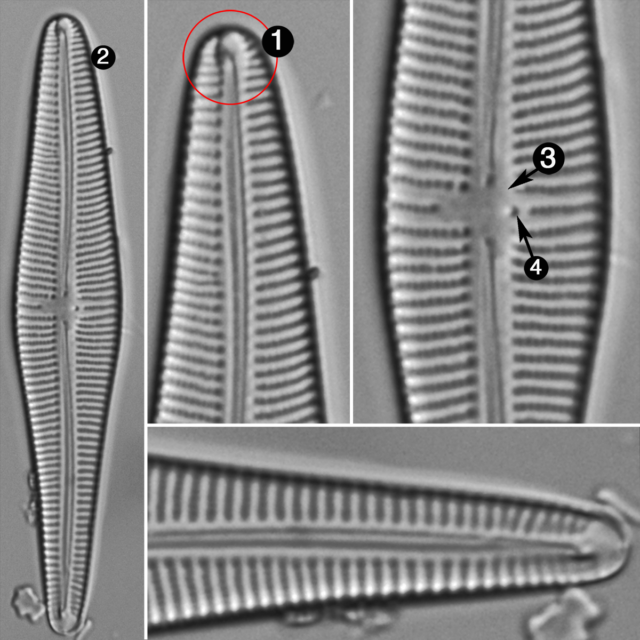
Valves are clavate to lanceolate, with obtuse apices. The raphe is oblique, with terminal ends that are not easily discerned. The axial area is distinct. The central area is asymmetric. The central area is bordered by a shorter stria on one side and a longer stria associated with a stigmoid on the opposite side. Some valves have more than one stigmoid in the central area. Striae encircle the headpole. Striae are radiate throughout, becoming more radiate near the footpole.
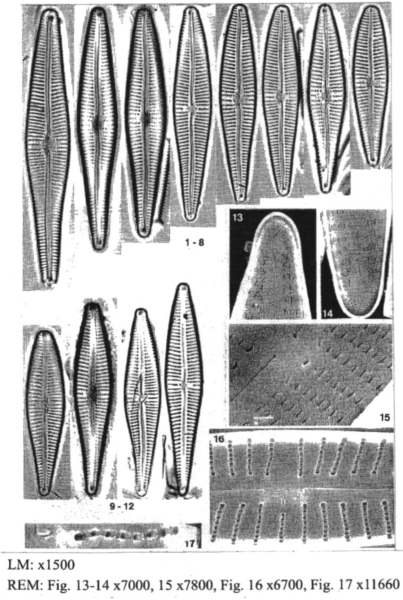
NOTE: Practitioners should be aware that this taxon is very similar to G. affine and the two taxa may no be distinguishable in LM. Gomphonema affine has c-shaped areolae in SEM (Van de Vijver and Abarca 2023), while G. stonei does not. The holotype of G. stonei is from North Carolina, yet Reichardt (1999) includes paratype images from Monticello Florida, and Everglades at Flamingo, Florida in the original description of G. stonei. The specimens seen on this page are from material collected in the Everglades of Florida.
Van de Vijver and Abarca (2023) designated a lectotype for G. affine,distinguishing it from G. gracile.
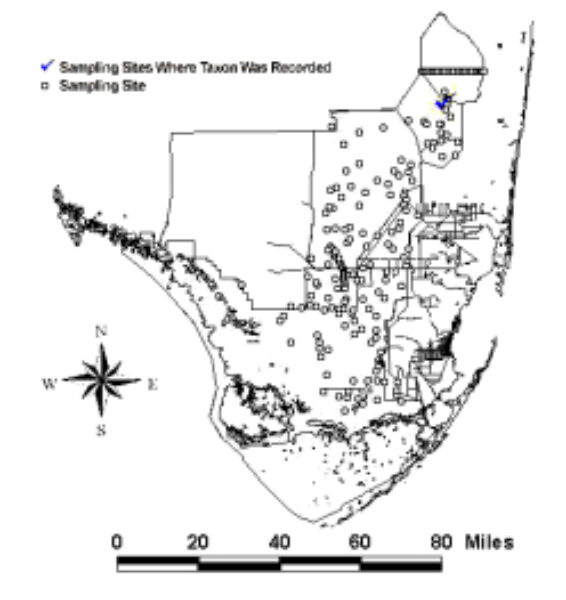
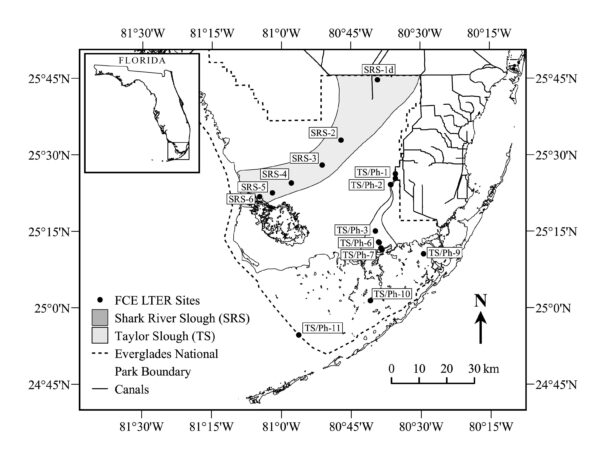
This taxon been observed in South Florida from Shark River Slough (Everglades National Park), Loxahatchee National Wildlife Refuge, and Water Conservation Area 1, 2, and 2A (Morales 2002, Tobais and Gaiser 2006). Sites where it was collected are considered somewhat enriched in phosphorus relative to a highly oligotrophic background. Tobias and Gaiser (2006) include physicochemical data from the sites where G. stonei was collected, with an abundance-weighted mean water depth of 52 cm, pH of 6.7, and water total phosphorus of 54 ug L-'.


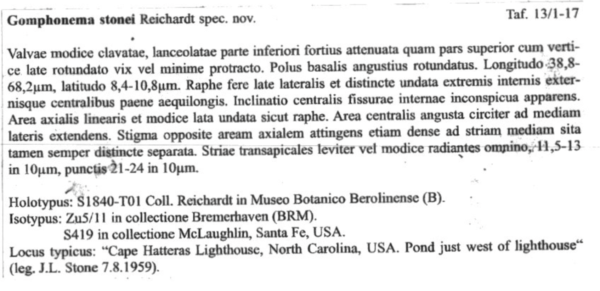
Valvae modice clavatae, lanceolatae parte inferiori fortius attenuata quam pars superior cum vertice late rotundato vix vel minime protracto. Polus basalis angustius rotundatus. Longitudo 38,8-68,2µm, latitudo 8,4-10,8µm. Raphe fere late lateralis et distincte undata extremis internis externisque centralibus paene aequilongis. Inclinatio centralis fissurae internae inconspicua apparens. Area axialis linearis et modice lata undata sicut raphe. Area centralis angusta circiter ad mediam lateris extendens. Stigma opposite aream axialem attingens etiam dense ad striam mediam sita tamen semper distincte separata. Striae transapicales leviter vel modice radiantes omnino, 11,5-13 in 10µm, punctis 21-24 in 10µm.
Holotypus: S1840-T01 Coll. Reichardt in Museo Botanico Berolinense (B).
Isotypus: ZuS/11 in collectione Bremerhaven (BRM). S419 in collectione McLaughlin, Santa Fe, USA.
Locus typicus: "Cape Hatteras Lighthouse, North Carolina, USA. Pond just west of lighthouse” (leg. J.L. Stone 7.8.1959).
Johnson, K. (2023). Gomphonema stonei. In Diatoms of North America. Retrieved October 14, 2026, from https://diatoms.org/species/62006/gomphonema-stonei
The 15 response plots show an environmental variable (x axis) against the relative abundance (y axis) of Gomphonema stonei from all the stream reaches where it was present. Note that the relative abundance scale is the same on each plot. Explanation of each environmental variable and units are as follows:
ELEVATION = stream reach elevation (meters)
STRAHLER = distribution plot of the Strahler Stream Order
SLOPE = stream reach gradient (degrees)
W1_HALL = an index that is a measure of streamside (riparian) human activity that ranges from 0 - 10, with a value of 0 indicating of minimal disturbance to a value of 10 indicating severe disturbance.
PHSTVL = pH measured in a sealed syringe sample (pH units)
log_COND = log concentration of specific conductivity (µS/cm)
log_PTL = log concentration of total phosphorus (µg/L)
log_NO3 = log concentration of nitrate (µeq/L)
log_DOC = log concentration of dissolved organic carbon (mg/L)
log_SIO2 = log concentration of silicon (mg/L)
log_NA = log concentration of sodium (µeq/L)
log_HCO3 = log concentration of the bicarbonate ion (µeq/L)
EMBED = percent of the stream substrate that is embedded by sand and fine sediment
log_TURBIDITY = log of turbidity, a measure of cloudiness of water, in nephelometric turbidity units (NTU).
DISTOT = an index of total human disturbance in the watershed that ranges from 1 - 100, with a value of 0 indicating of minimal disturbance to a value of 100 indicating severe disturbance.