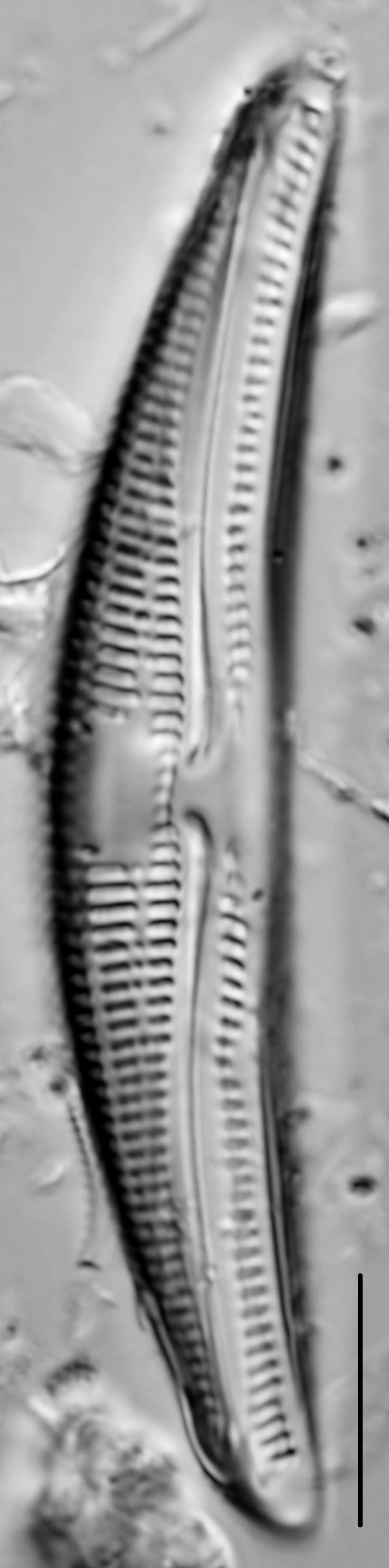
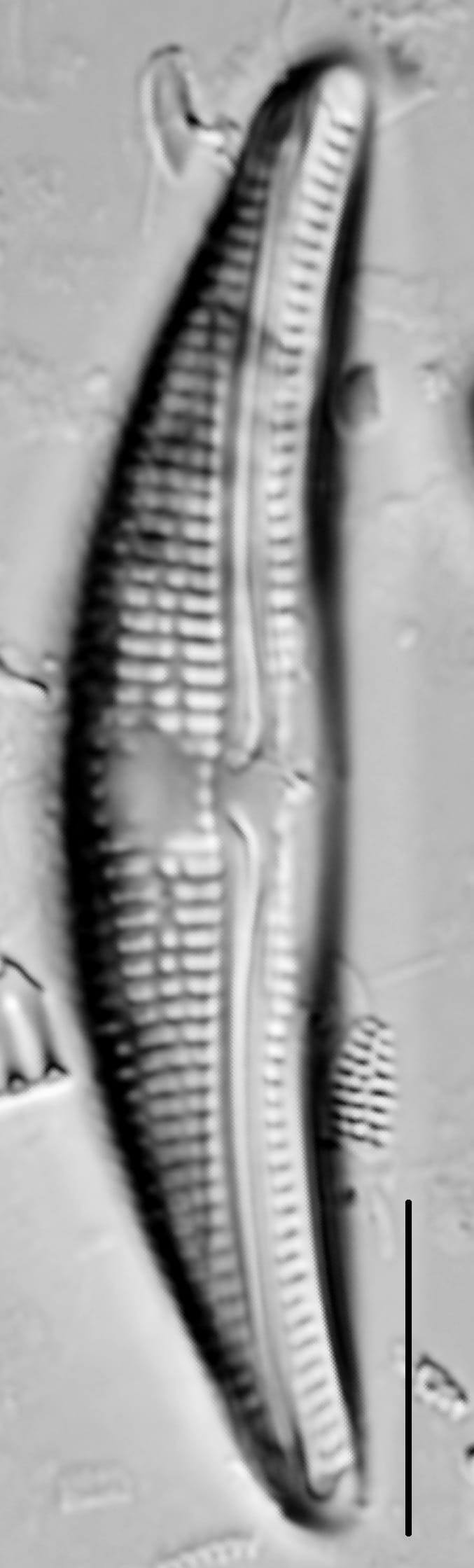
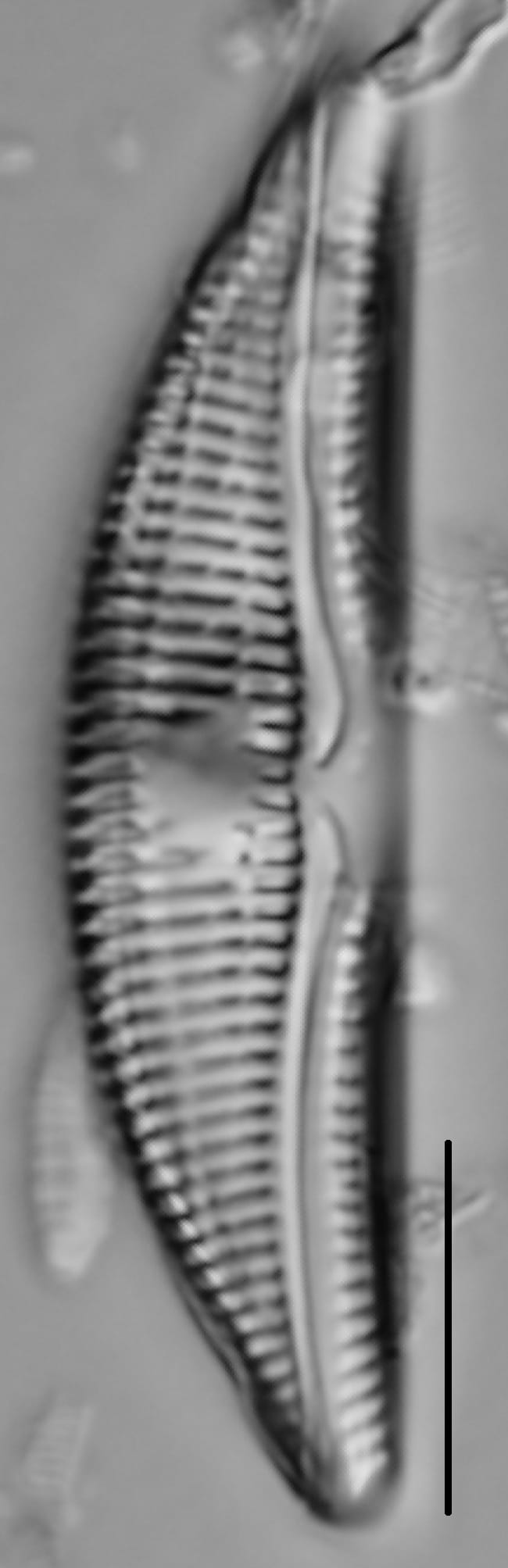
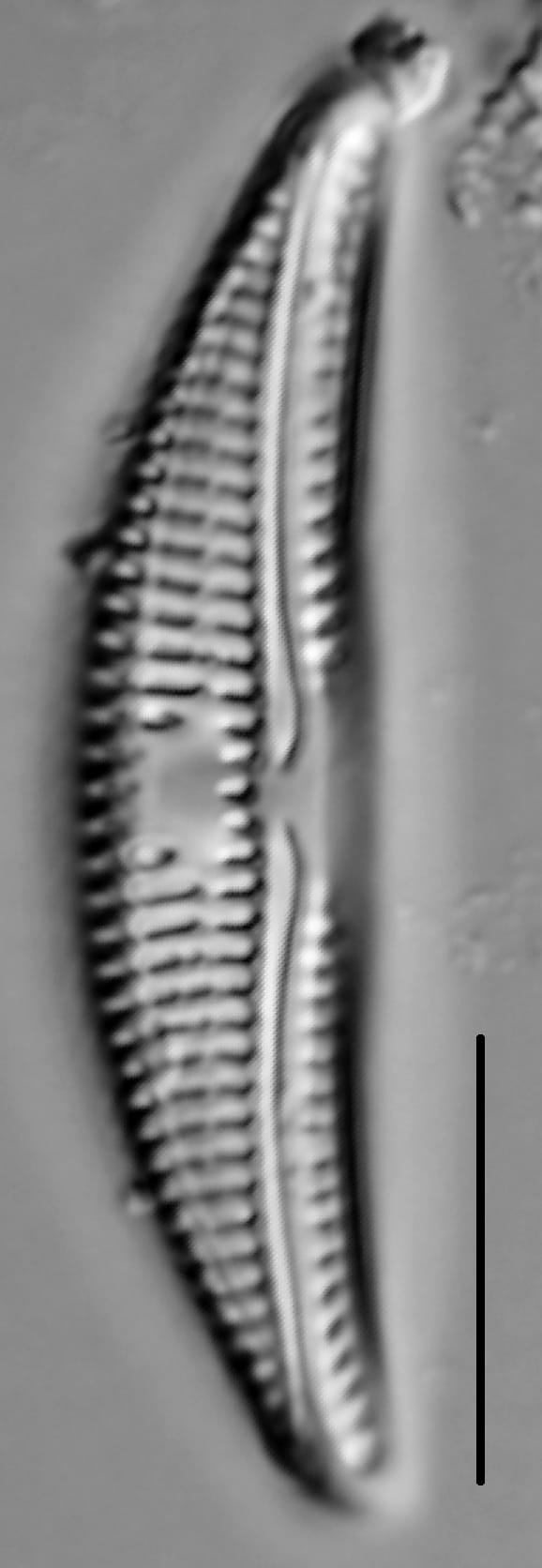
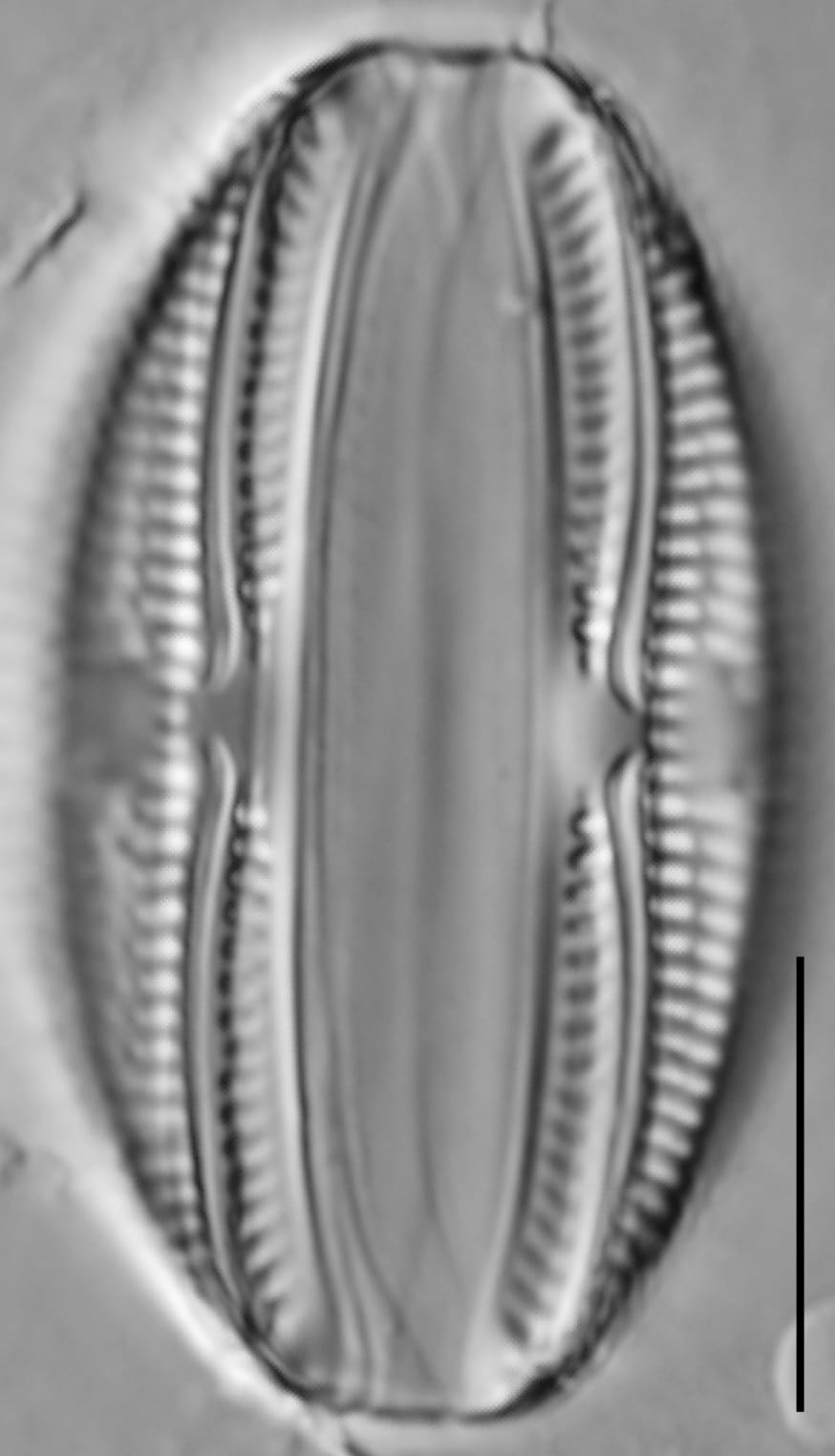
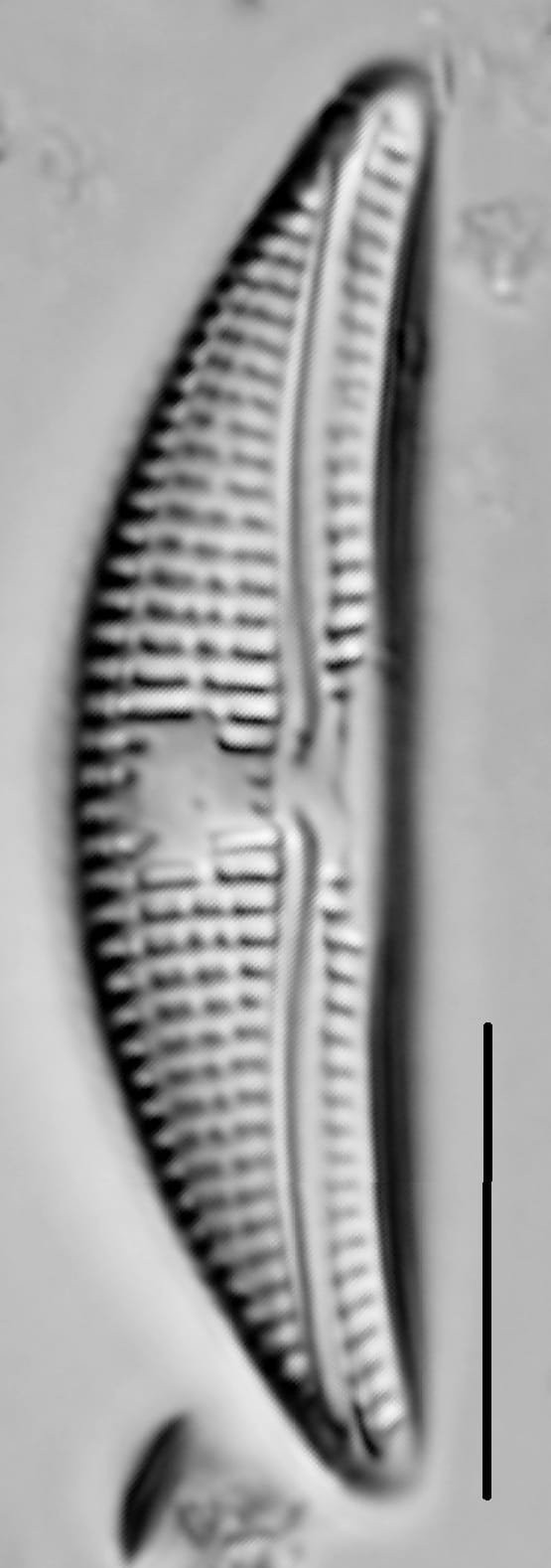
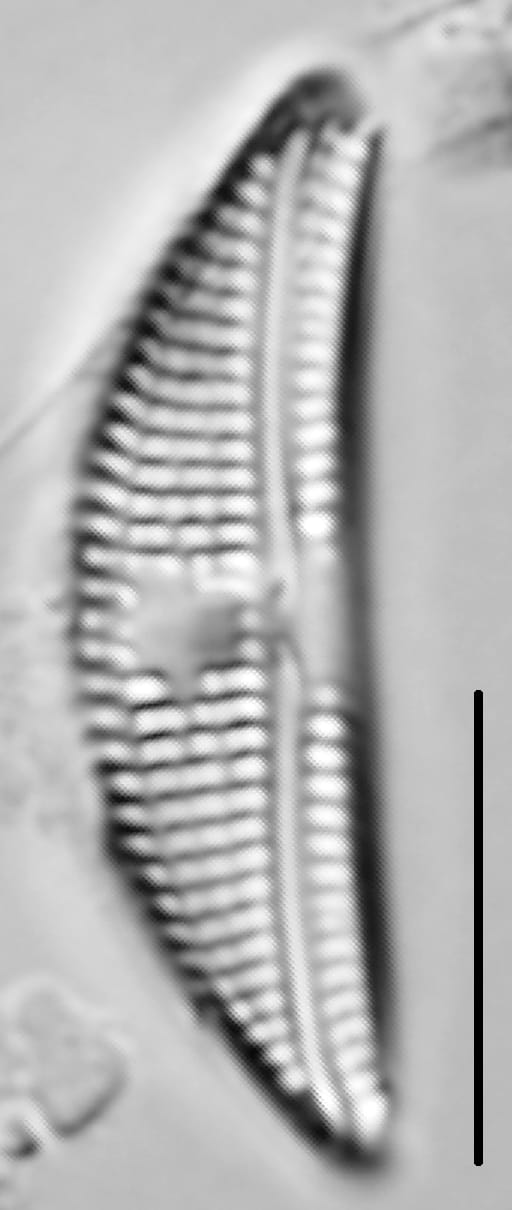
Valves are semi-lanceolate to semi-elliptical. The dorsal margin is smoothly arched and the ventral margin is concave. Valve ends are narrowly rounded. The axial area is narrow. The raphe is arched and positioned toward the ventral margin. The proximal and distal ends of the raphe are both dorsally deflected. Dorsal fascia are distinct and round to elliptical. The dorsal fascia are typically “closed” to the axial area and dorsal margin by a row of short striae. The ventral fascia are typically longer (in the apical axis) than dorsal fascia. The ventral fascia extend to the ventral margin. Dorsal striae are weakly radiate in the central area, becoming more radiate at the apices. The dorsal striae are interrupted by intercostal ribs. A thickened, hyaline bar is often visible on the dorsal margin separating valve face and mantle. The ventral striae are uninterrupted. The ventral striae are radiate in the middle, convergent toward the apices, and consist of a single areola.
This taxon is widely distributed. It has been reported with light micrographs from Alaska (Foged 1981), northern Québec and Labrador (Fallu et al. 2000), the Canadian Arctic Archipelago (Antoniades et al. 2008), and Northwestern North America (Bahls 2021).
In the Great Lakes National Parks (Edlund et al. 2009, 2011, 2012, 2013), this taxon is common (5-25% abundance) in sediment core material from Shell Lake (Sleeping Bear Dunes) to uncommon (1-5% abundance) or rare (0.1-1% abundance) in Isle Royale (Ahmik and Richie lakes), Voyageurs (Peary Lake), Pictured Rocks (Beaver Lake),and Sleeping Bear Dunes (Florence and Bass lakes).
This taxon is reported to occur in lakes, ponds, rivers and streams with warm, alkaline water of moderate conductivity and nutrient content (Bahls 2021).
According to Mann and Poulíčková (2010), this taxon has a single lobed ventral chloroplast, nuclei with granular heterochromatin and a single nucleolus. It is heterothallic, with two mating types that do not differ in gamete behavior.
Several research groups consider this taxon an indicator organism and published regional environmental optima and tolerances including:
Antoniades et al. (2008): pH - 8.2, Tolerance Range - 7.8-8.5, Conductivity - 142 µS/cm, Tolerance Range - 63-317 µS/cm, Dissolved Organic Carbon - 3.79 mg/L, Tolerance Range - 1.74-8.29 µS/cm for populations from the Canadian Arctic Archipelago.
Bahls (2021): Conductivity - 1897 µS/cm, pH - 8.3, Temperature - 18.0°C, Total Nitrogen - 3.54 mg/L, Total Phosphorus - 118 µg/L for populations across Northwestern North America.
Frustulis sparsis lanceolatis acutis, apicibus hyalinis, binalim copulatis, opposite incurvatis, luteo-fuscis, medio subinflatis et macula hyalina orbiculari notatis.
Unter schwarzbraunem Schaume, der sich am Uter eines kleinen Baches bei Bruckdorf unweit Halle gebildet hatte, sie war noch mit Frustulia acuminata vermischt und schein ganz bewegungslos.


From 2011 until 2026, the autecological information on this taxon page was limited. As of this update, information on ecology, biogeography, and environmental optima have been added. - Lane Allen and Mark Edlund
Stepanek, J., Kociolek, P., Edlund, M., Allen, L. (2011). Amphora copulata. In Diatoms of North America. Retrieved October 14, 2026, from https://diatoms.org/species/45405/amphora_copulata
The 15 response plots show an environmental variable (x axis) against the relative abundance (y axis) of Amphora copulata from all the stream reaches where it was present. Note that the relative abundance scale is the same on each plot. Explanation of each environmental variable and units are as follows:
ELEVATION = stream reach elevation (meters)
STRAHLER = distribution plot of the Strahler Stream Order
SLOPE = stream reach gradient (degrees)
W1_HALL = an index that is a measure of streamside (riparian) human activity that ranges from 0 - 10, with a value of 0 indicating of minimal disturbance to a value of 10 indicating severe disturbance.
PHSTVL = pH measured in a sealed syringe sample (pH units)
log_COND = log concentration of specific conductivity (µS/cm)
log_PTL = log concentration of total phosphorus (µg/L)
log_NO3 = log concentration of nitrate (µeq/L)
log_DOC = log concentration of dissolved organic carbon (mg/L)
log_SIO2 = log concentration of silicon (mg/L)
log_NA = log concentration of sodium (µeq/L)
log_HCO3 = log concentration of the bicarbonate ion (µeq/L)
EMBED = percent of the stream substrate that is embedded by sand and fine sediment
log_TURBIDITY = log of turbidity, a measure of cloudiness of water, in nephelometric turbidity units (NTU).
DISTOT = an index of total human disturbance in the watershed that ranges from 1 - 100, with a value of 0 indicating of minimal disturbance to a value of 100 indicating severe disturbance.