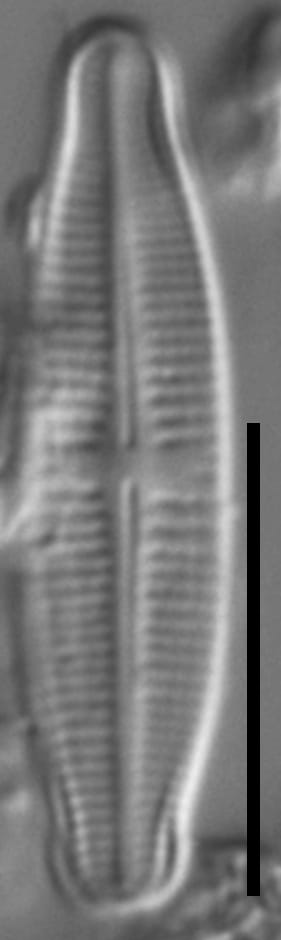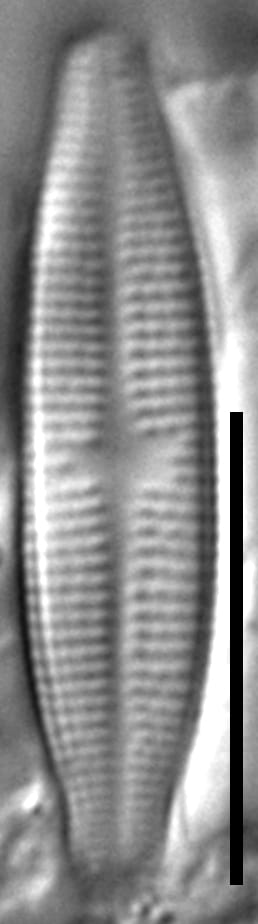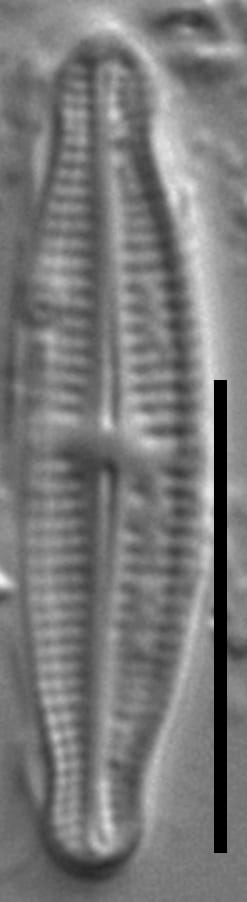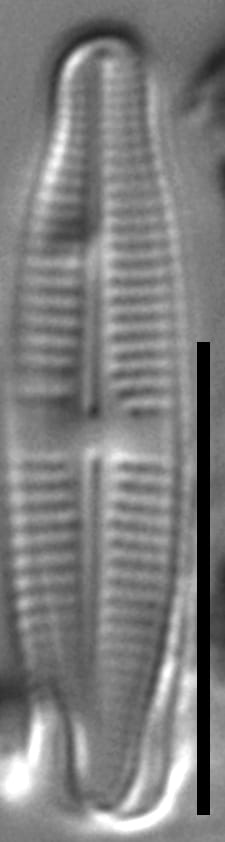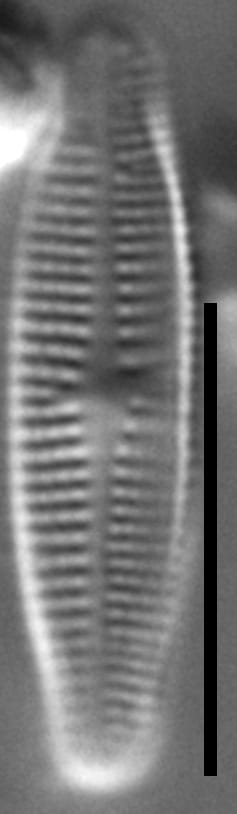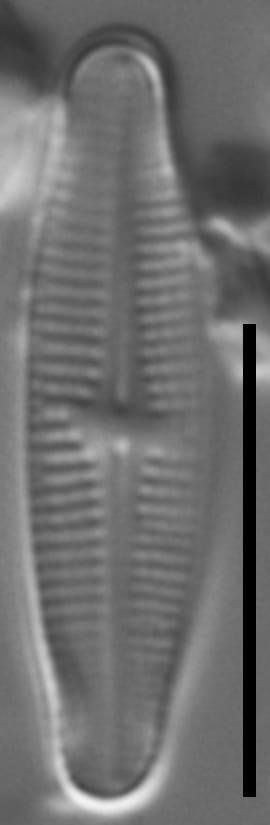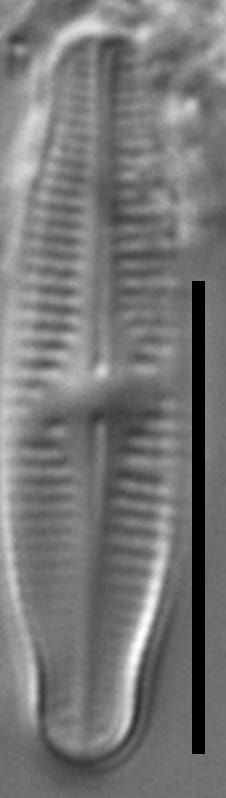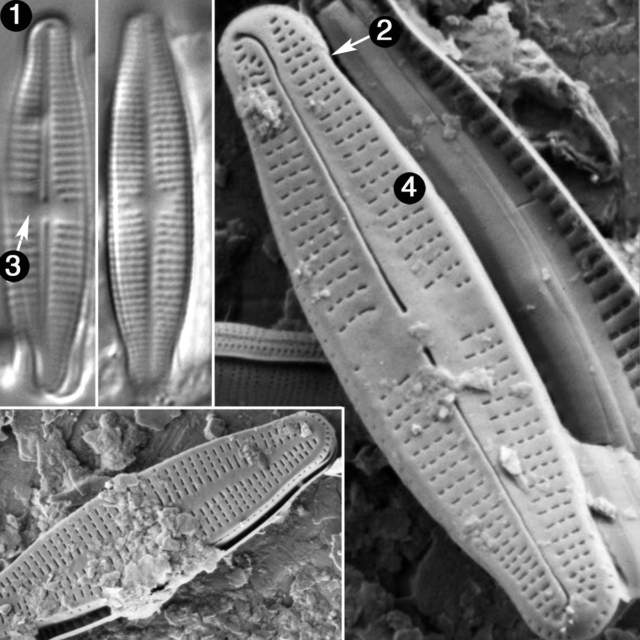
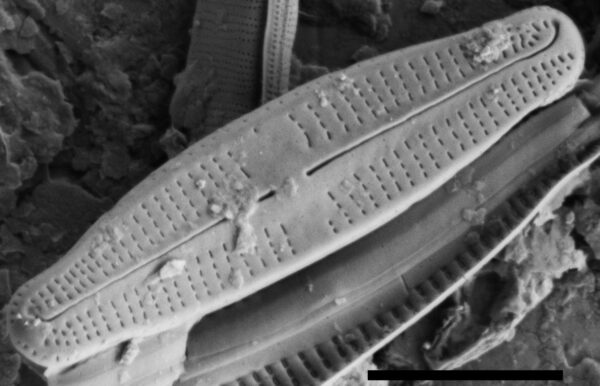
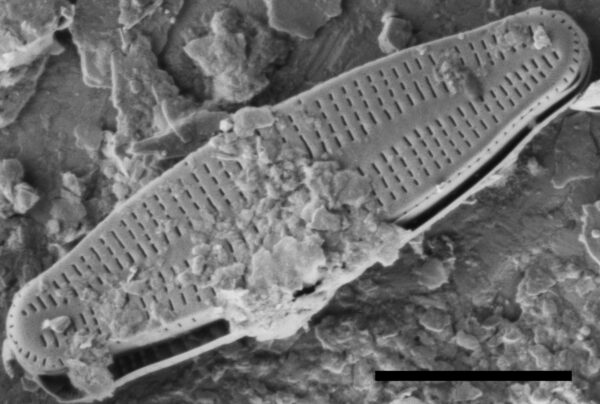
Valves are linear to linear-lanceolate with rostrate to subcapitate ends. Raphe valve has a linear axial area, which slightly widens in the middle portion of the valve. Central area on the raphe valve reaches valve margin, is often asymmetrical, and may be a fascia, or subfascia. On rapheless valve, the axial area is narrow, linear, while the central area is small and varies in shape, but never reaches valve margins. Terminal raphe ends are strongly hooked to the same side and somewhat teardrop-shaped. The striae are parallel throughout both valves or very slightly radiate in the middle of the valve and slightly convergent at the apices. Striae are uniseriate, with most striae having 2-4 transapically elongated areolae.
Achnanthidium thienemannii has been recorded in cold-water rivers and springs of Europe (Hustedt 1942, Jüttner et al. 2023, Potapova 2006) and North America (Bahls 2006, Patrick and Freese, as Achnanathes utukakensis). Specimens shown in this page are from Northern Alaska.
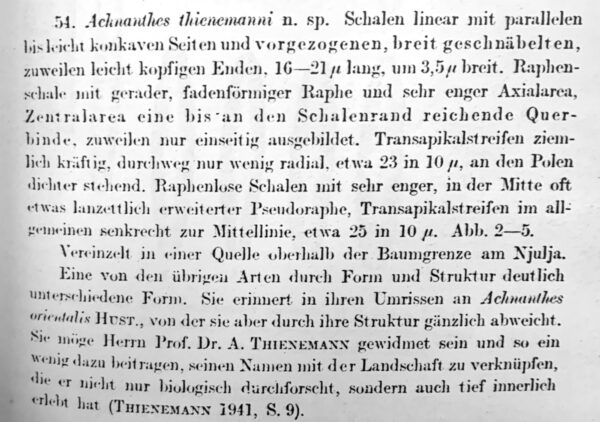
Achnanthes thienemanni n. sp. Schalen linear mit parallelen bis leicht konkaven Seiten und vorgezogenen, breit geschnäbelten, zuweilen leicht kopfigen Enden, 16-21μ lang, um 3,5μ breit. Raphen-schale mit gerader, fadenförmiger Raphe und sehr enger Axialarea, Zentralarea eine bis an den Schalenrand reichende Quer-binde, zuweilen nur einseitig ausgebildet. Transapikalstreifen ziemlich kräftig, durchweg nur wenig radial, etwa 23 in 10μ, an den Polen dichter stehend. Raphenlose Schalen mit sehr enger, in der Mitte oft etwas lanzettlich erweiterter Pseudoraphe, Transapikalstreifen im allgemeinen senkrecht zur Mittellinie, etwa 25 in 10 μ. Abb. 2-5.
Vereinzelt in einer Quelle oberhalb der Baumgrenze am Njulja.
Eine von den übrigen Arten durch Form und Struktur deutlich unterschiedene Form. Sie erinnert in ihren Umrissen an Achnanthes orientalis Hust., von der sie aber durch ihre Struktur gänzlich abweicht.
Sie möge Herrn Prof. Dr. A. THIENEMANN gewidmet sein und so ein wenig dazu beitragen, seinen Namen mit der Landschaft zu verknüpfen, die er nicht nur biologisch durchforscht, sondern auch tief innerlich erlebt hat (THIENEMANN 1941, S. 9).
Leppik, S., Potapova, M. (2026). Achnanthidium thienemannii. In Diatoms of North America. Retrieved October 24, 2026, from https://diatoms.org/species/61592/achnanthidium-thienemannii
The 15 response plots show an environmental variable (x axis) against the relative abundance (y axis) of Achnanthidium thienemannii from all the stream reaches where it was present. Note that the relative abundance scale is the same on each plot. Explanation of each environmental variable and units are as follows:
ELEVATION = stream reach elevation (meters)
STRAHLER = distribution plot of the Strahler Stream Order
SLOPE = stream reach gradient (degrees)
W1_HALL = an index that is a measure of streamside (riparian) human activity that ranges from 0 - 10, with a value of 0 indicating of minimal disturbance to a value of 10 indicating severe disturbance.
PHSTVL = pH measured in a sealed syringe sample (pH units)
log_COND = log concentration of specific conductivity (µS/cm)
log_PTL = log concentration of total phosphorus (µg/L)
log_NO3 = log concentration of nitrate (µeq/L)
log_DOC = log concentration of dissolved organic carbon (mg/L)
log_SIO2 = log concentration of silicon (mg/L)
log_NA = log concentration of sodium (µeq/L)
log_HCO3 = log concentration of the bicarbonate ion (µeq/L)
EMBED = percent of the stream substrate that is embedded by sand and fine sediment
log_TURBIDITY = log of turbidity, a measure of cloudiness of water, in nephelometric turbidity units (NTU).
DISTOT = an index of total human disturbance in the watershed that ranges from 1 - 100, with a value of 0 indicating of minimal disturbance to a value of 100 indicating severe disturbance.